Craft · 13 min read
Sozni Embroidery: Kashmir's Needlework, Explained
Sozni embroidery is worked by hand on woven pashmina, not woven into the cloth. The stitches, motifs, GI and signs that separate handwork from machine.
By Timothy V. Manley
7 November 2026
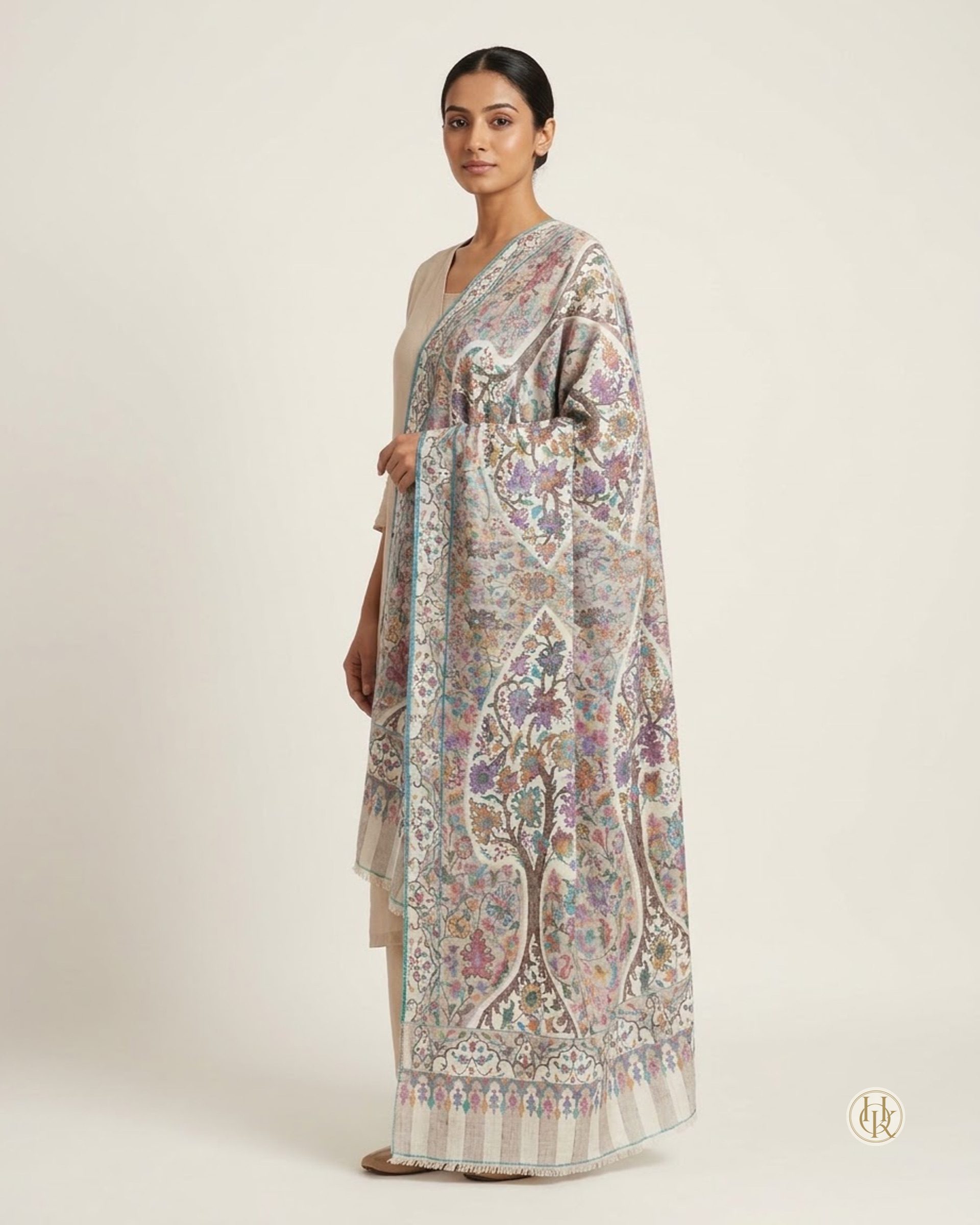
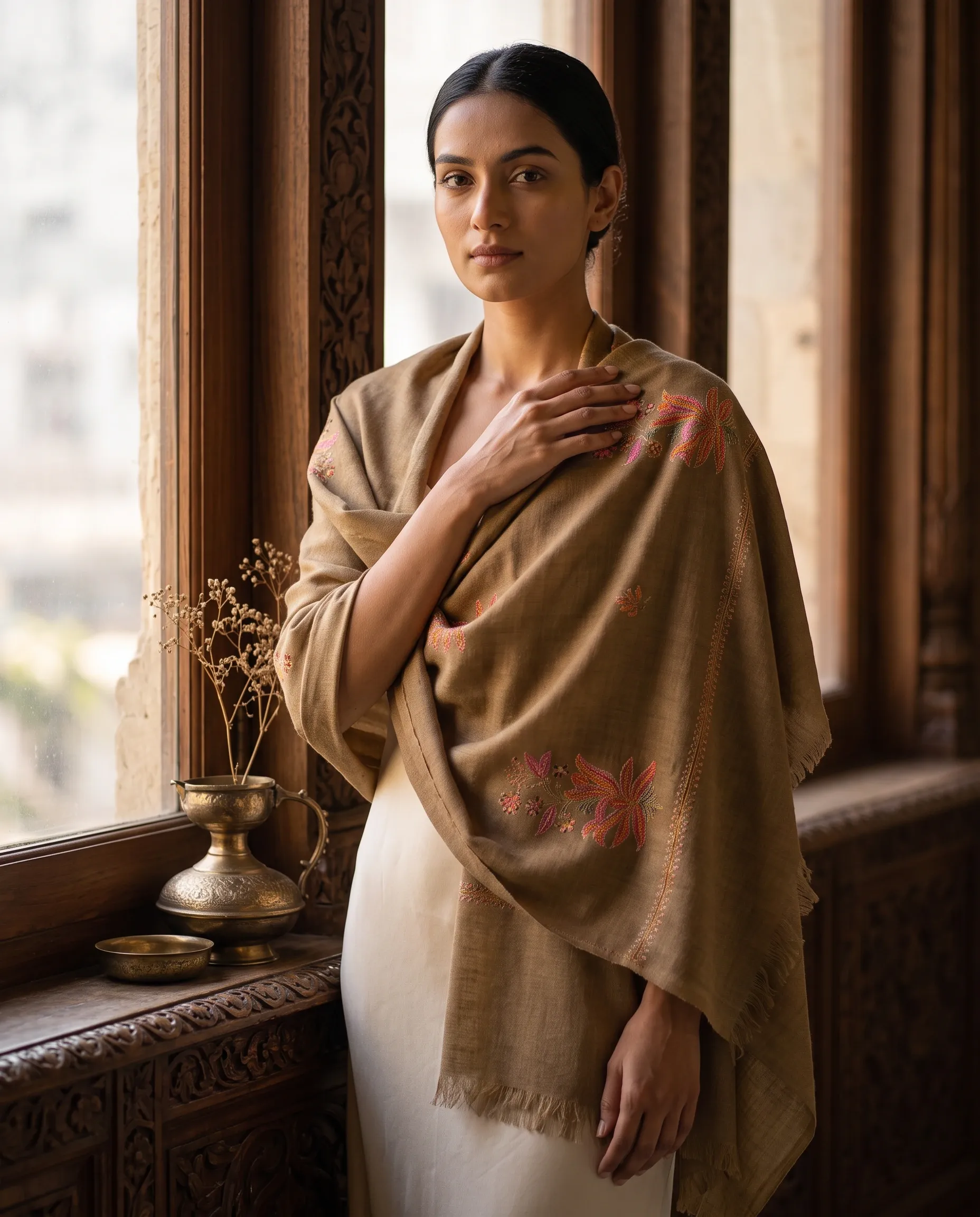
Sozni embroidery is fine handwork on woven pashmina in Kashmir, worked with silk or viscose thread. The sozani, darn and stem stitches carry most of the work; buttonhole, herringbone, chain, satin and knot stitches appear in smaller proportions [2]. It is a separate craft from Kani weaving and holds its own Geographical Indication [1].
The distinction matters, because the market blurs it. Kani builds a pattern inside the cloth: coloured weft is locked around warp threads on the loom, row by row. Sozni comes afterwards, on cloth already woven, washed and finished at the edge. A needle then lays a pattern on top.
That order of operations explains almost everything else about the craft — why an embroidered shawl can be lighter than a woven one, why the reverse tells you more than the front, why two pieces of the same size and the same motifs can differ by months of labour.
The questions we are asked about Sozni are rarely about history. They are about how the stitch is made, what the grades mean, and how to tell the hand from the machine. Those are the questions this article answers.
What Sozni embroidery is, and what it is not
The Kashmir Sozani Craft is a registered Indian Geographical Indication, application 48, certificate 98, issued in 2008 and valid to 2036 [1]. The applicant was TAHAFUZ, the same applicant as the Kashmir Pashmina and Kani registrations. The registration matters because it fixes a definition in public rather than leaving it to the shop.
A GI is a place-based mark: it says that a product's quality or reputation is credited to where it was made, and handicrafts can be protected this way [3]. So a GI on Sozni is a statement about where and how the work was done. It is not a grading of beauty, and it is not a certificate of fineness. An indifferent piece and an exquisite one can both be genuinely Sozni.
What the word does not cover is equally useful. Sozni is not a printed pattern, not a machine embroidery, and not a woven design. It is not the same as Kani, and the two are not interchangeable in a description even when the motif looks identical. A shawl can also be both woven and embroidered — a Kani ground with a Sozni border exists — in which case the two descriptions should be given separately, with the labour of each named.
The ground matters too. Under the Kashmir Pashmina registration the registered cloth is pure pashm, with a 16-micron ceiling, yarn spun by hand and weaving in Jammu and Kashmir [3]. Sozni is worked on cotton and silk as well, but on pashmina the ground is itself a registered product, so two certificates can sit behind a single shawl.
Four hands, one cloth
An embroidered shawl passes through more than one pair of hands, and each stage constrains the next.
The naqash draws. The designer works the motif on paper — a border, a scattered buti, a field of vines, an all-over composition — and the drawing becomes the architecture the embroiderer follows. The naqash fixes the scale of the repeat, the density of the fill and the amount of empty ground. On a fine piece this is not a sketch but a specification, because a motif that reads well on paper can collapse when it is reduced to thread at a quarter of the size.
The tracing transfers. The line is lifted onto the woven cloth, and on pashmina this is delicate: the marks must be faint enough to sit under the needle without showing through, and precise enough that a repeat forty centimetres away still lands in the right place. A trace that ghosts after cleaning is a fault.
The sozankar stitches. This is the long stage, and the one that determines the character of the piece. The embroiderer works from the traced line with silk or viscose thread, building the motif stitch by stitch. The two yarns behave differently: silk has a quieter sheen and takes dye deeply, viscose has a brighter, cooler lustre and is more slippery in the hand. Neither is a substitute for the other, and the registered specification allows both [2].
The finishing checks. The cloth is cleaned, pressed and inspected. In our workshop the reverse is examined as closely as the face, because the back records the decisions the embroiderer made: where threads were carried, how far a jump runs, whether tension held across a long border. A piece can look correct from the front and be careless underneath.
The stitches, one by one
The registered specification names the stitches precisely, and the proportions are part of the definition rather than a matter of taste: sozani, darn and stem stitches predominate, while buttonhole, herringbone, chain, satin and knot stitches are used in limited proportions [2].
The sozani stitch is the heart of it. It is a fine couching stitch — a laid thread running along the surface, held down at short intervals by a second, reinforcing stitch worked across it [2]. The effect is a raised, continuous line of colour that follows a curve without the breaks a running stitch would leave. Because the holding stitches are tiny and closely spaced, the thread appears to lie on the cloth as a drawn line rather than a sewn one.
Stitch · What it does on the cloth · Where it is used
Reading a piece means reading which of these is doing the work. A shawl whose motifs are outlined in chain stitch and filled in satin is a different object from one built from couched sozani and darned fill, even if the drawing is the same. The first is quicker; the second holds its shape through cleaning and wears more slowly at the surface.
- Sozani (couching) What it does on the cloth: Lays a thread along the surface and pins it with a fine cross stitch, giving an unbroken curved line; Where it is used: Outlines, vines, the spine of a leaf, fine borders
- Darn What it does on the cloth: Works over a ground in close parallel passes, building flat colour; Where it is used: Filling petals and leaves, shading a motif
- Stem What it does on the cloth: A narrow line of overlapping stitches that reads as a stem or an edge; Where it is used: Stalks, tendrils, the edge of a border
- Buttonhole What it does on the cloth: Loops over the edge of a shape, giving a crisp, slightly raised rim; Where it is used: Small flowers, the rims of buti
- Herringbone What it does on the cloth: Crosses a band in angled pairs, leaving a light, open texture; Where it is used: Narrow borders, dividing lines between motifs
- Chain What it does on the cloth: A linked loop that makes a heavier, rounder line; Where it is used: Coarser outlines, bolder motifs
- Satin What it does on the cloth: Covers a shape in flat, parallel passes for a solid sheen; Where it is used: Small solid forms, accents, metallic work
- Knot What it does on the cloth: A single twisted knot, set close, for texture rather than line; Where it is used: Centres of flowers, stamen clusters, seeding
Motif grammar and the drawn line
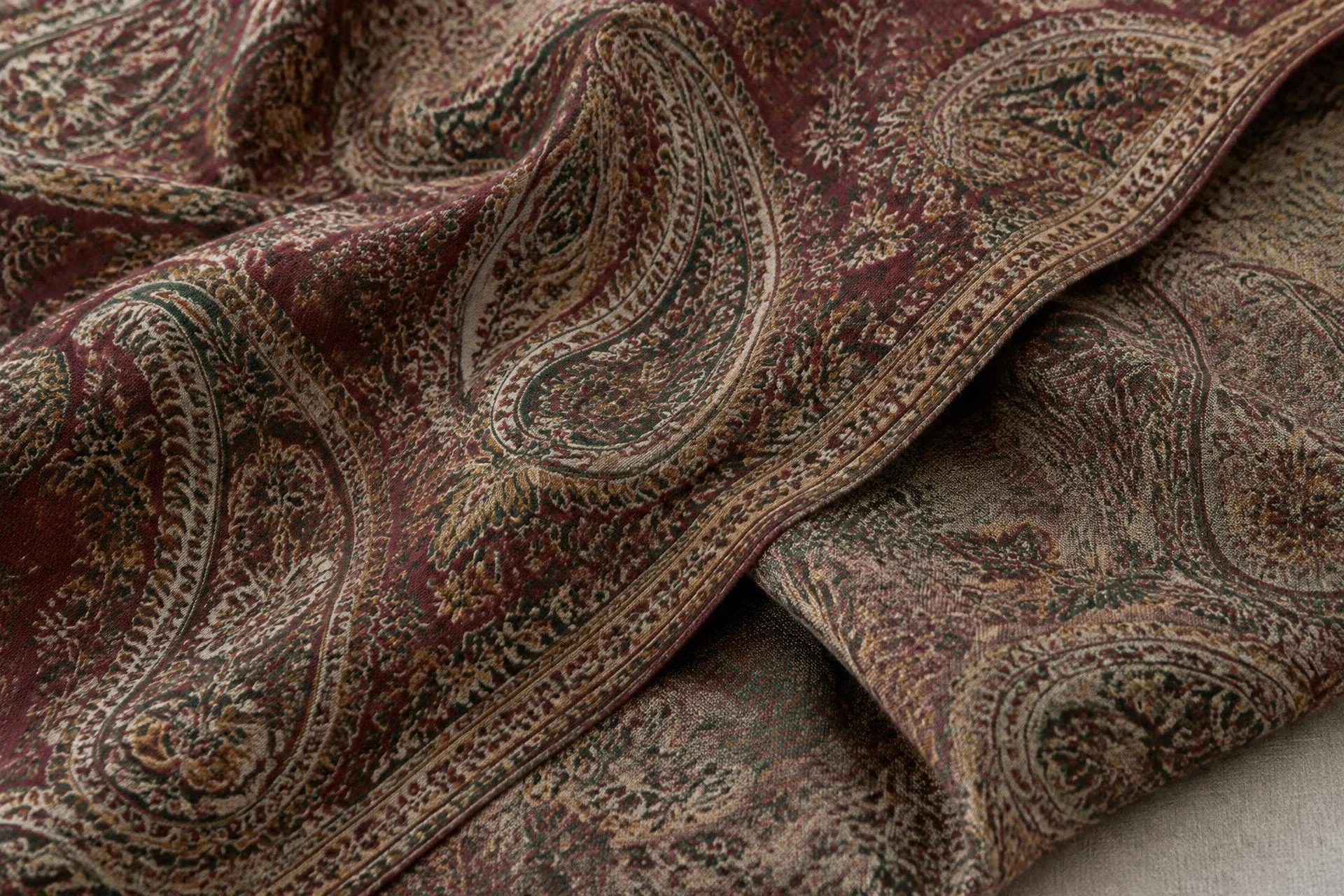
The vocabulary is narrow, which is why quality shows in the composition rather than the invention. The chinar leaf, the cypress, the almond, the vine and the flower do most of the work, with the boteh at the centre of the repertoire. Scale, negative space and direction separate a drawn field from a filled one; the boteh and the paisley shawl sets out the motif grammar in full.
Three things separate a drawn field from a filled one. The first is scale, whether the motifs were drawn for this cloth or lifted from a stock sheet and enlarged. The second is negative space: a densely worked border needs plain pashmina beside it or the edge reads as a band of colour rather than a design. The third is direction, whether the vine grows or merely travels.
Maheen kari: the fine end of the scale
In the trade, maheen kari — fine work — names the finest grade of Sozni: very thin thread, very small stitches, and a density that turns the ground into a soft haze of colour. It is a workshop grade, not a registered one, and not a different technique: the same stitches held to a tighter standard.
The practical consequences are weight and time. A maheen kari piece adds little to the weight of the shawl because the thread is so fine, yet it can carry a motif across the whole field. The same composition in a heavier thread and a longer stitch would add bulk and stiffen the drape.
Time is the other consequence, which is why grade should be the first question a buyer asks. In our experience a narrow border takes weeks, a scattered buti longer, and an all-over composition in fine maheen kari can occupy an embroiderer for months. The difference is not the drawing, which may be identical, but the number of needle movements needed to fill it.
Because grade is not a registered category, the word is used loosely. The defence is the stitch length itself. Hold the piece at arm's length, then close: fine work keeps its definition at both distances, while coarse work reads well across a room and falls apart under the eye.
Handwork against the machine
Machine embroidery can now imitate a Sozni motif convincingly in a photograph. It cannot imitate the economics or the underside.
The clearest single test is the reverse. Hand work carries threads between motifs in short, slightly irregular jumps, and the tension varies with the embroiderer's hand. Machine work is regular to the point of monotony, and where colours change it often leaves long floats trimmed later or left in place. Turn the piece over in daylight and the argument ends.
The second test is the edge of a motif. Hand couching thickens and thins along a curve as the holding stitches find their spacing; the line breathes. Machine work holds a constant width, and on tight curves it either breaks the line or doubles it.
The third is the ground. Hand embroidery is worked on cloth already washed and finished, and the needle marks the surface lightly. Machine work is often done on a stretched panel before finishing, which can leave a faint rectangular impression and a slight flattening of the weave beneath dense stitching.
None of this requires expertise, only light. What it cannot do is prove origin; for that, the GI certificate is the check that can be verified, because the registration number is public.
Time, price and what the needle costs
An embroidered shawl carries two labour bills, and buyers who understand one tend to misread the price. The first is the cloth: combing, spinning, warping, weaving and finishing. The second is the needle, charged by the month rather than the metre.
Two shawls of identical size and near-identical pattern can therefore sit at very different prices without either seller being dishonest. The difference is the density of the fill, the fineness of the thread and the number of hands that touched the piece. A price list that quotes by size alone is quoting the cloth and giving the embroidery away, and a low price on an embroidered pashmina is information about the ground, the thread or the hand that made it.
Caring for an embroidered shawl
Embroidery changes the care rules, because two materials now share one cloth. The silk or viscose thread responds to water and heat differently from the pashmina beneath it; a wash that suits the ground can dull the thread or lift a stitch.
We recommend dry cleaning for any embroidered piece, by a cleaner who handles fine wool and has seen embroidery before. Water-based spot treatments are the usual cause of damage: a wet patch on a darned fill can leave a tide mark that no later cleaning removes.
Storage follows the same logic as for plain pashmina, with one addition. Fold along lines that avoid the densest embroidery, because a crease pressed through a heavy motif for a season will crack the thread before it marks the cloth. Interleave with acid-free tissue, keep the piece flat rather than hanging, and air it between wears.
Questions we are asked
Is Sozni embroidery or weaving?
Embroidery. Kani is woven on the loom, the pattern formed by coloured weft; Sozni is worked with a needle on cloth already woven. The J&K Handicrafts Department describes the two shawl techniques in exactly these terms, loom-woven Kani and needle-embroidered Sozni [4].
How can I tell hand Sozni from machine work?
Turn the piece over in good light. Hand work shows short, uneven jumps between motifs and a living variation in the couching interval; machine work is mechanically regular and leaves long floats where colours change. Then check a curve, where hand couching thickens and thins and machine work holds a constant width.
What does maheen kari mean?
Fine work: the finest grade of Sozni, worked with very thin thread and very small stitches, so the motif carries across the cloth with little added weight. It is a standard of execution, not a separate technique.
Does Sozni have its own GI?
Yes. Kashmir Sozani Craft is registered as application 48, certificate 98, dated 2008 and valid to 2036 [1]. It is separate from the Kashmir Pashmina registration for the cloth and the Kani Shawl registration for woven pieces.
Can a shawl be both Kani and Sozni?
It can, and the description should say so. A woven Kani ground may carry an embroidered border or scattered buti, holding two distinct bodies of handwork. Ask which part is woven and which is stitched; the answer changes the price and the care.
If you are considering a first embroidered piece and want to understand what separates one grade from another before you commit, enquire with our family and we will talk it through. The our Sozni pages describe the craft as we practise it, and the our workshop notes trace the fibre from fleece to finished cloth. For the wider distinction between the crafts, Kani vs jamawar sets weaving against weaving; for the material itself, what pashmina is starts at the fibre. If a certificate is part of the sale, our guide to the pashmina GI tag sets out its limits.
A last thing, from the table rather than the archive. If you would rather see the work in person or by appointment, our private client service arranges it. The needle is slow, and the slowness is the product. The even tension across a long border and the reverse that survives inspection are time made visible, and buyers who look for that first tend to be satisfied with what they find.
Sources
- Intellectual Property India, GI Registry. "Details — Kashmir Sozani Craft (GI Application 48)." https://search.ipindia.gov.in/GIRPublicSearch/Application/Details/48. Accessed 2026-11-07.
- Craft Development Institute, Srinagar. "Quality Manual for Enforcement of Kashmir Sozani GI," updated 2023. http://iictsrinagarcarpet-gi.org/documents/Quality%20Manual%20Kashmir%20Sozani%20Updated%202023.pdf. Accessed 2026-11-07.
- Craft Development Institute, Srinagar. "Quality Manual for Enforcement of Kashmir Pashmina GI," updated 2023. http://iictsrinagarcarpet-gi.org/documents/Quality%20Manual%20Kashmir%20Pashmina%20Updated%202023.pdf. Accessed 2026-11-07.
- Handicrafts Department, Government of Jammu & Kashmir. https://dohh.jk.gov.in/. Accessed 2026-11-07.