Pashmina · 12 min read
Pashmina Scarves in Canada: A Winter Buyer's Guide
Pashmina scarf Canada: is it warm enough for a Canadian winter? Layering, size, colour, duty and care for Toronto, Montreal and beyond.
By Timothy V. Manley
7 November 2026
If you are buying a pashmina scarf in Canada, the question is always the same: is it warm enough? A fine stole worn under a parka collar, or doubled at the neck, adds warmth without bulk; on its own in extreme cold it will not replace a winter coat, but it will close the gaps.
The question arrives every November, usually from Toronto or Montreal, and usually in the same form: will this actually be warm enough? It is a fair question, because the pure pashmina shawls sold in photographs look delicate, and a Canadian winter is not delicate. The answer depends less on the shawl than on where it sits in the layers. A fine scarf worn as outerwear in a cold snap is a disappointment. The same scarf worn against the neck, under a parka, is the layer that makes the coat comfortable.
This guide works through the physics of that layering, the numbers behind a Toronto winter, the sizes and shades that make sense here, and the practical questions of duty, delivery and care that decide whether a piece gets worn or stays in a drawer.
Is a pashmina scarf warm enough for Canada's winter?
It is warm enough as a layer, and not warm enough as a substitute for a coat. The distinction is worth taking seriously, because most disappointment with fine scarves comes from asking them to do a coat's job.
Environment and Climate Change Canada's 1991–2020 normals for Toronto give a January daily average of -3.5°C and a February average of -2.7°C [1]. Those are averages, and averages are survivable in a scarf. The same record lists a minimum daily mean of -22.9°C for January and -22.2°C for February [1] — the coldest daily means in the normals, which is a different thing from a typical January day. A shawl worn as the outermost layer on such a day will not keep you warm. Worn under a parka, against the neck and chest, it will.
A dry -15°C with still air feels workable; the same temperature with wind removes the layer of warmed air that any clothing depends on. A shawl helps most when it is wrapped closely enough to stop that air moving, which is why a doubled stole at the neck outperforms a loosely draped shawl over the shoulders.
How layering works in dry cold
Winter clothing works by trapping still air. A parka does it with loft; a base layer does it with a close fit; a scarf does it by filling the gap between the two at the neck, where a coat is often open to the chin. The scarf is not generating heat. It is preventing the coat's warm air from leaving through the one place the coat cannot close.
That is why the position of the scarf matters more than its thickness. Doubled at the neck, under the collar, a fine stole sits in the gap and stays there. Worn over the shoulders, outside the coat, it is exposed to wind and does little.
Dry cold and damp cold are different problems. In the dry cold of the prairie and central Canada, the air holds little moisture and the main enemy is wind; a tightly wrapped fine scarf is effective because it seals the neck. In the wet cold of the coasts, moisture is the issue, and a soaked scarf conducts heat away rather than holding it. In that climate, the shawl should sit under a waterproof shell rather than outside it.
Indoor heat is the third condition. Canadian buildings are warm, often very warm, and a shawl that is right for the street is wrong for the office. This is the strongest argument for a fine piece rather than a thick one: it can be worn open indoors without becoming a burden.
Why a fine shawl works under a parka
Bulk is the enemy of layering. A thick knitted scarf under a close-fitting parka collar pushes the coat away from the neck, creates a gap at the shoulders and restricts movement. A fine woven shawl adds warmth without changing the fit of the coat, which is why it works in a way that a chunky scarf does not.
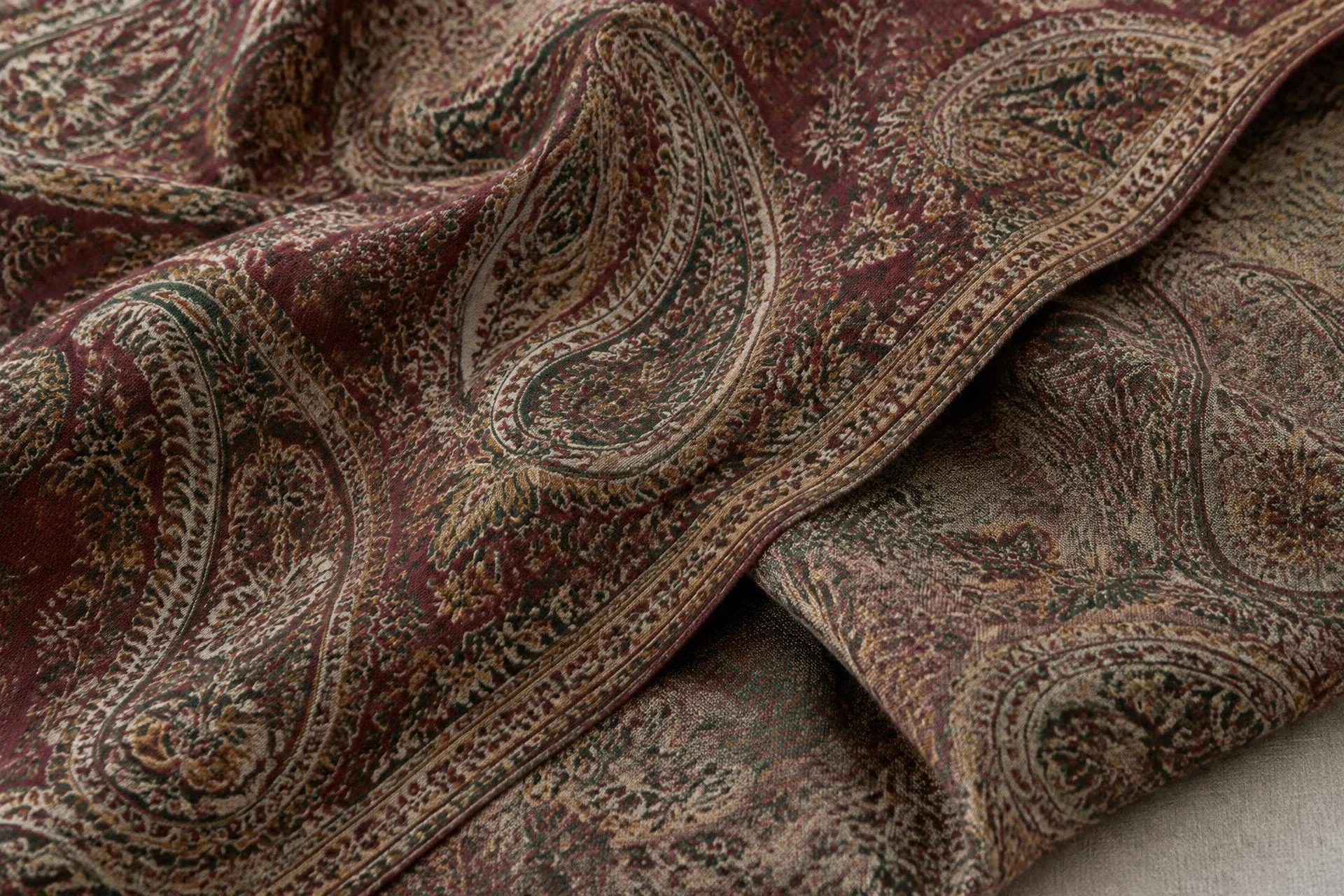
The fibre helps. The Kashmir Pashmina specification allows a fineness of up to 16 microns with hand-spun yarn and handweaving [3], while cashmere as a fibre family is defined by a mean diameter no greater than 19 microns [2]. Fine fibre can be woven into a thin, dense cloth, and a thin cloth folds flat under a collar. It also feels smooth against the skin, which matters when the scarf sits against the neck for hours.
There is a limit to this. A fine shawl is not a windproof layer. If the parka is open, or the collar is loose, the shawl will not compensate.
The same property that makes it good under a parka makes it good indoors. A fine shawl over a shirt or a dress adds a little warmth without the weight of a cardigan, and it can be taken off and folded into a bag without creasing badly — useful when a restaurant is warmer than the street.
Size and weight for a Canadian wardrobe
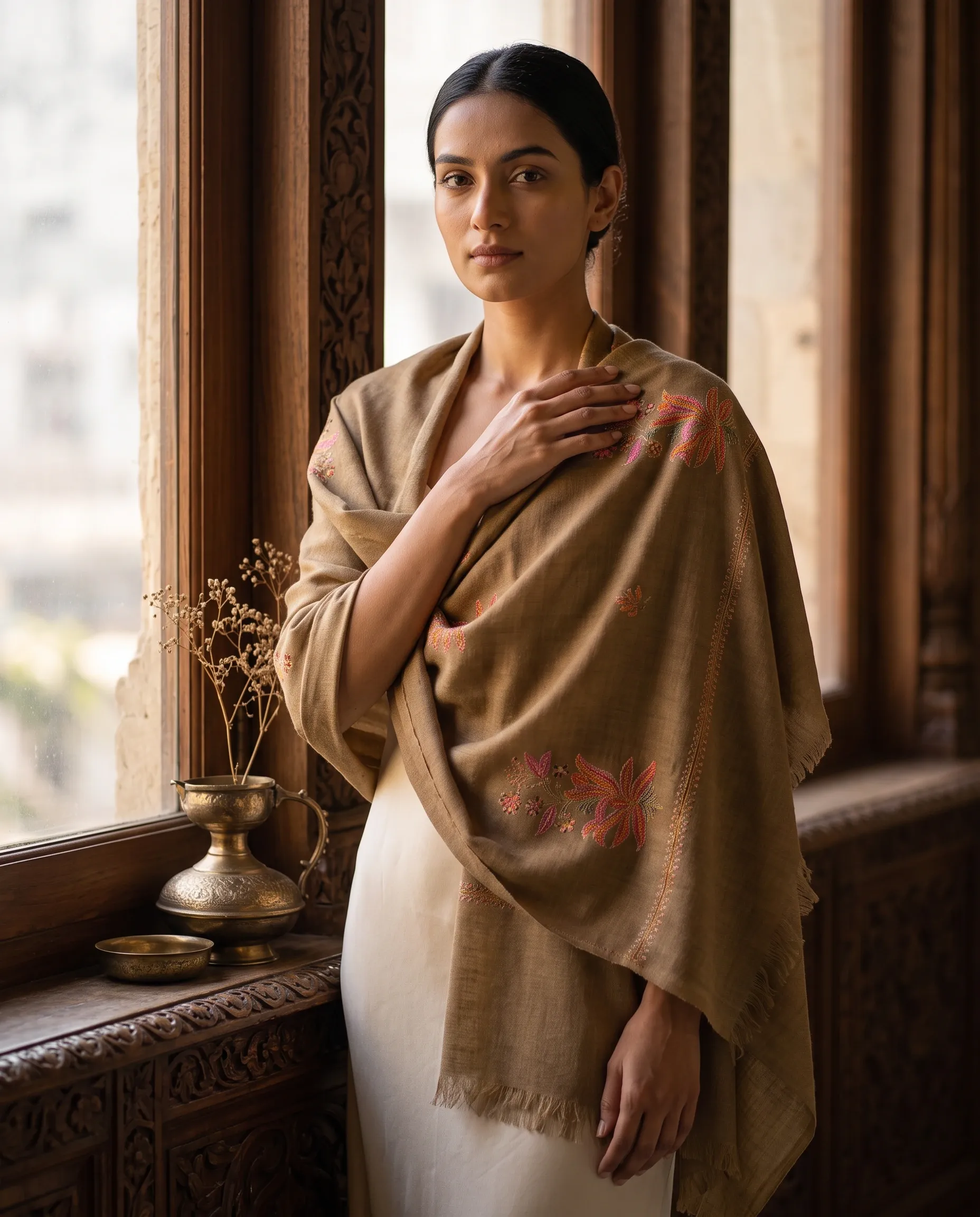
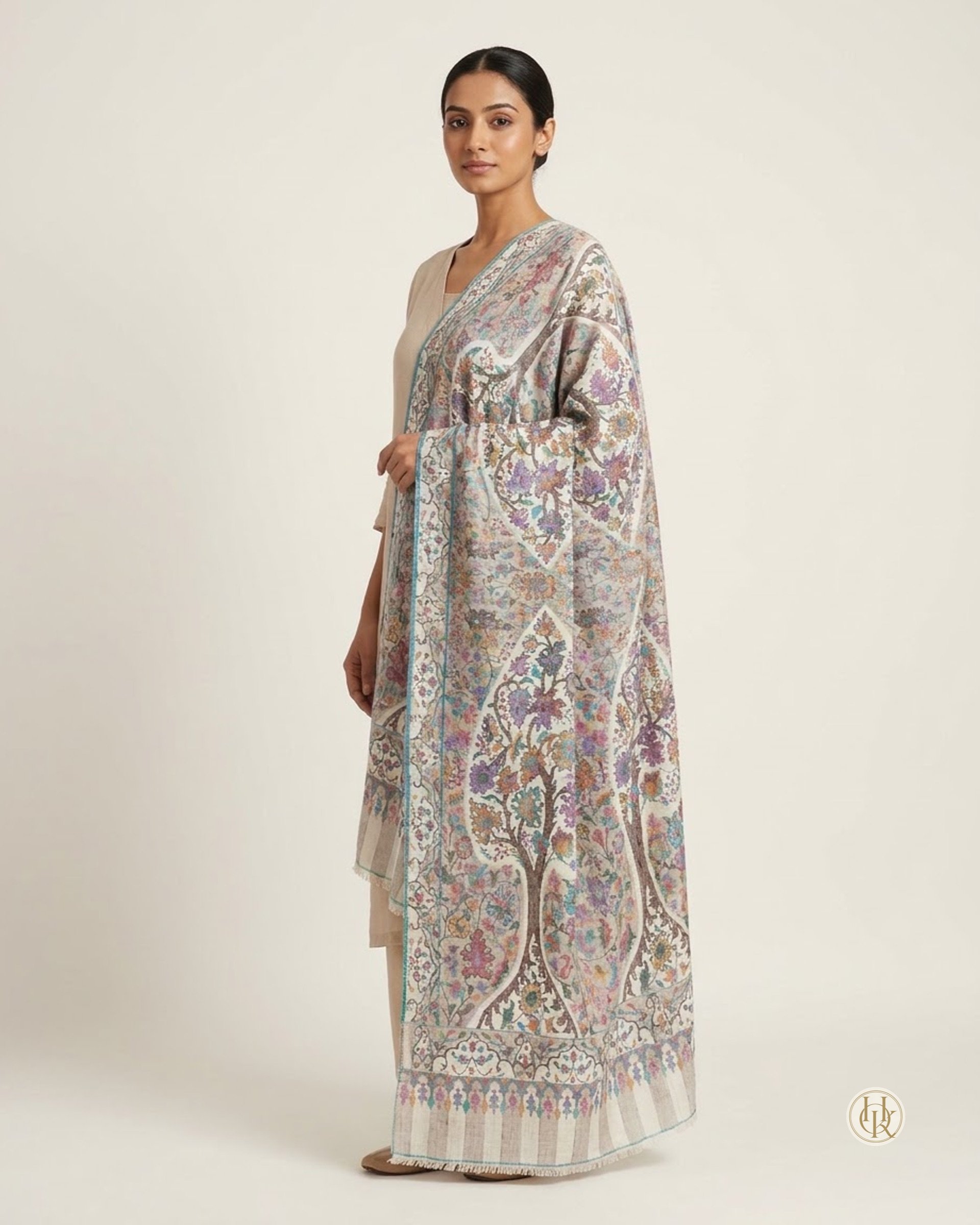
Two sizes cover most Canadian use. A stole around 70 by 200 centimetres is the everyday piece: long enough to double at the neck, narrow enough to sit under a collar, light enough to carry indoors. A shawl of about 100 by 200 centimetres is the evening and indoor piece: wide enough to cover the shoulders, large enough to use as a light blanket on a sofa or a plane.
If you are choosing one piece for a Canadian winter, choose the stole. It does more work in more places. If you are choosing two, add the larger shawl in a lighter weight for indoors and for travel.
Weight alone tells you little, because the same weight can be woven tightly or loosely. What matters is the hand: a cloth that feels dense and smooth will block air better than one that feels loose and fluffy, even if the loose one is heavier. In our experience, a tightly woven stole outperforms a thicker, softer scarf in wind.
Setting · Weight · Size · Use
Length matters more than width for a Canadian winter, because length is what allows a second wrap around the neck. A piece that is wide but short cannot be doubled, and doubling is the whole technique.
- Toronto average winter day (-3.5°C in January) Weight: Medium; Size: 70 × 200 cm stole; Use: Doubled at the neck under a coat
- Cold snap near -23°C daily mean Weight: Medium; Size: 70 × 200 cm stole; Use: Under a parka, sealing the collar
- Heated indoors Weight: Light; Size: 100 × 200 cm shawl; Use: Open over the shoulders
- Wet coastal cold Weight: Medium; Size: 70 × 200 cm stole; Use: Under a waterproof shell
- Spring and autumn Weight: Light; Size: 70 × 200 cm stole; Use: Scarf by day, wrap by evening
Colour for winter light and road salt
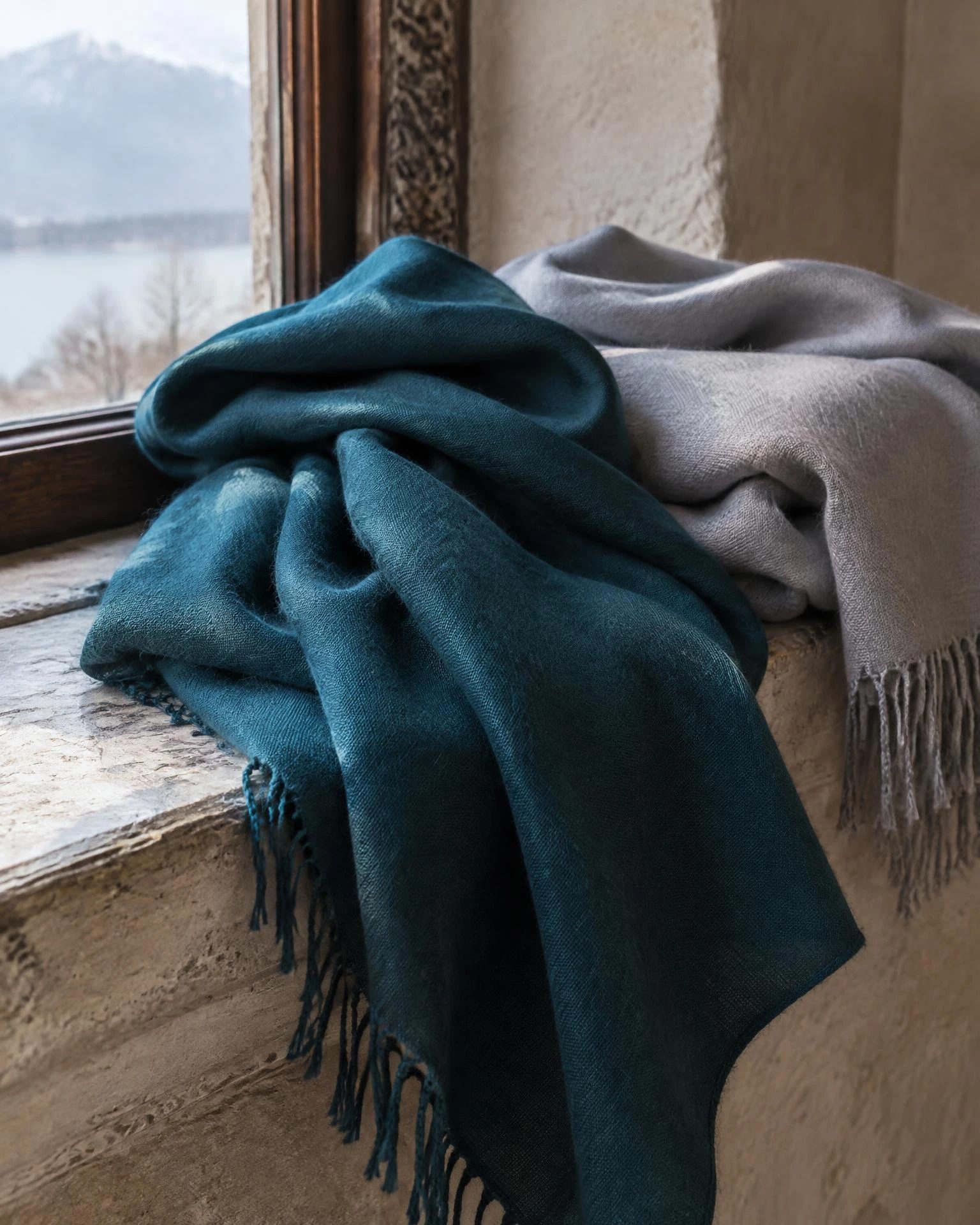
Canadian winter light is low, grey and often reflected off snow. Under that light, warm shades lose saturation and cool shades gain it: a camel can look washed out, a navy can look black, an ivory can look grey. The colours that hold up best are the mid-tones and the darks with some depth — charcoal, navy, a deep camel, a slate blue, a forest green.
Road salt is the practical hazard. It is tracked into cars, hallways and shops, and it leaves a pale, crusted mark on hems and fringes. On a dark shawl the mark is obvious; on an ivory one it is invisible until it dries. The response is the same either way: blot rather than rub, let it dry, brush off the residue and rinse the affected area in cool water before storing.
If you want one shade for a Canadian wardrobe, charcoal is the most forgiving. It works with black, navy, grey and camel coats, it does not show lint the way black does, and it looks deliberate in low light. Navy is the second choice, with the caveat that it can read as black indoors.
Ivory is the shade most often bought for photographs and least often worn in February. Beautiful against snow, unforgiving against slush. If you want a pale piece, choose cream rather than pure white and keep it for occasions rather than commutes.
Duties, delivery and the first wear
A shawl shipped from Srinagar to Canada is an imported good, and the cost at the door is not always the cost at checkout. The Canadian Customs Tariff sets duty according to the classification of the goods and their origin, and it is based on the Harmonized Commodity Description and Coding System [4]. The rate for a particular piece therefore depends on how it is classified and where it was made, and it should be checked against the current tariff rather than assumed.
We do not quote a duty rate in advance, because the rate is not ours to set and can change. What we do is confirm delivery times, duties and taxes at the time of enquiry, so that the figure is known before the piece is dispatched. If a parcel is assessed on arrival, the carrier will usually collect the amount due before delivery, and the invoice explains the charge.
Keep the invoice with the packaging until the piece is delivered and inspected. And if you are buying a gift sent directly to a recipient, tell us, because the recipient may be the one asked to pay the assessment.
When it arrives, open the parcel indoors, let the shawl hang for an hour to recover from the journey, and look at it in daylight before deciding.
Our returns policy allows 14 days, with return shipping paid by the customer, after inspection. That window is long enough to try the piece with your coat, check the shade against your winter wardrobe and see whether the size doubles comfortably. Do not remove labels or wear the piece outdoors until you are sure; a scarf that has been through a salt-stained street is no longer in resalable condition.
If the colour is wrong, say so early. A shade that looks grey in Srinagar can look blue in Toronto, and the difference is the light rather than the dye. An exchange is simpler than a dye job.
Care in heated indoor air
Canadian indoor air in winter is dry, and dry air is hard on fine fibre. Static builds, the cloth can feel crisper than it did in summer, and repeated washing strips the natural oils that keep it soft. The response is to wash less, not more: air the shawl after wear, spot-clean marks, and reserve a full wash for the end of the season or a genuine stain.
Steam is the best tool for creases and for reviving the drape. Hang the piece in a bathroom during a shower, or pass a steamer over it on the lowest setting, keeping it moving. A hot iron pressed flat will flatten the weave and leave a sheen on dark shades.
Storage matters as much here as anywhere. Moths and carpet beetles attack protein fibres and seek undisturbed, dark places, which describes a folded shawl at the back of a closet [5]. Clean the piece before storing it, fold it with acid-free tissue, keep it in a breathable cotton bag and check it once a season. The full storage routine is set out in how to store pashmina shawls.
If you are building a winter wardrobe, a charcoal stole and an ivory shawl will cover more occasions than two dark pieces.
Questions we are asked
Will a pashmina keep me warm at -20°C?
Not on its own. At a daily mean near -23°C, which Toronto's normals record for the coldest January days [1], a shawl worn as outerwear is not enough. Worn doubled at the neck under a parka, it keeps the collar gap sealed and makes the coat noticeably warmer.
Should I wear it under or over my coat?
Under, for warmth. Over, for appearance. A fine stole under the collar traps air where the coat is open; a larger shawl over the shoulders is for indoors and for evenings.
Will road salt damage the fibre?
Salt leaves a crusted mark and can dry the fibre if it stays in the cloth. Blot it, let it dry, brush off the residue and rinse the area in cool water. Do not rub the mark while it is wet, which pushes the salt into the weave.
How much duty will I pay?
It depends on the tariff classification and the origin of the goods, which is why the rate has to be checked against the current Canadian Customs Tariff rather than quoted in advance [4]. We confirm the expected duties and taxes with you at the time of enquiry, before dispatch.
What if the colour looks different in Canadian light?
It often does, because winter light is cooler and greyer than the light a piece was chosen in. Use the 14-day return window to look at it in daylight beside your coat. If the shade is wrong, exchange it rather than living with a piece you will not wear.
Where to go from here
The useful way to choose is to start from the coat, not the shawl. A charcoal parka, a navy wool coat and a camel wrap each want a different neighbour, and the piece that works with all three is usually a mid-tone in a fine weave. Once the size and shade are settled, the rest is arithmetic: how often you will wear it, how you will store it, and whether the duty and delivery cost still make sense.
If you are comparing fibres before deciding, pashmina vs cashmere sets out the difference in micron, origin and handwork. If you are buying at a distance, buy pashmina online covers the checks that matter before payment. And if you would rather see the cloth against your own coat, ask us for a private client appointment appointment and we will photograph pieces in daylight for you.
We deliver worldwide; you can see what we hold by private enquiry through where to buy, with delivery times, duties and taxes confirmed before anything is sent. A winter scarf should be a piece you reach for every morning from November to March; the right one is chosen once and then simply worn.
Sources
- Environment and Climate Change Canada, "Canadian Climate Normals 1991–2020 — Toronto" — Accessed 2026-11-07.
- Cashmere and Camel Hair Manufacturers Institute, "CCMI Definition of Cashmere, Fine and Superfine Wool" — Accessed 2026-11-07.
- Craft Development Institute, Srinagar, "Quality Manual for Enforcement of Kashmir Pashmina GI" — Accessed 2026-11-07.
- Canada Border Services Agency, "Canadian customs tariff" — Accessed 2026-11-07.
- Canadian Conservation Institute, "Caring for textiles and costumes" — Accessed 2026-11-07.