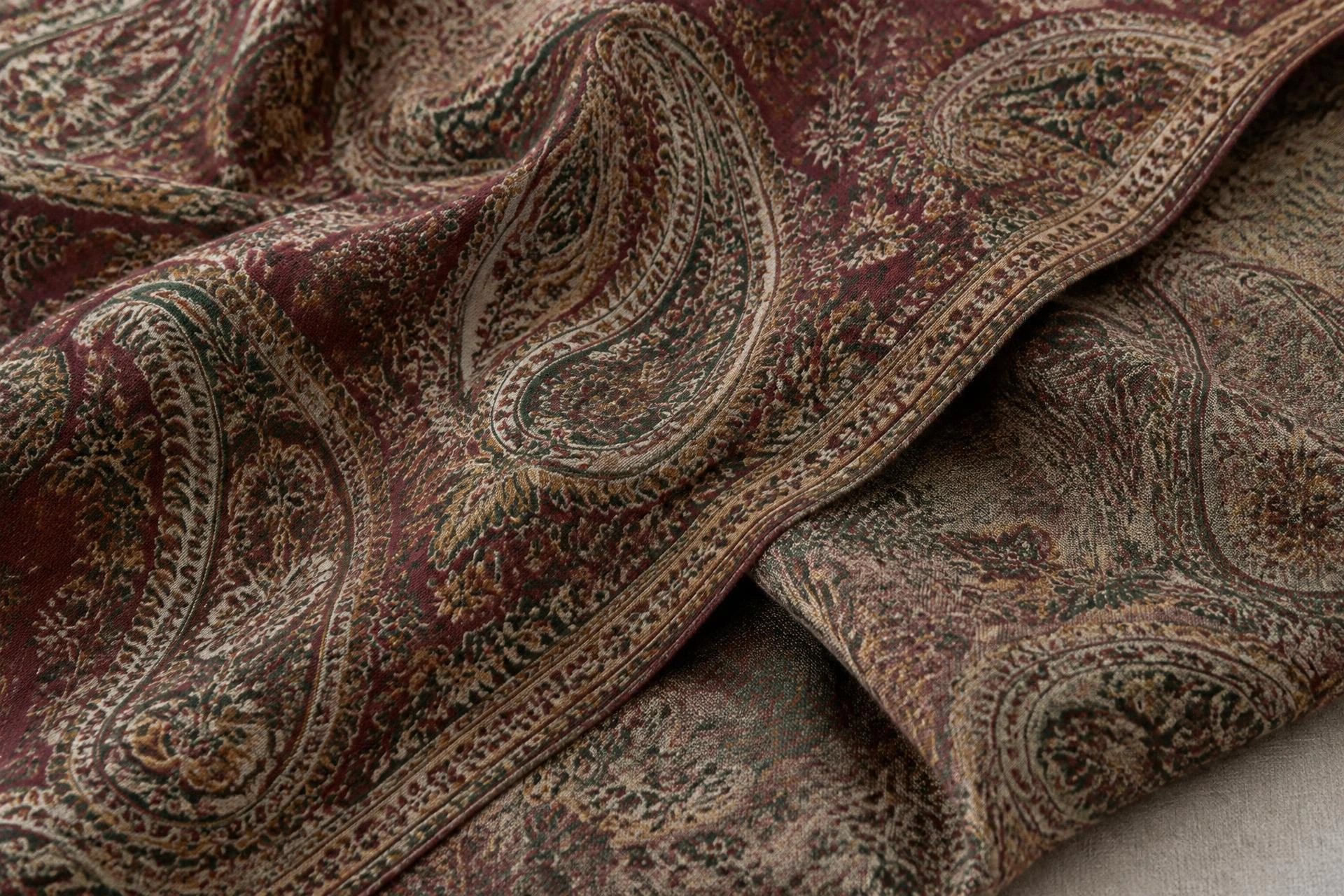
Craft · 12 min read
Shahtoosh: The Kashmir Shawl That Is Illegal to Own
Shahtoosh is woven from the underwool of the chiru, a protected antelope. Why the trade is banned, how to recognise it and what to do if offered one.
By Timothy V. Manley
7 November 2026
Shahtoosh is a shawl woven from the underwool of the chiru, Pantholops hodgsonii, a Tibetan antelope. International trade in chiru products has been prohibited under CITES since 1975, India bans the trade under its Wildlife Protection Act, and one shawl requires the pelts of three to five animals [1].
The word is Persian, and the cloth was regarded as the finest in Kashmir before anyone counted the cost. It is among the finest materials ever woven in Kashmir, and the reason a small antelope on a high plateau was brought close to collapse.
This article is not a buyer's guide, because there is nothing lawful to buy. It is an account of the fibre, why the trade is banned, how the ban is enforced, and what to do if a shawl is offered to you — or arrives in an inheritance.
We write it because the questions reach us regularly. A visitor is shown a shawl in a back room and told it is the prohibited fibre; a family finds one in a trunk and does not know whether keeping it is an offence. Both need a plain answer rather than a romantic one.
The animal and the underwool
The chiru is a medium-sized antelope of the Chang Tang, the high plateau of Tibet and the western Chinese provinces, with small populations across the high ground of Ladakh. Its coat is built for that climate: a dense underwool beneath longer guard hair, grown for winter and shed in spring.
That underwool is the fibre. It is extraordinarily fine and warm for its weight, which is exactly what made it valuable and exactly what made it vulnerable.
The IUCN Red List assessment of 2016 lists Pantholops hodgsonii as Near Threatened [2]. That is a category worth reading carefully: not Extinct, not Critically Endangered, but close to qualifying for a threatened category. It is the most recent assessment on the Red List entry, so treat it as the last formal position rather than a current count.
Two details matter. The fibre cannot be harvested without killing the animal: chiru are not domesticated and are not combed like the goats that give pashmina. And because the underwool is collected from the carcass, the fibre and the pelt are the same transaction.
Why the trade is prohibited
The Convention on International Trade in Endangered Species has prohibited member nations from engaging in the import, export, sale and trade of Tibetan antelope products since 1975 [1]. That is more than fifty years of prohibition, and it covers the commercial channels by which a shawl would travel rather than only the border crossing.
India's domestic position is separate and stricter in practice: the Tibetan antelope is listed in India's Wildlife Protection Act, which prohibits trade in the fibre [1]. So the country where the shawl is woven has banned its trade, and the international convention bans its movement. Between them, there is no lawful route by which a new shahtoosh shawl can be made and sold.
The prohibition has been in place long enough that every shawl in existence is either older than the ban or made in breach of it. An old piece is not thereby lawful to sell, but the facts around it differ from those around a new one.
What the law does not do is make the cloth disappear. Prohibition suppresses a market rather than abolishing it.
Three to five animals for one shawl
The figure that changes the argument is this: the pelts from three to five dead antelope are required to produce one shawl [1]. Not one animal, and not a by-product of a natural death. A single shawl is the direct result of a small herd.
That ratio explains the economics. A weaver working the fibre is not paid for a rare fibre in the way a pashmina weaver is paid for a fine one. The scarcity is biological rather than agricultural, which means the price rises with the difficulty of obtaining the raw material rather than with the skill of the maker. Enforcement does not raise the cost of production; it raises the cost of the risk, and the price adjusts.
It also explains why the cloth is so light. The underwool from three to five animals, compressed into one shawl, produces a fabric of extraordinary fineness, and fineness of that order cannot be imitated by blending coarser fibre. That is why the ring stories persist: the cloth really is unlike anything legal.
There is a second ratio worth holding beside the first. A Kashmir Pashmina shawl is made from the combed underfleece of Changthangi goats that are sheared or combed in spring and live on. The Kashmir Pashmina rule is exacting: pure pashm, no fibre above 16 microns, woven in Jammu and Kashmir from hand-spun yarn [3]. Ordinary cashmere is broader: a dehaired goat undercoat whose mean stays at or below 19 microns, with a 24% variation cap and a 3% weight limit on fibre above 30 microns [4]. Those are fibres that regrow every year. The chiru fibre is the one that does not.
Fibre · Species · Legal status · Note
- Pashmina (Kashmir Pashmina GI) Species: Changthangi goat, combed underfleece; Legal status: Lawful; GI-registered in India; Note: 100% pashm up to 16 microns, hand-spun and handwoven [3]
- Cashmere Species: Cashmere goat, dehaired undercoat; Legal status: Lawful; Note: Mean diameter not exceeding 19 microns [4]
- Shahtoosh Species: Chiru, Pantholops hodgsonii; Legal status: Prohibited: CITES since 1975; banned in India; Note: Three to five animals per shawl [1]
- "Shahtoosh-type" or "chiru blend" Species: Any; Legal status: Prohibited if it contains chiru fibre; Note: A description that admits the fibre is an admission of the offence
Enforcement, and the laundering problem
Enforcement has run through criminal cases rather than customs seizures alone. In a landmark United States case, shahtoosh dealers pleaded guilty after an investigation into the sale of shawls made from the Tibetan antelope [1]. The case is old, and it remains the clearest published example of the trade being treated as trafficking rather than as a retail irregularity.
The structural difficulty is identification. The fibre is a keratin like wool and cashmere, and a shawl can be described as pashmina, as a speciality blend, or as an antique of unspecified material. Light microscopy under ISO 17751-1:2023 is the recognised way to separate cashmere, wool and other speciality animal fibres, and it is what turns a suspicion into evidence in a laboratory report [5].
The second difficulty is age. A shawl made in 1950 and one made last year are visually similar, and a claim of inheritance is easy to make and hard to disprove, which is why enforcement usually concerns the transaction rather than the object.
The third is that the market is small and closed. The trade moves through private introductions, so the buyer is often being flattered as much as sold to. The shawl is presented as a privilege and the legal question as a matter of taste.
Recognising shahtoosh, and refusing it
You will hear that the cloth can be drawn through a wedding ring. It is a parlour test, not a proof: fineness of that order is necessary, not sufficient, and a loosely woven fine fabric can pass through a ring without being shahtoosh.
What a demonstration does establish is that the cloth is exceptionally fine for its weight. Treat that as a prompt to ask for documentation, not as an identification. Real identification is a laboratory matter under ISO 17751-1 [5].
Four signals in a conversation are worth more than any physical test.
The first is the word itself. If a seller names shahtoosh, the transaction is being offered as a prohibited one. There is no version of the sale that is compliant, whatever the age of the piece is claimed to be.
The second is the vocabulary of secrecy: back rooms, introductions, no receipts, a price quoted in cash, a request not to photograph. Legitimate trade in fine textiles does not require any of this.
The third is the story of the fibre. A seller who explains that the wool is gathered from bushes where the animals have rubbed against them, or that the animals are not harmed, is repeating a claim that does not survive contact with how the fibre is obtained [1].
The fourth is a certificate. A GI certificate for Kashmir Pashmina covers pashmina, not chiru fibre, and cannot be attached to a chiru shawl as evidence of anything. If a certificate is produced for such a piece, it is either unrelated or forged.
Refusing is simple and does not require a confrontation. You can say that you do not buy shahtoosh, and leave. You are not obliged to explain the law to the seller, and you are not obliged to report a conversation. If you wish to report an offer of sale, the wildlife authority in the relevant jurisdiction is the correct recipient, and in the United States the Fish and Wildlife Service is the agency that has brought these cases [1].
If you are offered one, or inherit one
The awkward cases are the inherited ones. A shawl arrives in a trunk, the family knows what it is, and nobody knows what to do with it.
We are not able to give legal advice, and this article should not be read as advice. The correct step is to ask the wildlife authority in your own jurisdiction what the position is for an inherited item that is not being sold. The question to put to them is specific: whether possession is permitted, and whether any permit or declaration is required. Different countries treat possession, sale, import and export separately, and the answer for a piece that stays in a cupboard is not necessarily the answer for a piece that crosses a border.
Three things are worth doing before that conversation. Do not sell it, do not ship it and do not take it to a valuer for a sale. Photograph it, record what you know of its history, then ask the authority in writing and keep the reply.
Museums are the other route. A textile collection may advise on the object's status, and some institutions may accept such material with documentation that makes the acquisition lawful. That conversation should happen before anything changes hands.
What the law permits: the alternatives
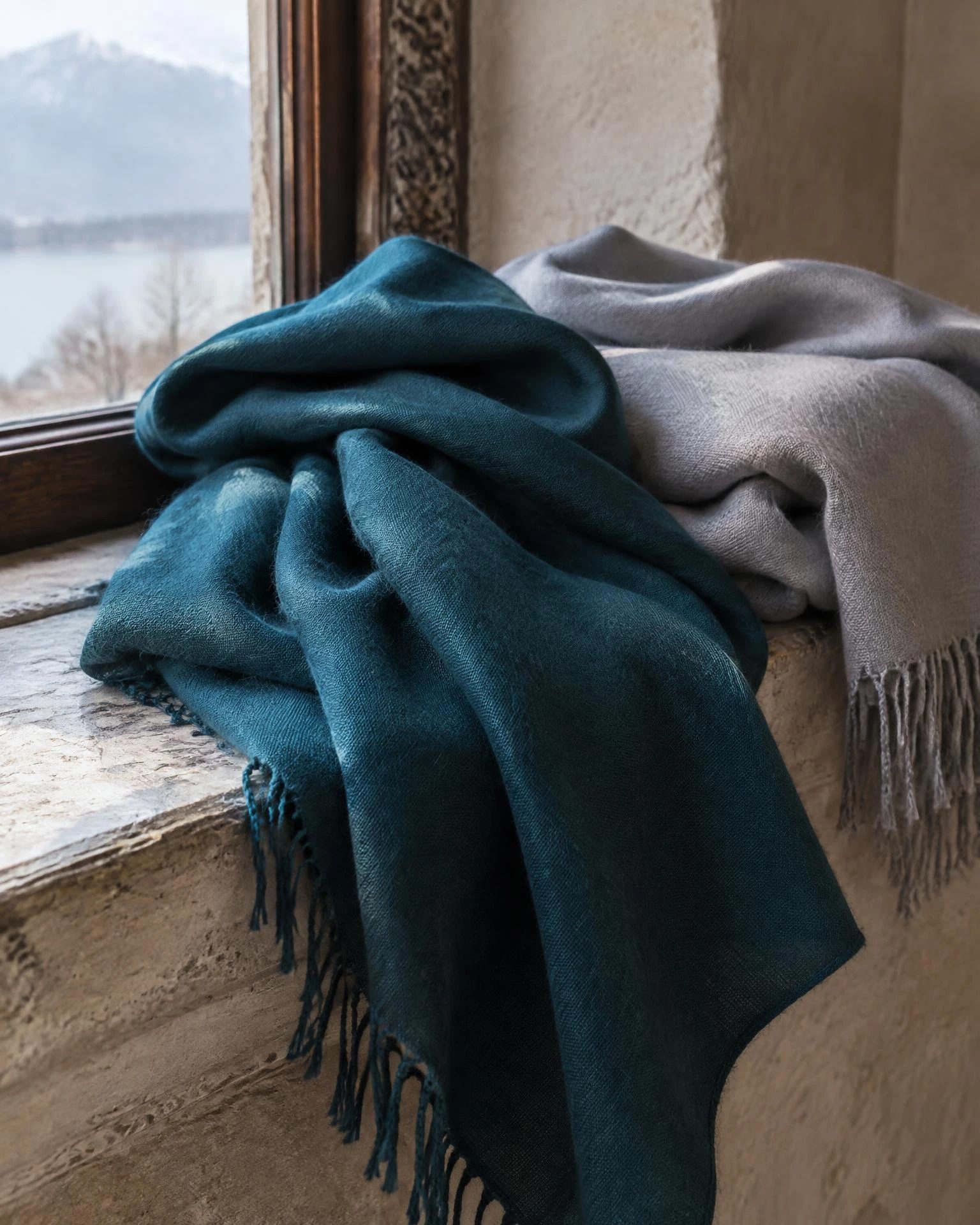
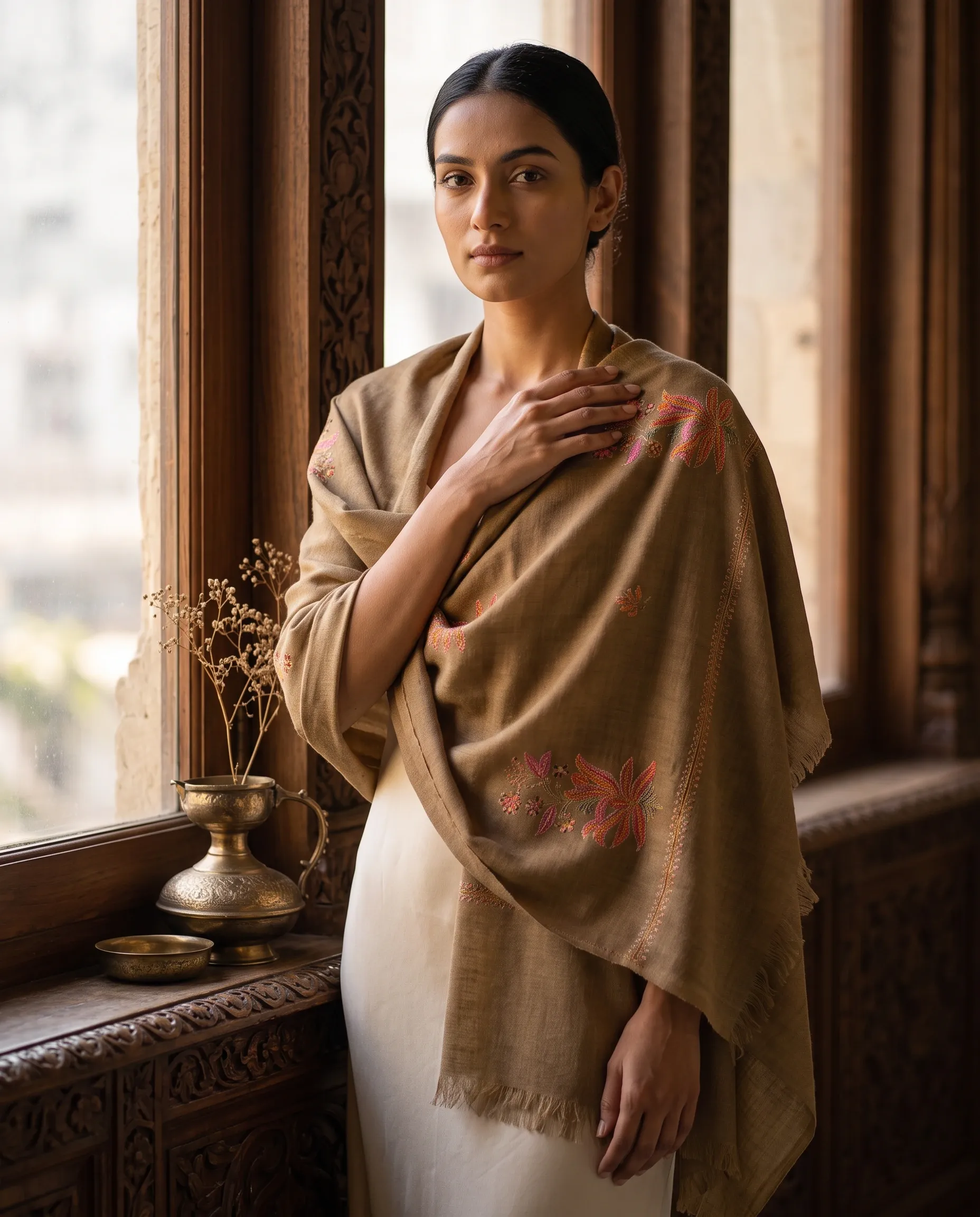
If you want the warmth without the offence, the legal fibre is not a compromise. Pashmina is combed from a living animal each spring and spun by hand, and the registered Kashmir rule is demanding: pure pashm, nothing above 16 microns, yarn spun by hand, cloth woven in Jammu and Kashmir [3].
The difference in warmth is smaller than the difference in law. The fibre reaches a fineness pashmina does not, and there is no point pretending otherwise. But a well-made pashmina layered under a coat does the work most buyers want, without the animal, the prohibition or the risk of confiscation.
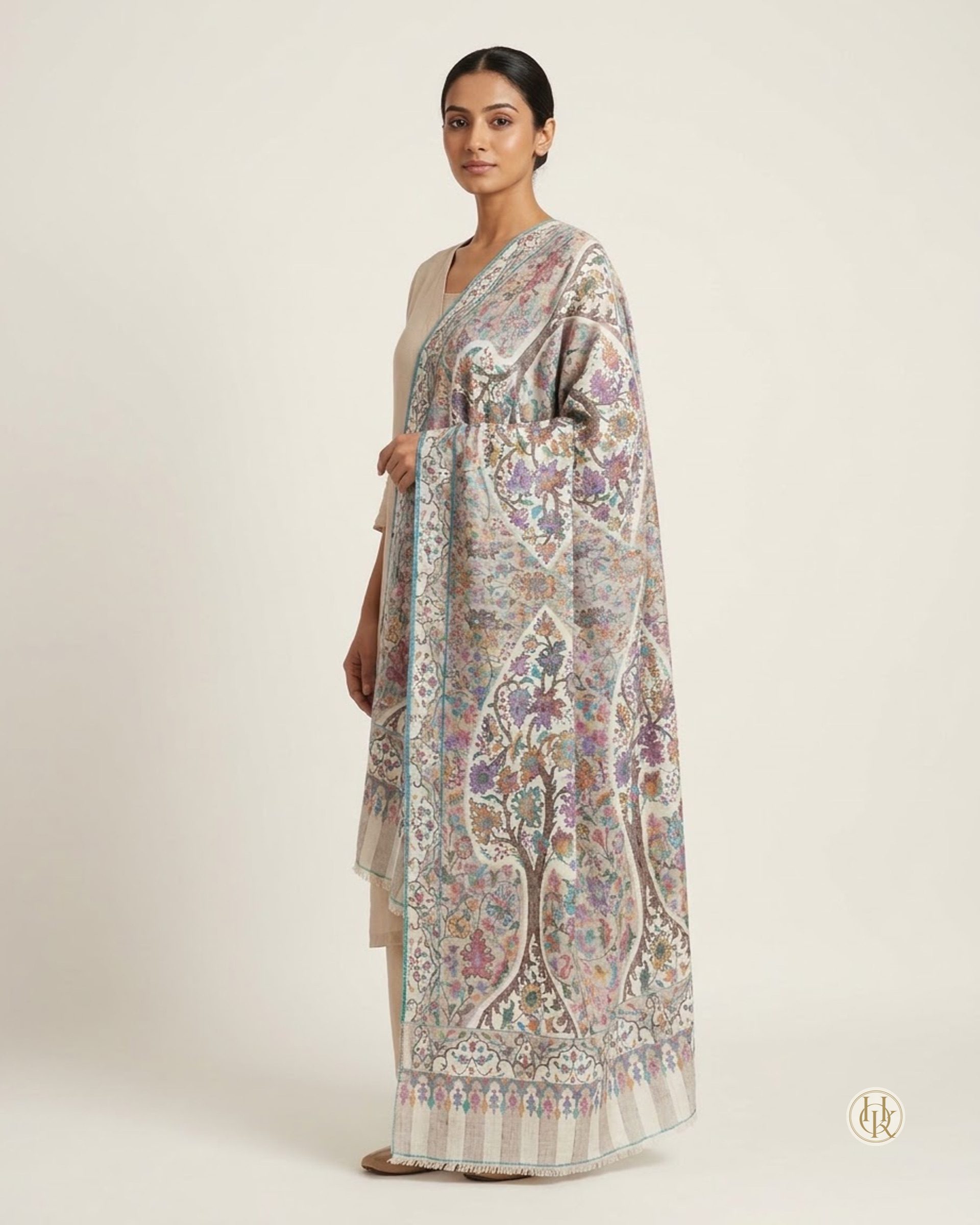
There is also the question of what the shawl means. A pashmina carries the record of a goat, a comb, a spinning wheel and a loom, and the house that made it can tell you about all four. A chiru shawl carries the record of three to five antelope and a transaction that has been illegal for half a century. Those are different objects to own, whatever the cloth feels like in the hand.
If you want to understand what a lawful, well-documented shawl looks like, see what we hold at the house and we will show you the fibre, the reverse and the certificate. The our pashmina pages set out the material, Kani weaving pages covers the loom, and the heritage pages place both in the valley's textile history.
Questions we are asked
Is shahtoosh illegal to own?
It depends on the jurisdiction, and it is a question for the wildlife authority rather than for a seller. International trade in chiru products has been prohibited under CITES since 1975, and India prohibits trade in the fibre under its Wildlife Protection Act [1]. Possession, sale and import are separate legal questions, which is why an inherited piece needs a specific answer from the authority in your country.
How can I tell shahtoosh from pashmina?
Not by a ring, and not by hand-feel alone. The fibre can be separated by light microscopy under ISO 17751-1:2023, the recognised method for cashmere, wool and other speciality animal fibres [5]. In practice the safest position is that an undocumented shawl offered as shahtoosh should be refused on the description alone.
Why is shahtoosh more expensive than pashmina?
Because the raw material costs animals rather than a haircut. Three to five chiru are needed for one shawl [1], and the fibre cannot be obtained from a living animal. The price reflects the scarcity and the risk of an unlawful transaction, not a higher standard of weaving.
Could a shawl be an antique and therefore legal?
Age does not create a lawful market. The prohibition attaches to the species and to trade in its products, and a claim of age is difficult to verify in either direction. Ask the wildlife authority in your jurisdiction about the specific item before you buy, sell or ship anything described as shahtoosh.
What should I do if a shop offers me one?
Decline and leave. You are not obliged to explain the law or to report a conversation. If you want to report an offer of sale, the wildlife authority in that jurisdiction is the right recipient; in the United States, the Fish and Wildlife Service is the agency that has brought these cases [1].
The subject attracts fantasy, and the fantasy is usually generous to the cloth. The documented position is narrower and more useful: a protected antelope, a banned trade, three to five animals for a shawl, and no lawful way to buy one [1]. If you take a single thing from this article, take the ratio. It settles the rest. For buyers who would rather spend the same money on something they can wear without a question attached, our private client service will walk you through what the house holds, and what pashmina actually is starts at the fibre. When a certificate is offered anywhere, what the GI tag certifies explains what it covers — and, as here, what it does not.
Sources
- U.S. Fish & Wildlife Service. "Shahtoosh Dealers Plead Guilty in Landmark Case," July 2000 (archived). https://web.archive.org/web/20251010035120/https://www.fws.gov/story/2000-07/shahtoosh-dealers-plead-guilty-landmark-case. Accessed 2026-11-07.
- IUCN Red List of Threatened Species. "Pantholops hodgsonii (Chiru)," assessed 2016. https://www.iucnredlist.org/species/15967/50192544. Accessed 2026-11-07.
- Craft Development Institute, Srinagar. "Quality Manual for Enforcement of Kashmir Pashmina GI," updated 2023. http://iictsrinagarcarpet-gi.org/documents/Quality%20Manual%20Kashmir%20Pashmina%20Updated%202023.pdf. Accessed 2026-11-07.
- Cashmere and Camel Hair Manufacturers Institute. "Definition of Cashmere, Fine and Superfine Wool" (archived). https://web.archive.org/web/20240523004544/https://www.cashmere.org/definition-cashmere-wool.php. Accessed 2026-11-07.
- International Organization for Standardization. "ISO 17751-1:2023 — Quantitative analysis of cashmere, wool, other speciality animal fibres and their blends: light microscopy method." https://www.iso.org/standard/83595.html. Accessed 2026-11-07.