Pashmina · 13 min read
What Is Pashmina? The Fibre, the Goat and the Word
What is pashmina? The fine undercoat of the Changthangi goat, not a generic scarf: the fibre, its micron range, GI and what the label means.
By Timothy V. Manley
7 November 2026
What is pashmina? It is the fine undercoat grown by the Changthangi goat on the high plateau of Ladakh, combed out in spring, separated from the coarse guard hair by hand, then spun and woven in Kashmir. It is a fibre and a craft before it is a product, and not every soft wrap sold under the name qualifies.
The word has drifted a long way from the animal. In a resort gift shop it describes a soft scarf; in a marketplace it describes whatever the seller needs it to mean before lunch. None of those uses belongs to the fibre, and the drift has consequences: a buyer can pay a real price for a shawl containing no pashm, and a maker can be undercut by a label that says the same word on a different object.
This article is the reference we use when a customer writes to ask whether the shawl in front of them is what its label claims. It covers the animal, the preparation of the fleece, the measurements that decide quality, the registrations that carry legal weight and the reading of a label. Our pashmina shawls and stoles pages show the pieces this definition describes.
The animal behind the word
Pashm comes from a goat, not a sheep, and not a llama, camel or yak. The registered Indian specification for Kashmir Pashmina names the animal as the mountain goat Capra Hiracus and describes the raw material as the under fleece [2]. The international cashmere definition names the cashmere goat as Capra hircus laniger [3]. The two names refer to the same animal family; the spelling in the Indian registration is the one recorded in the certificate, and it is worth knowing that the paperwork uses its own wording.
The goat lives at altitude, on the Changthang plateau and the pastures around it, where the winter is long and the summer is short. Its protection is a double coat: a long, coarse outer layer that sheds wind and a dense down beneath it that holds warmth close to the skin. The down is what the word pashmina means.
Herding families comb that down out in spring, when the animal begins to shed it, rather than shearing the coat. A shear cuts through both layers at once and mixes them; combing lifts the loose down first and leaves the guard hair behind. The difference matters downstream, because the two fibres cannot be separated cheaply once they are blended.
From combing to dehairing
Raw pashm arrives at the workshop as a cloud of down and guard hair, with dust, vegetable matter and the odd burr. Dehairing is the process of removing the coarse hair, and it is done either by hand or by machine. Hand dehairing is slower and loses more weight; it also breaks fewer fibres and leaves the longest staples intact. Machine dehairing is faster and more uniform, and it is what most of the world's cashmere passes through.
A large share of the raw weight leaves at this stage. That loss is one of the reasons a genuine shawl costs what it does: you are paying for the fraction that survives, not for the weight you could have weighed on a scale at the farm gate.
After dehairing comes sorting. Natural pashm ranges from ivory through sand and fawn to a grey-brown, and the colour of the fleece sets the floor for whatever dye is applied later. Pale fibre can go anywhere; dark fibre can only go darker.
Then spinning. On the Kashmiri wheel, the yinder, the spinner draws the dehaired down into a yarn fine enough to weave but strong enough to hold a warp. The registered specification for Kashmir Pashmina requires hand-spun yarn, and it requires the cloth to be handwoven by artisans in Jammu and Kashmir [2]. Those two clauses are doing a lot of work: they exclude the power-spun, power-woven cloth that carries the same fibre and a similar name.
What is pashmina, measured
A micron is one thousandth of a millimetre, and the diameter of the fibre is the single most useful number in the trade. The Kashmir Pashmina registration sets the ceiling at 16 microns [2]. The international cashmere definition is slightly wider: a mean diameter not exceeding 19 microns, a coefficient of variation around the mean no greater than 24%, and no more than 3% by weight of fibres over 30 microns [3]. The United States applies its own three-part test: dehaired goat undercoat, an average diameter of 19 microns or less, and no more than 3 percent by weight of fibres over 30 microns [4]. It sets no coefficient-of-variation limit.
Read those clauses together and the shape of the problem appears. A mean of 15 microns is compatible with a batch that also contains a small proportion of fibres well above 30 microns, and those coarse fibres are the ones that prickle against the neck. The coefficient of variation is therefore as informative as the average, and the 30-micron ceiling exists because that is the diameter at which a fibre stops feeling soft against skin. A seller who quotes an average and nothing else is telling you half of the story.
Fibre · Where it comes from · Diameter standard · What the label claim means
In our experience the finest lots sit in the low teens of microns, and a shawl woven from them has a coolness in the hand that is difficult to describe and easy to recognise once felt. We would not ask anyone to take that on trust; a laboratory can measure it.
- Pashmina (pashm) Where it comes from: Undercoat of the Changthangi goat, combed on the high plateau; Diameter standard: Registered Kashmir Pashmina: 100% pashm, up to 16 microns, hand-spun and handwoven in Jammu and Kashmir [2]; What the label claim means: A fibre claim, an origin claim and a process claim, if the piece is certified
- Cashmere (general) Where it comes from: Undercoat of the cashmere goat, any origin; Diameter standard: Mean not exceeding 19 microns and no more than 3% over 30 microns [4]; CCMI adds a 24% coefficient of variation [3]; What the label claim means: A fibre claim only; it says nothing about origin, spinning or weaving
- Merino Where it comes from: Fleece of the merino sheep; Diameter standard: Fine wool, measured under wool rules; not cashmere; What the label claim means: Softness is not the test; a merino scarf is a wool scarf
- Silk blend Where it comes from: Pashm mixed with silk filament; Diameter standard: Declared percentages, plus the pashmina share of the blend; What the label claim means: More drape and strength, less warmth per gram, and a different care routine
Spinning by hand, and why twist direction matters
Hand-spun yarn is uneven. The spinner's fingers thicken and thin the thread by a few thousandths of a millimetre as they draw, and the cloth woven from it has a faint irregularity that reads as life rather than fault. Machine-spun yarn is even, and cloth woven from it is even too.
The technical difference is measurable. The enforcement manual for the Kashmir Pashmina registration describes testing with a twist tester, where hand-spun yarn shows an S twist and machine-spun yarn a Z twist [2]. In plain terms, the two yarns are twisted in opposite directions, and a laboratory can tell which one is in the cloth. That is unusual and useful: most quality claims in textiles are matters of opinion, and this one is not.
Two labours: weaving and embroidery
A shawl can carry a pattern in two completely different ways, and the difference in labour is enormous.
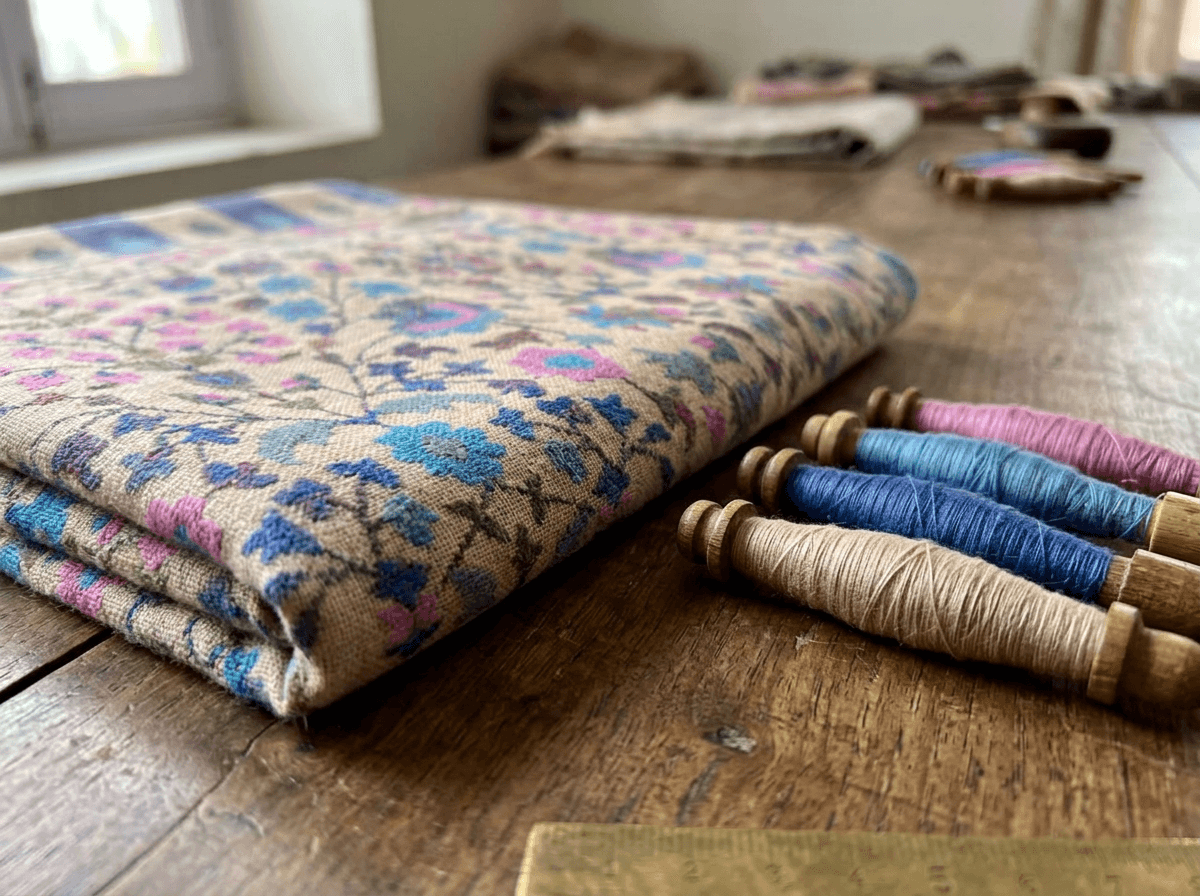
The first is woven in. On a handloom, the weaver raises and lowers the warp and passes the weft across. In the Kani technique the shuttle is replaced by a set of small wooden bobbins, each carrying a colour, inserted by hand around a counted number of warp threads; the pattern is built row by row from a written code. The Kani shawls woven on our looms carry their design in the structure of the cloth.
The second is embroidered on afterwards. Sozni is needlework worked onto a finished woven ground, with a fine couching stitch and a small vocabulary of supporting stitches. The cloth is woven first and decorated second, which means two artisans, two sets of hours and two opportunities for the work to be done well or badly. Our Sozni embroidery pages page describes the needle; our our craftsmanship pages page follows the whole sequence from fleece to finish.
A buyer who cannot tell woven pattern from embroidered pattern cannot judge the price of either. The reverse settles it: embroidery leaves a second surface of thread on the back, while a woven pattern shows the same colours on both faces.
What the GI protects, and what it does not
An origin mark is not a grade. It links a product to a place whose qualities or reputation are attributed to that origin, and handicrafts can be protected [6]. Kashmir Pashmina appears in the Indian registry as application 46, certificate 97, granted in 2008; renewal papers were filed in 2025 [1]. Kani and Sozni have their own entries.
The registered rule: pure pashm, no fibre coarser than 16 microns, hand-spun yarn, handwoven in Jammu and Kashmir [2]. A certified piece has been checked for content, diameter, twist and weave, and the testing body can identify the cloth it tested.
What the registration does not do is grade the shawl. It does not promise that the dye is lightfast, that the embroidery is fine, that the fringe is hand-twisted or that the piece will suit you. It is a threshold, not a ranking, and a certified shawl and an uncertified one can sit at very different points of quality on either side of it. We explain the certificate and its limits in more detail in our guide to the pashmina GI tag.
What pashmina is not
It is not merino, lambswool or any other sheep fibre, however soft the finish. Sheep wool is a different animal with a different fibre structure, and no finishing process turns it into pashm.
It is not viscose, rayon or a polyester microfleece. Those fibres can be spun fine and brushed soft, and they can be blended with a small proportion of pashm so that the label is technically honest while the cloth is mostly something else. Fibre content must be declared on wool products in the United States, and the word cashmere may only be used where the three-part test is met [4]; that is the lever a buyer has.
It is not shahtoosh. That fibre comes from the chiru, a high-altitude antelope, and it is a different animal with a different fleece; it is not a substitute for pashm and it is not something we sell.
It is not a brand, and there is no licensing body that owns the word. Nor is it a synonym for scarf. A scarf is a shape; pashmina is a material, and the two words answer different questions, which is why a guide to pashmina scarf, stole and shawl sizes is a separate subject from this one.
How to read a label
Start with the fibre content, in percentages. "100% pashmina" is a claim about the whole cloth; "pashmina blend" tells you that something else is present and usually declines to say how much. In the United States, the cashmere rules set the diameter test that any such claim has to meet [4].
Next, look for a method. A micron figure with no test behind it is marketing. A laboratory identifies and quantifies the fibre by light microscopy, following ISO 17751-1 [5], and that is the standard it would work to if a dispute arose. A seller who understands the number will usually know which method produced it.
Then the origin claim. If the piece is presented as Kashmir Pashmina, ask for the certificate number and check it against the registry record [1]. The certificate names a product and a holder, and it can be verified independently of the shop.
Finally, the process claims. Hand-spun and handwoven are testable, at least in the aggregate: twist direction for the yarn [2], and the structure of the cloth for the weave. None of this requires a laboratory in the shop. It requires a seller who is willing to show you the reverse, the selvedge and the paperwork, in that order.
If you are choosing a first piece and would rather ask questions than decode a label, write to us through where to buy. We would sooner describe a shawl's measurements, test and photographs of its reverse than have you guess.
Questions we are asked
What is pashmina compared with cashmere?
Pashmina is a cashmere, in the sense that it comes from the undercoat of a cashmere goat. The reverse is not true: cashmere on a label can come from any herd in any country, machine-spun and power-woven. The words overlap on fibre and separate on origin and process [2][3]. We set the two side by side in our pashmina vs cashmere comparison.
Is pashmina wool?
Not in the textile sense. Wool comes from sheep; pashm comes from a goat. Shops use "pashmina wool" as a convenience, and the phrase has no legal definition in the United States, where the cashmere rules apply instead [4].
Why does a cheap shawl say 100% pashmina?
Sometimes because the cloth is a blend that has not been declared, sometimes because it is a different fibre with a soft finish, and sometimes because the words "100% pashmina" are printed without any test behind them. Price is not proof either way, but a very low price and a very fine micron claim rarely travel together.
Can a laboratory tell pashmina from cashmere?
It can measure the fibre, identify the animal source and quantify a blend using light microscopy under ISO 17751-1 [5]. It can also read the twist direction of the yarn to distinguish hand-spun from machine-spun [2]. What it cannot do is tell you whether the shawl is beautiful.
Does a GI certificate mean the shawl is good?
It means the piece met a registered specification on fibre, fineness, spinning and place of weaving [2]. Quality within that specification still varies, and the certificate says nothing about design, colour or finishing.
If any of this leaves you with a question about a particular shawl, ask us before you buy it. We answer enquiries about single pieces, including the ones we did not make, through the same private enquiry route; a clear answer now is worth more to us than a sale you regret.
Sources
- Intellectual Property India, GI Registry. "Details — Kashmir Pashmina (GI Application 46)." https://search.ipindia.gov.in/GIRPublicSearch/Application/Details/46. Accessed 2026-11-07.
- Craft Development Institute, Srinagar. "Quality Manual for Enforcement of Kashmir Pashmina GI," updated 2023. http://iictsrinagarcarpet-gi.org/documents/Quality%20Manual%20Kashmir%20Pashmina%20Updated%202023.pdf. Accessed 2026-11-07.
- Cashmere and Camel Hair Manufacturers Institute. "Definition of Cashmere, Fine and Superfine Wool" (archived copy). https://web.archive.org/web/20240523004544/https://www.cashmere.org/definition-cashmere-wool.php. Accessed 2026-11-07.
- U.S. Federal Trade Commission. "16 CFR § 300.19 — Use of terms 'mohair' and 'cashmere'." https://www.law.cornell.edu/cfr/text/16/300.19. Accessed 2026-11-07.
- International Organization for Standardization. "ISO 17751-1:2023 — Quantitative analysis of cashmere, wool, other speciality animal fibres and their blends." https://www.iso.org/standard/83595.html. Accessed 2026-11-07.
- World Intellectual Property Organization. "Geographical Indications." https://www.wipo.int/geo_indications/en/. Accessed 2026-11-07.