Pashmina · 12 min read
Pashmina Shawl Size: Scarf, Stole and Wrap Dimensions
Pashmina shawl size explained: scarf, stole and wrap dimensions, how to measure, drape and choose the right piece for travel, weddings and daily wear.
By Timothy V. Manley
7 November 2026
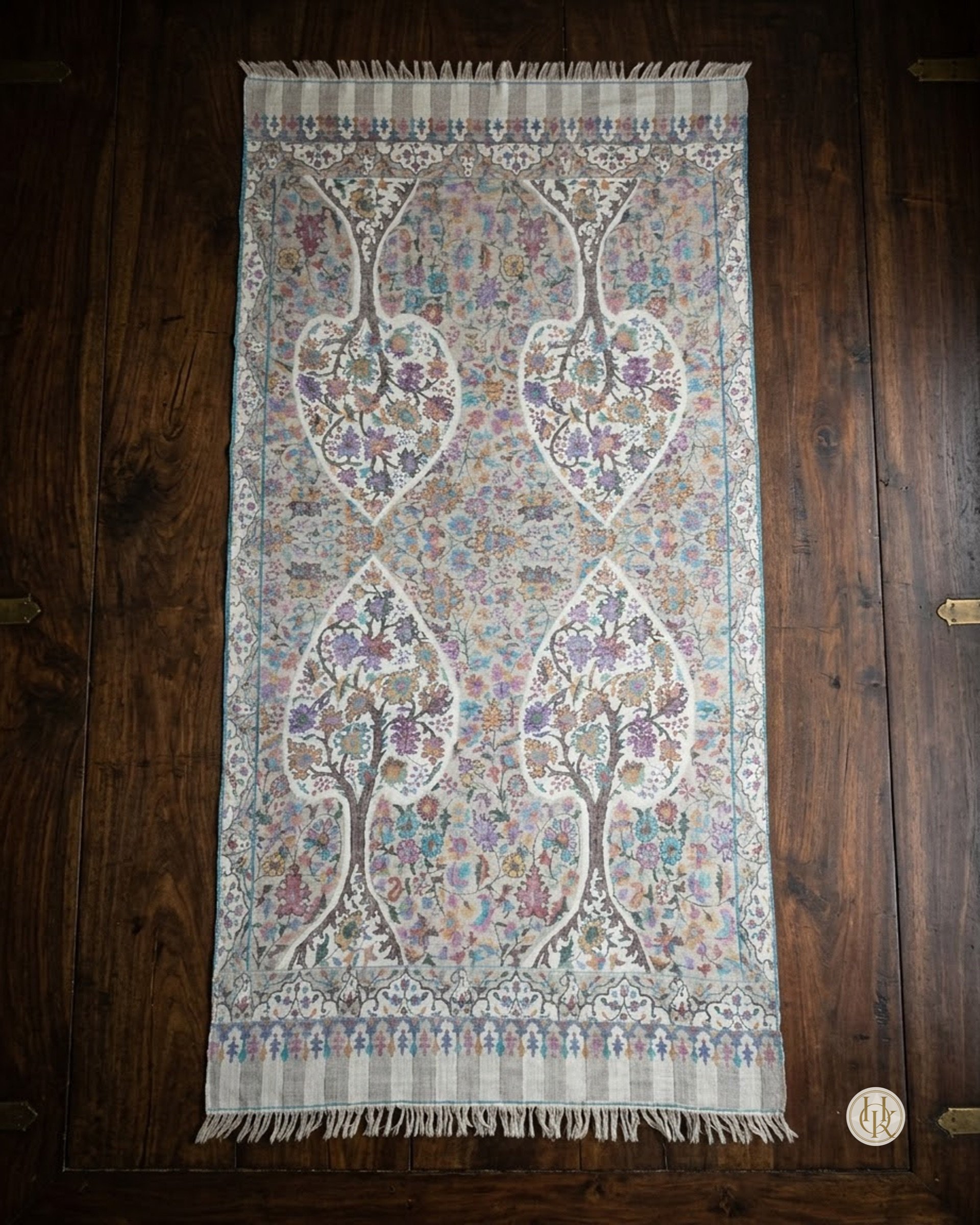
A pashmina scarf is narrow, a stole is long and moderately wide, a shawl is wider again and a wrap is the largest of the four. In our house the scarf is 45 × 180 cm, the stole 70 × 200 cm, the shawl 100 × 200 cm and the wrap 110 × 250 cm.
Those four words are used loosely in the trade, and the looseness costs buyers real money. The same 70 × 200 cm rectangle is sold as a scarf on one site, a stole on another and a shawl on a third. A piece described only as "one size" tells you nothing about whether it will cover a shoulder at a wedding or disappear under a coat collar. Measurements in centimetres and inches settle the question in a way that names do not.
This guide sets out what each word means, the measurements we cut to and label, how to measure a piece you already own, and which size suits which occasion. Other houses work to their own standards, and some of them differ from ours by a good margin. The numbers below are ours; the reasoning applies to any shawl you are considering.
Four names, one cloth
A scarf is the narrowest form. It is built to go round the neck or sit inside a coat, so width matters more than length: too wide and it bunches under a collar, too narrow and it will not fill the neckline. Most scarves sit between 30 and 50 cm across and between 170 and 200 cm long. A pure Pashmina shawl pages scarf is the same fibre as a larger piece, cut narrow.
A stole is the middle form, and the word has a specific history. It comes from the Latin stola by way of the long, narrow shoulder garment worn over a gown. In pashmina terms a stole is a long rectangle, wide enough to sit on both shoulders without slipping, and light enough to carry indoors. It is the piece most often worn to an office, a dinner or a ceremony where a coat would be too much.
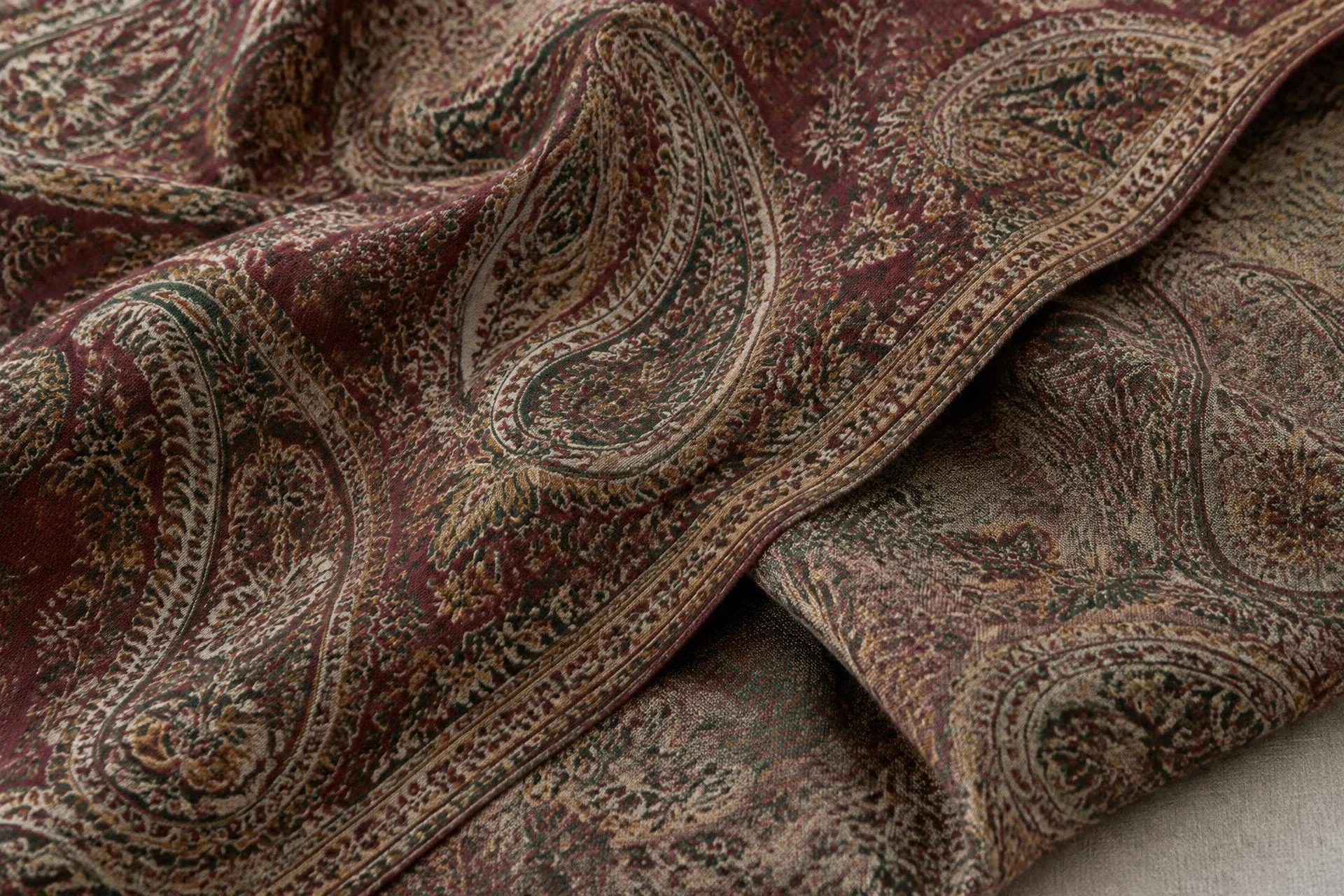
A shawl is larger in both directions. The historic Kashmir shawl was a substantial textile, and the Victoria and Albert Museum's record of a nineteenth-century example describes "a large shawl of woven goat-hair (pashmina)" in a 2x2 twill at 84 warps to the inch [3]. A modern shawl is usually a rectangle rather than a square, wide enough to cover the back and drape over both arms.
A wrap is the largest of the four, and the least defined. It is often wider than a shawl and sometimes longer, and it is designed to be wrapped around the body rather than simply laid on the shoulders. It is the piece that works as a blanket on a flight, a cover in a cold room and a layer over an evening dress.
All four can be the same cloth. The Kashmir Pashmina specification does not change with the size: pure pashm within the 16-micron ceiling, yarn spun by hand, and cloth woven by hand in Jammu and Kashmir [1]. For the fibre itself, see what is pashmina. A Kani piece adds the twill tapestry structure, with small eyeless bobbins replacing the shuttle and the weft interlocked at every colour join [2]. Size changes what the piece is for, not what it is.
What pashmina shawl size actually means
Size is a description of the woven cloth, not of the fringe and not of the box. When we quote a measurement, it is the flat rectangle from selvedge to selvedge and from the last pick of the weave to the first, with the fringe excluded. That convention matters, because a hand-twisted fringe can add several centimetres at each end, and a seller who measures the fringe as well is describing a longer piece than the one you will wear.
Piece · Our dimensions · Approximate inches · Works best for
Read the table as a set of trade-offs rather than a ladder. A wider piece covers more and weighs more; a longer piece drapes further and is more likely to trail. The finest cloth in the world will not behave like a shawl if it is cut 45 cm wide, and a heavy piece cut 110 cm wide can be too much for an indoor room. Weight for a given area follows fibre diameter, and pashmina sits at the fine end of the cashmere range that the CCMI caps at a mean of 19 microns [4].
The measurements above are also a house convention rather than an industry law. A 70 × 180 cm stole is common, and so is a 100 × 200 cm shawl cut slightly shorter. When you are comparing two pieces, compare the numbers, not the nouns. If a listing gives no measurements at all, ask; a seller who cannot answer is telling you something.
- Scarf Our dimensions: 45 × 180 cm; Approximate inches: 18 × 71 in; Works best for: Inside a coat collar, under a jacket, light neck warmth
- Stole Our dimensions: 70 × 200 cm; Approximate inches: 28 × 79 in; Works best for: Everyday shoulder wear, office, dinner, ceremony
- Shawl Our dimensions: 100 × 200 cm; Approximate inches: 39 × 79 in; Works best for: Weddings, full shoulder and back coverage, deep winter
- Wrap Our dimensions: 110 × 250 cm; Approximate inches: 43 × 98 in; Works best for: Travel, an oversized drape, an evening layer
How to measure a piece you already own
Lay the piece flat on a clean floor or a large table. Do not stretch it, and do not let it hang over an edge, because gravity adds length that is not in the cloth. Smooth it with the flat of your hand and let it settle.
Measure the width from selvedge to selvedge — the finished edges, not the fringe — and the length down the centre fold, again excluding the fringe. If you want the figure a shop would quote including the finish, measure to the tips of the fringe and say so, because a 200 cm shawl with a long twisted fringe can read as 210 cm or more.
Then measure corner to corner. No listing will give you the diagonal, but it is the number that predicts drape: a long, narrow stole has a long diagonal and will wrap, while a wide, short shawl has a shorter one and will sit. Finally, hold one end at your shoulder and let the rest fall. Where the cloth ends — elbow, wrist, hip — tells you more than any label.
Drape, height and shoulder line
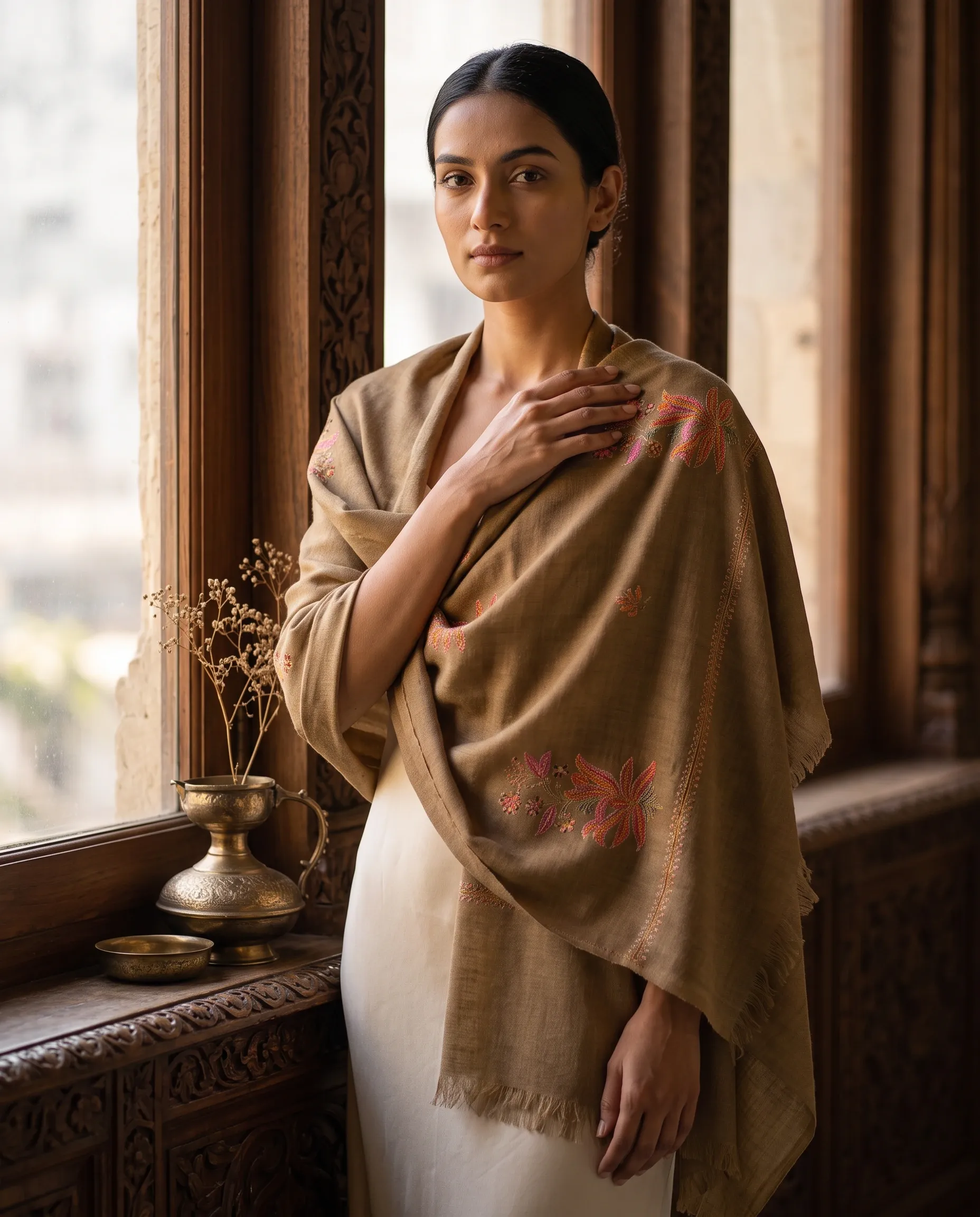
Width does the work in wear. A 45 cm scarf will sit inside a collar and nowhere else. A 70 cm stole can cover both shoulders if it is folded, but it will not stay there through a long ceremony without a pin. A 100 cm shawl covers the back and falls over the upper arms; a 110 cm wrap goes further still.
Height changes the arithmetic. On a shorter frame, a 100 × 200 cm shawl reaches further down the arm and can look generous rather than oversized; on a taller frame, the same piece reads as a neat shoulder cover. The usual mistake is buying for the body rather than for the use. A tall person who wants a scarf does not need a 100 cm width; a petite person who wants a wedding cover does not need less cloth than anyone else.
Shoulder line matters too. A sloping shoulder sheds a smooth stole; a squarer shoulder holds it. If the cloth will slide, the answer is more width or a different drape, not a tighter knot. The Kani shawl pages page explains how the patterned pieces are built, which affects how they fall, since a dense twill behaves differently from a plain weave of the same size.
Which size for which occasion
For a wedding, the usual choice is the 100 × 200 cm shawl or the 110 × 250 cm wrap. You want enough cloth to cover the shoulders through a ceremony and a dinner without constantly rearranging it, and enough length to drape over one arm when the room warms up. A stole works if the dress already has structure at the shoulder; a scarf does not.
For travel, the wrap earns its place. It is the piece that doubles as a blanket on a flight and a layer in a cold city, and the extra width is what makes that possible. A stole is the better choice if you want something that packs small and looks correct at a dinner; a scarf is the lightest option and the least useful as a cover. Our guide to the travel scarf guide sets out the packing logic.
For an office or a dinner indoors, the stole is the natural size. It sits on the shoulders while you work, it does not trail, and it folds into a bag without creasing badly. The 70 × 200 cm rectangle is also the most forgiving gift, because it suits almost any frame and any outfit.
For men, the same logic applies with less tolerance for volume. A 70 × 200 cm stole works as a scarf over a coat and as a shoulder layer in the evening; a 100 × 200 cm shawl is the better choice over a heavy overcoat or for a man who wants a proper cover. Narrow, short scarves with heavy fringing read as fashion accessories rather than as warmth. The pashmina shawl for men guide deals with proportion in more detail.
For daily wear, the scarf and the stole cover almost everything. If you own one piece only, a stole is the more versatile purchase: it is small enough for a commute and large enough for a cool evening.
Fringe, selvedge and the finishes that change the measurement
A fringe is not decoration added at the end; it is usually the warp threads themselves, twisted or knotted after the cloth comes off the loom. That is why the fringe on a handwoven pashmina can be long, deliberately uneven and slightly heavier than the body. It also means the fringe is structural: cutting it shortens the warp and can loosen the end of the weave.
There are three finishes you will meet. A hand-twisted fringe is the most labour-intensive and the most traditional. A self-fringe, where the warp is left loose and grouped, is lighter and less formal. A stitched or bound edge closes the end with thread, which is tidy but less forgiving if the stitching pulls.
The selvedge matters as much. A handwoven selvedge is slightly firmer than the body, and on a good piece it runs straight without puckering. If it waves, the weft tension was uneven; if it draws in, the cloth will narrow after a wash.
When you compare measurements, ask whether the figure includes the fringe. A seller who quotes 200 cm including a long fringe may be selling a piece whose woven body is 190 cm, and that difference shows at the shoulder.
What "one size" hides
"One size" is a merchandising phrase, not a measurement. It usually means the house makes a single length and trusts that most buyers will accept it. Sometimes that is honest and the piece is genuinely generous. Often it hides a 60 cm width that will not stay on a shoulder, or a 170 cm length that will not wrap.
The remedy is dull and effective: ask for the numbers in centimetres, ask whether the fringe is included, and compare them with a piece you already own. If you cannot get the numbers, look for a photograph of someone wearing the piece and note where the ends fall. That is an estimate, not a measurement.
Size is also not a proxy for quality. A large shawl made from short, coarse fibre is a large poor shawl. What makes a pashmina worth owning is the fibre diameter, the hand-spinning, the weave and the finishing, none of which is measured in centimetres. Size determines whether you will actually wear the piece, which is the only test that matters over years.
One last piece of arithmetic is worth doing before you choose. Take the width you are considering and fold it in half; that is roughly the depth of cloth that will sit on each shoulder. Then decide whether that depth is enough for the room you have in mind. It is a crude test and a useful one, and it is the reason we quote measurements rather than names. If you would like to see the four sizes side by side, or have a piece measured against one you already own, the house is happy to help by private enquiry service or by private client appointment.
Questions we are asked
What size pashmina shawl is best for a wedding?
A 100 × 200 cm shawl is the safe choice for a wedding: wide enough to cover the shoulders and back, long enough to drape over one arm. A 110 × 250 cm wrap is better for a winter wedding or a long evening, and a 70 × 200 cm stole suits a dress with structure at the shoulder.
Is a stole the same as a scarf?
No. A scarf is narrow, usually 30 to 50 cm wide, and is worn at the neck. A stole is wider, usually around 70 cm, and is worn on the shoulders. The words are used interchangeably in retail, which is why the measurements matter more than the label.
What size pashmina should a man choose?
A 70 × 200 cm stole is the usual choice: it works as a scarf over a coat and as a shoulder layer indoors. A 100 × 200 cm shawl suits a heavy overcoat or a man who wants full coverage. Avoid short, narrow scarves with heavy fringes, which sit badly over a lapel.
How do I measure a shawl I already own?
Lay it flat without stretching, measure selvedge to selvedge for the width, and measure the woven length down the centre fold. Note whether you are including the fringe. Measure the diagonal as well if you want to compare drape rather than area.
Does a bigger shawl mean better quality?
No. Size describes how much cloth there is; quality describes the fibre, the spinning, the weave and the finish. A large shawl can be coarsely woven and a small one can be impeccable. Judge the cloth first and the dimensions second.
Sources
- Craft Development Institute, Srinagar, "Quality Manual for Enforcement of Kashmir Pashmina GI", http://iictsrinagarcarpet-gi.org/documents/Quality%20Manual%20Kashmir%20Pashmina%20Updated%202023.pdf — Accessed 2026-11-07.
- Craft Development Institute, Srinagar, "Quality Manual for Enforcement of Kani Shawl GI", http://iictsrinagarcarpet-gi.org/documents/Quality%20Manual%20Kani%20Updated%202023.pdf — Accessed 2026-11-07.
- Victoria and Albert Museum, "Kashmir Shawl", https://collections.vam.ac.uk/item/O478533/kashmir-shawl — Accessed 2026-11-07.
- Cashmere and Camel Hair Manufacturers Institute, "CCMI Definition of Cashmere, Fine and Superfine Wool" (archived), https://web.archive.org/web/20240523004544/https://www.cashmere.org/definition-cashmere-wool.php — Accessed 2026-11-07.