Style · 13 min read
The Travel Scarf: Why a Pashmina Earns Its Place
The travel scarf that earns its place: how to choose a pashmina's size, colour and weight for flights, cold cities and desert nights.
By Timothy V. Manley
7 November 2026
A travel scarf earns its place by doing several jobs with one piece of cloth: a warm layer in a cold cabin, a cover in a cold city, a wrap for a cool evening and a folded cushion on a night flight. Choose a size you can both drape and pack, in a colour that survives photographs and repeated wear.
Most travel advice adds objects. This is an argument for subtracting one. A single fine shawl can replace the aeroplane blanket you would rather not use, the cardigan that only works indoors, the scarf that is too short to cover your shoulders and the wrap you would otherwise buy at the destination in a colour you do not want. The case for pashmina is not that it is luxurious. It is that the fibre gives a useful amount of warmth for very little weight and volume, which is the only currency that matters in a carry-on.
What follows is not a packing list. It is a way of choosing one piece for many trips, and of looking after it while you are away from the wardrobe and the ironing board.
What a travel scarf has to do
The demands of travel are unusually specific. A scarf worn at home sits still; a scarf worn travelling is crushed into a bag, wrapped around a neck, used as a pillow, dragged across a seat and washed in a hotel basin at midnight.
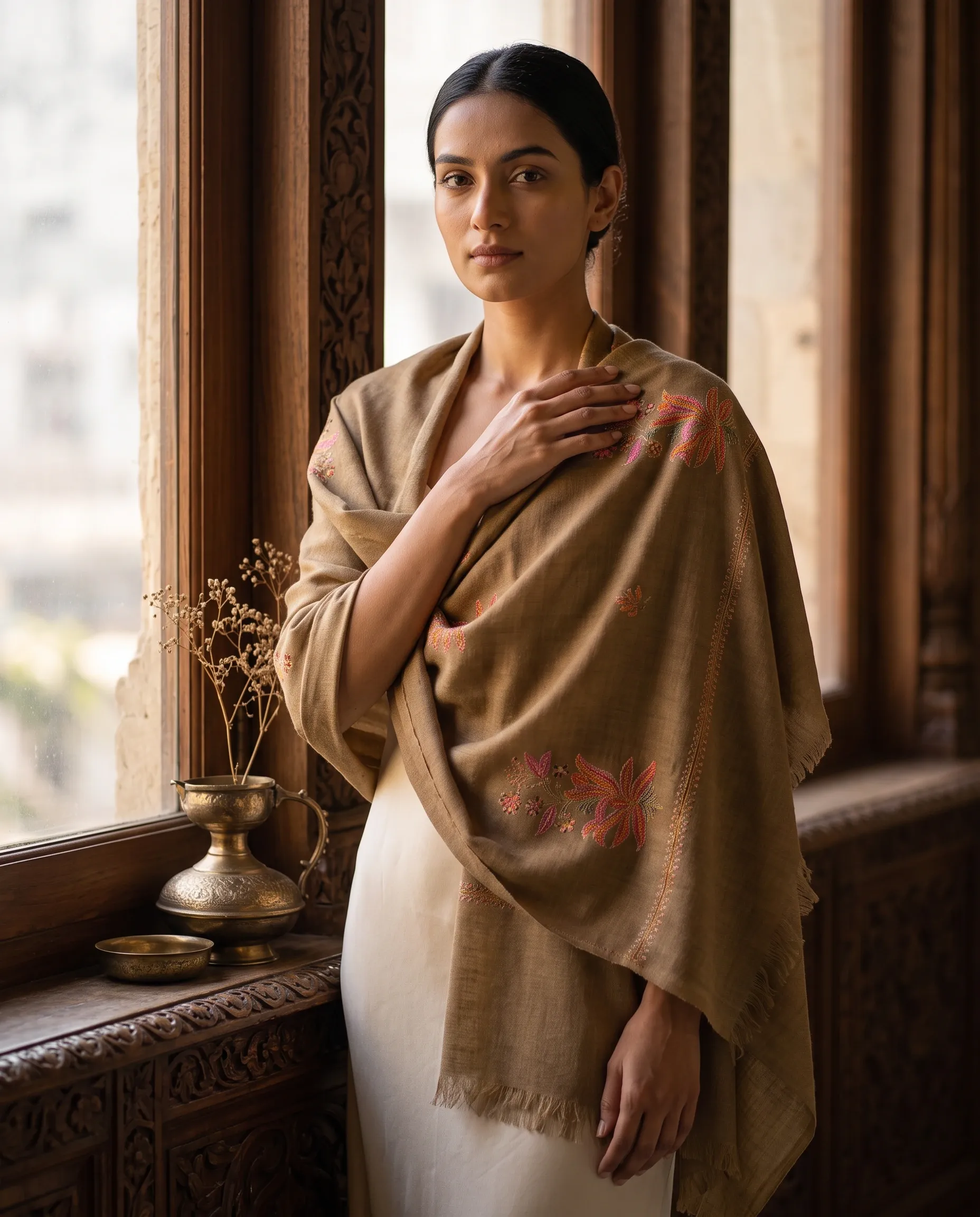
It has to work with the clothes you travelled in, not a wardrobe you left behind. That rules out shades that need a particular outfit and sizes that only work with a particular coat. The useful test is whether the piece can be worn three ways in one day: doubled at the neck in the morning, open over the shoulders in the afternoon, folded across the knees in the evening.
Finally, it has to pack small enough that you do not resent it. A heavy blanket shawl is wonderful at home and a nuisance in a case. The pieces that travel best are the ones you forget you packed until you need them.
Warmth without weight
The advantage of the pure pashmina shawls we weave is structural rather than magical. The fibre is fine: the Kashmir specification allows up to 16 microns, with hand-spun yarn and handweaving [2], while the cashmere family as a whole is defined by an average fibre diameter of 19 microns or less [1]. Fine fibre can be spun into a thin, dense cloth that traps still air close to the body without the bulk of a knitted wool scarf.
Still air is the insulator, not the fibre itself. A thin cloth works when it sits close to the skin or closes the gap at a collar; it works less well when it hangs loose in wind. That is why the same shawl can feel warm on a plane and cold on a street corner. The variable is not the shawl but the fit.
This also explains why a pashmina is a poor substitute for a coat and an excellent supplement to one. It adds a layer where a coat leaves a gap — at the neck, across the chest, over the shoulders when the coat is open — and it does so without adding bulk under a collar. Judged as a coat, it fails. Judged as the layer that makes a coat work, it earns its place.
Warmth depends on what you wear underneath, how tightly the shawl is wrapped, whether there is wind and how long you are outside. In our experience a fine, tightly woven cloth gives more warmth per gram than a coarser one of the same thickness, which is the property that makes it worth carrying.
Three settings: cabin, cold city, desert night
The cabin is the easiest case. Air conditioning keeps the aircraft cool and dry, and the blanket is often thin, missing or in a plastic bag you would rather not open. A shawl folded across the lap and shoulders does the work of a blanket without the space of one. On a night flight, a large shawl folded twice makes a passable cushion against a window.
A cold city is a different problem. Here the shawl is a layer rather than a cover: doubled at the neck under a coat, opened over the shoulders indoors, wrapped around the head when the wind turns. The size that works is the one that can be doubled without becoming a knot. A stole of roughly 70 by 200 centimetres doubles comfortably; a larger shawl is better worn open.
A desert evening is the third case, and the one travellers underestimate. The temperature falls quickly after sunset, the air is dry and the wind carries dust. A shawl is useful as a wrap, as a head cover and as something to sit on. In that setting, a mid-weight piece in a mid-tone is more practical than a pale or a very dark one, because dust shows on both extremes.
The table in the next section sets out a workable middle, and a piece chosen there will serve all three settings.
Size: what packs and what drapes
Size is the decision that determines everything else. A scarf is narrow and short, a stole is longer and wider, a shawl is wider again, and a wrap is usually the largest of the four. The differences sound trivial and are not: they change how the cloth drapes, how much of it there is to fold and whether it covers the shoulders when opened.
For travel, two sizes do most of the work. The first is the stole, around 70 by 200 centimetres, which packs into the corner of a case, doubles at the neck and works as a light blanket. The second is the shawl, closer to 100 by 200 centimetres, which is too much for a neck but excellent on a plane seat, over an evening dress or around the shoulders in a cold room. If you only own one, the stole is the more versatile object.
By light we mean a cloth that folds into a jacket pocket; by medium, one that fills a small cotton bag. The table below is a starting point rather than a rule, because the right piece depends on the coat you wear and the hours you spend outside.
Trip · Size · Weight · Colour
Width matters more than length for coverage, and length matters more for knotting. A long narrow piece can be wrapped three times and still look neat; a short wide piece cannot. Our guide to pashmina shawl size sets out the dimensions in centimetres and inches, with the trade-offs for each.
If you are choosing for a man's wardrobe, the same logic applies with a different default: the pashmina shawl for men guide recommends a stole for the neck and a larger shawl for the seat and the shoulders, in charcoal, navy or camel. Those three shades also travel well, because they hide the marks that handling leaves.
- Long-haul flight Size: 100 × 200 cm shawl; Weight: Light to medium; Colour: Slate or navy
- Cold city in winter Size: 70 × 200 cm stole; Weight: Medium, tightly woven; Colour: Charcoal or camel
- Desert or cool evening Size: 100 × 200 cm shawl; Weight: Light; Colour: Ivory or madder
- Multi-stop business trip Size: 70 × 200 cm stole; Weight: Light to medium; Colour: Mid-blue or taupe
- Warm-weather travel Size: 70 × 200 cm stole; Weight: Light; Colour: Undyed ivory
Colour that survives a trip
Travel is hard on pale cloth. Aircraft seats, taxi upholstery, restaurant chairs and luggage belts all leave marks, and a cream shawl that looks wonderful in a shop will look tired by the third day. This is not a reason to avoid pale shades; it is a reason to choose them for trips where the shawl will mostly be worn, not carried.
The most practical travel shades are mid-tones: taupe, camel, sage, slate and a mid-blue. They show less than ivory, they do not show lint like black, and they work with most of the clothes people actually pack. Navy and charcoal are the next best, with the caveat that both show dust and both read as black in photographs.
Two shades deserve special mention. Ivory is the most flattering in daylight and the least forgiving in a taxi. A deep madder or rust is warm, distinctive and good at hiding marks, but it limits what it can be worn with. If you travel with one piece, choose the mid-tone; if you travel with two, pair a mid-tone with an ivory for evenings.
Packing: fold, roll, compress
The way a shawl is packed determines how it looks on arrival. Fold it along its existing creases rather than across them, then roll it loosely from the fringe end. Rolling spreads the curve of the fold across the cloth instead of concentrating it on one line, which is why it produces fewer sharp creases than folding flat.
A breathable cotton bag is better than plastic. Plastic traps moisture and holds odour, and a shawl that has been worn in a warm cabin will arrive smelling of the bag rather than of nothing. If you use a packing cube, put the shawl on top rather than at the bottom, where the weight of everything else will press a fold into it.
Compression is useful and easy to overdo. A vacuum bag will flatten a shawl into a fraction of its volume and leave it looking like paper; the fibres recover, but the creases take longer than a hotel room allows. A light compression sack, or a rolled shawl secured with a soft band, is enough.
If you are choosing a piece from photographs rather than in person, buy pashmina online sets out what to ask for before you pay.
One habit is worth adopting: pack the shawl last, on top, and take it out first. It is the piece most likely to be needed during the journey, and the one least likely to be improved by an hour under a suitcase.
Creases, and how to recover them
A creased shawl is not damaged, only untidy, and most travel creases can be removed without an iron. Hang the piece in a bathroom while you shower: the steam relaxes the fibres and the weight of the cloth does the rest. Shake it out, hang it by two corners rather than one, and leave it overnight.
If a crease persists, steam it directly. Hold the iron an inch above the cloth and let the steam pass through, or use a steamer on the lowest setting, keeping it moving. Never press a pashmina flat with a hot iron: the fibre is fine, the weave is visible and a hard press will flatten both. If you must use an iron, put a clean cotton cloth between the soleplate and the shawl and work on the reverse.
A hotel towel can help. Lay the shawl flat on a dry towel, roll the towel and the shawl together loosely, and leave it for an hour. The towel draws out surface moisture and the roll removes the memory of the fold. This is also the gentlest way to dry a shawl that has been dampened by rain.
Do not pull a crease out by stretching the cloth; pulling distorts the weave and the selvedge, and the distortion does not come out with steam.
Care on the road
Travel care is mostly about doing less. A shawl does not need washing after every wear; airing it overnight is usually enough. When it does need washing, a basin of cool water and a pH-neutral detergent, a gentle press rather than a rub, and a flat dry away from heat will see it through. Hotel laundry is the riskiest option, because the process is unknown and the turnaround is fast.
Keep the piece away from velcro, zips and the metal fittings of bags, which catch and pull the weave. Fold it differently each night so that the same line does not take a set. If it gets wet, dry it flat and away from a radiator; direct heat is worse than damp.
Storage during a trip matters more than travellers expect. Moths and carpet beetles seek undisturbed, dark places, and a shawl left folded in a drawer for a week is exactly the habitat they look for [3]. Shake it out, air it and keep it in a cotton bag rather than at the bottom of a wardrobe in a hotel room.
The last piece of care is attention. A shawl that is checked at the end of each day — a quick look at the fringe, the selvedge and the fold lines — will last for years of travel, and the check takes less time than finding a replacement in an unfamiliar city.
If you are deciding between sizes for a trip, we are glad to talk it through with the coat and the case in front of you; a private client appointment appointment can be arranged online or in Srinagar. You can see what we hold by enquiry through where to buy.
Questions we are asked
Can I use a pashmina as a blanket on a plane?
Yes, and it is one of the best uses for a large shawl. Fold it across the lap and shoulders rather than wrapping it tightly, and keep the fringe away from the seat mechanism. A 100 by 200 centimetre shawl covers the shoulders and the lap, and packs into a fraction of the space a blanket takes.
Will it crease in a suitcase?
It will take a fold, not a permanent crease. Roll the shawl rather than folding it flat, put it on top of the packing, and hang it in steam on arrival.
Is a pashmina warm enough for a cold city?
As a layer, yes; as a coat, no. It works best doubled at the neck under a coat, or opened over the shoulders indoors. In wind, wrap it closely rather than leaving it loose, because a shawl warms by trapping still air close to the body.
What size packs best?
A stole of about 70 by 200 centimetres is the easiest piece to travel with: it packs small, doubles at the neck and covers the shoulders when opened. A larger shawl is better for flights and evenings but takes more space.
Can I wash it in a hotel room?
You can, with cool water, a mild detergent and a flat place to dry. The risk is the drying, not the washing: a shawl left hanging over a chair will stretch, and one left near a radiator will dry too fast. Roll it in a towel, then lay it flat.
Sources
- Cashmere and Camel Hair Manufacturers Institute, "CCMI Definition of Cashmere, Fine and Superfine Wool" — Accessed 2026-11-07.
- Craft Development Institute, Srinagar, "Quality Manual for Enforcement of Kashmir Pashmina GI" — Accessed 2026-11-07.
- Canadian Conservation Institute, "Caring for textiles and costumes" — Accessed 2026-11-07.