Style · 12 min read
How to Wear a Pashmina Shawl: A Guide for Men
Pashmina shawl for men: sizes, colours and four ways to wear one over a coat, with a suit or as a travel wrap, plus what to check before buying.
By Timothy V. Manley
7 November 2026
A pashmina shawl for men is a question of width and length before it is a question of style. A stole of about 70 by 200 cm works as a scarf under a coat collar; a shawl of about 100 by 200 cm is what you need when the cloth itself has to be the outer layer.
Most advice for men and scarves is about knots. That advice belongs to neckerchiefs and to the narrow woollen scarf, and it is the wrong starting point for a piece of cloth this size. A shawl is worn by drape: it hangs from the shoulders, it follows the line of a coat, and it stays where it is put because the cloth has enough surface and enough weight to hold itself. Get the dimensions right and the wearing takes care of itself.
This guide covers the two sizes we make, the four ways we see them worn, the colours that earn their place and the mistakes that make a good shawl look like a costume. It assumes you already know what the fibre is; if not, our what is pashmina reference is the place to start.
Stole or shawl: what changes for a man
The words describe size rather than gender, and the trade uses them loosely. In practice, a stole is the long, relatively narrow piece — the one you can wrap twice and still have tails — and a shawl is the wider, squarer-feeling cloth that covers the shoulders.
For a man, the distinction has one practical consequence. A narrow piece worn as a scarf sits inside the coat, filling the V of the lapel and keeping the wind off the neck. A wide piece worn as a wrap sits outside the coat, over the shoulders, and does the work of a topcoat in the interval between a car and a door.
Both are legitimate. What does not work is trying to make one do the other's job. A narrow stole spread over the shoulders will slide and look mean; a wide shawl bundled twice around the neck will sit like a cushion under the chin.
If you wear tailoring most days, the stole is the more useful purchase, because it disappears into the coat and can be worn indoors over a jacket without looking theatrical. If you travel, or if you spend winter evenings outdoors, the shawl earns its place.
Measurements that matter
Two numbers govern everything: the width and the length. The quality manual that accompanies the Kashmir Pashmina registration lists labelled lengths by product, at roughly 106 inches for a gents shawl, 81 inches for a ladies shawl and for a stole, 72 inches for a muffler and 45 inches for a scarf [1]. In metric terms that is about 269 cm, 206 cm, 183 cm and 114 cm respectively.
Those are traditional trade lengths rather than a rule, and our own pieces are made to two house measurements: a stole at about 70 by 200 cm and a shawl at about 100 by 200 cm. Both sit near the traditional stole length of about 81 inches (206 cm) and are shorter than the traditional 106-inch gents shawl; they differ mainly in width.
Width is what you feel. A 70 cm stole folded lengthways gives a scarf of about 35 cm, which fills a coat collar without bunching. A 100 cm shawl folded in half gives 50 cm of coverage across the back, enough to sit on the shoulders without slipping.
Height changes the arithmetic. A taller man can carry the larger shawl without it swamping him, because there is more shoulder and more coat for the cloth to fall against. A shorter man will usually find the stole more proportionate, and the larger shawl better used as a blanket than as a drape. The old trade lengths were not designed around modern sizing, which is why a measurement in centimetres is more useful than the name on the label.
Length is what you see. At 200 cm a stole can go once around the neck and still hang to the waist, which is the proportion most men want with an overcoat. Shorter pieces end above the belt and look mean; much longer pieces need a second wrap, which adds bulk at the throat.
The fringe matters less than the internet suggests, but it does affect length. A hand-twisted fringe adds a few centimetres at each end and gives the piece weight, which helps it hang. A cut edge is lighter and will curl.
If you already own a shawl and are unsure what you have, measure it flat, without stretching, from fringe to fringe and across the middle. Our guide to pashmina scarf, stole and shawl sizes gives the full set of definitions and a method for measuring.
Four ways men wear a pashmina shawl
There are more than four, and most of the rest are variations. These are the ones that work with the coats men actually own.
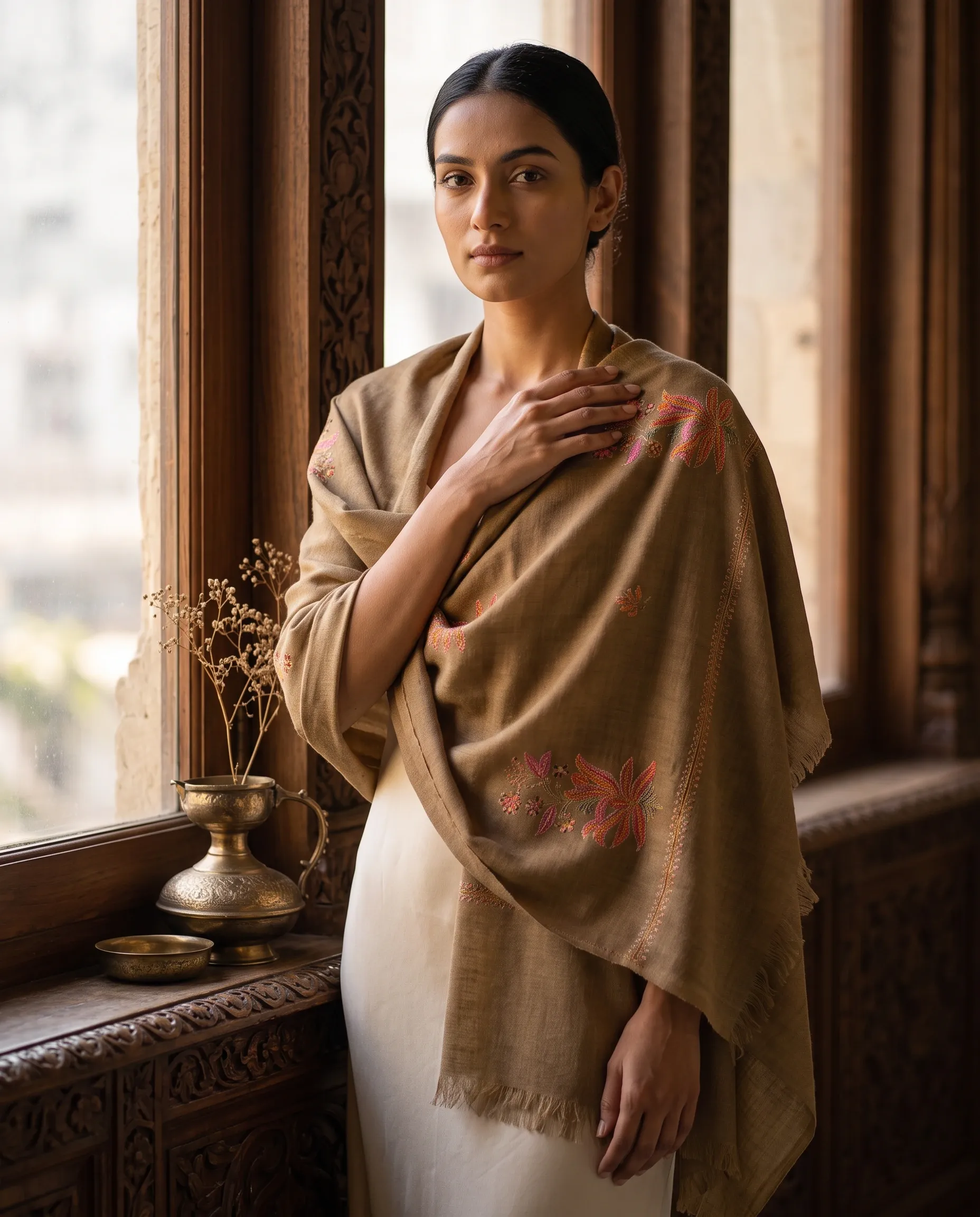
The overcoat drape. Fold the shawl in half lengthways so it forms a wide band, place the fold at the back of the neck and let the two ends fall down the front of the coat, one on each side. No knot, no tuck. The cloth should sit on the shoulders and cover the lapel line. This is the wear for a 100 by 200 cm shawl and a single-breasted overcoat, and it is the one that reads as evening.
The once-around. Fold the stole lengthways to a width of about 30 cm, put it behind the neck, cross the ends once at the front and let them hang. The crossing should sit low, near the sternum, not under the chin. This is the everyday wear for a 70 by 200 cm stole and any coat, and it works over a suit jacket indoors.
The travel blanket. Unfolded across the shoulders or the lap, the large shawl is a blanket that weighs almost nothing. On a flight it replaces the synthetic throw; in a cold station it goes over the coat. This is the wear that justifies the larger size for anyone who travels.
The evening shoulder. Over a dinner jacket or a dark suit, the shawl goes across the back with the ends falling loosely in front, not wrapped and not knotted. The cloth does the work; the wearer does nothing. It is the least practical and the most effective of the four, and it needs a plain shawl rather than a patterned one.
Wear · Size · Coat type · Formality
- Overcoat drape Size: 100 by 200 cm; Coat type: Single-breasted overcoat, trench, chesterfield; Formality: Business to evening
- Once-around Size: 70 by 200 cm; Coat type: Any coat, or a suit jacket indoors; Formality: Everyday
- Travel blanket Size: 100 by 200 cm; Coat type: None, or over whatever you are wearing; Formality: None
- Evening shoulder Size: 100 by 200 cm; Coat type: Dinner jacket or dark suit; Formality: Evening
A shortlist of five colours
Most men need one shawl rather than a collection, which makes the colour decision the important one. These five cover almost every case.
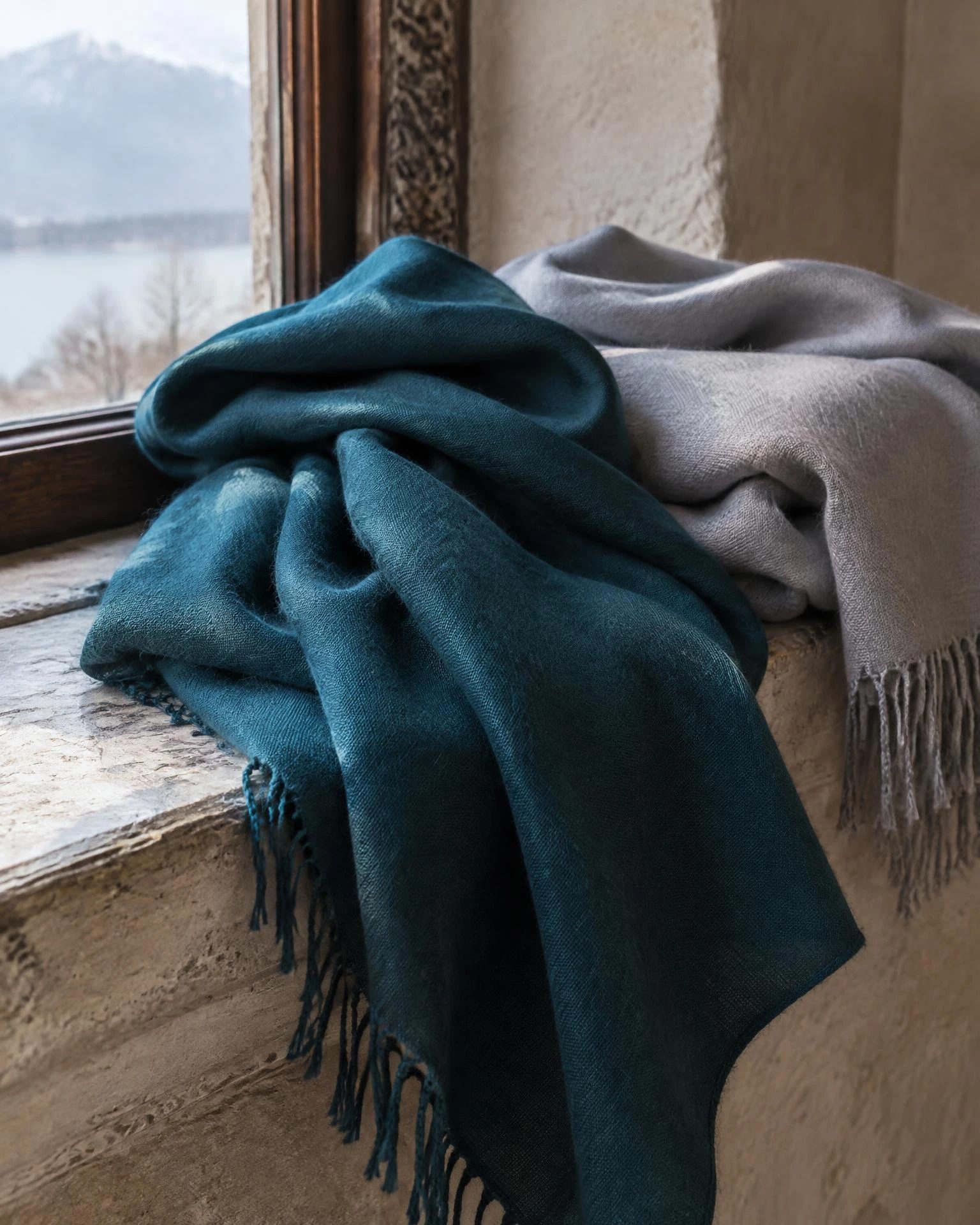
Charcoal is the safest and the most useful. It reads as an extension of a grey or navy coat, it does not show the marks that a commute puts on a shawl, and it works with black without matching it.
Navy is the dressier choice and the one that flatters most complexions. It sits well with camel, grey and olive coats, and it is the colour we recommend to anyone who wears a navy suit and wants one piece for both.
Camel is the warmest-looking and the hardest to keep clean. It lifts a dark coat and looks deliberate in a way that grey does not. It marks at the collar and at the fold, so it suits a wearer who rotates pieces rather than one who owns a single shawl.
Ivory is the most striking and the least forgiving. Against a dark overcoat it is the best of the five in a photograph and the worst on a wet Tuesday. It also shows collar soil, which means it needs cleaning more often than the fibre would otherwise require.
Black is the evening answer. A black shawl over a black coat can look like a uniform; worn with charcoal or grey it looks considered. It is also the colour most likely to show light surface fluff, which brushes off.
If you want one piece and one only, charcoal or navy. If you want a second for evenings, black. If you want a gift for a man whose wardrobe you do not know, charcoal.
What to avoid
The first mistake is the short fringed scarf. A narrow neck scarf of 30 cm or so is a different garment with a different job; it cannot fill a coat opening and it cannot sit on the shoulders. Buying one because it is described as pashmina is a way of spending money on the wrong object.
The second is the tight knot over a lapel. A knot pulls the shawl into a rope, crushes the collar of the jacket underneath and leaves a crease that takes a day to hang out. If the shawl will not stay put without a knot, it is too narrow or too light for the coat.
The third is volume under a padded coat. A large shawl over a puffer or a parka adds bulk exactly where the coat is already thick, and the result is a silhouette with no neck. With technical outerwear, wear the stole inside the collar instead.
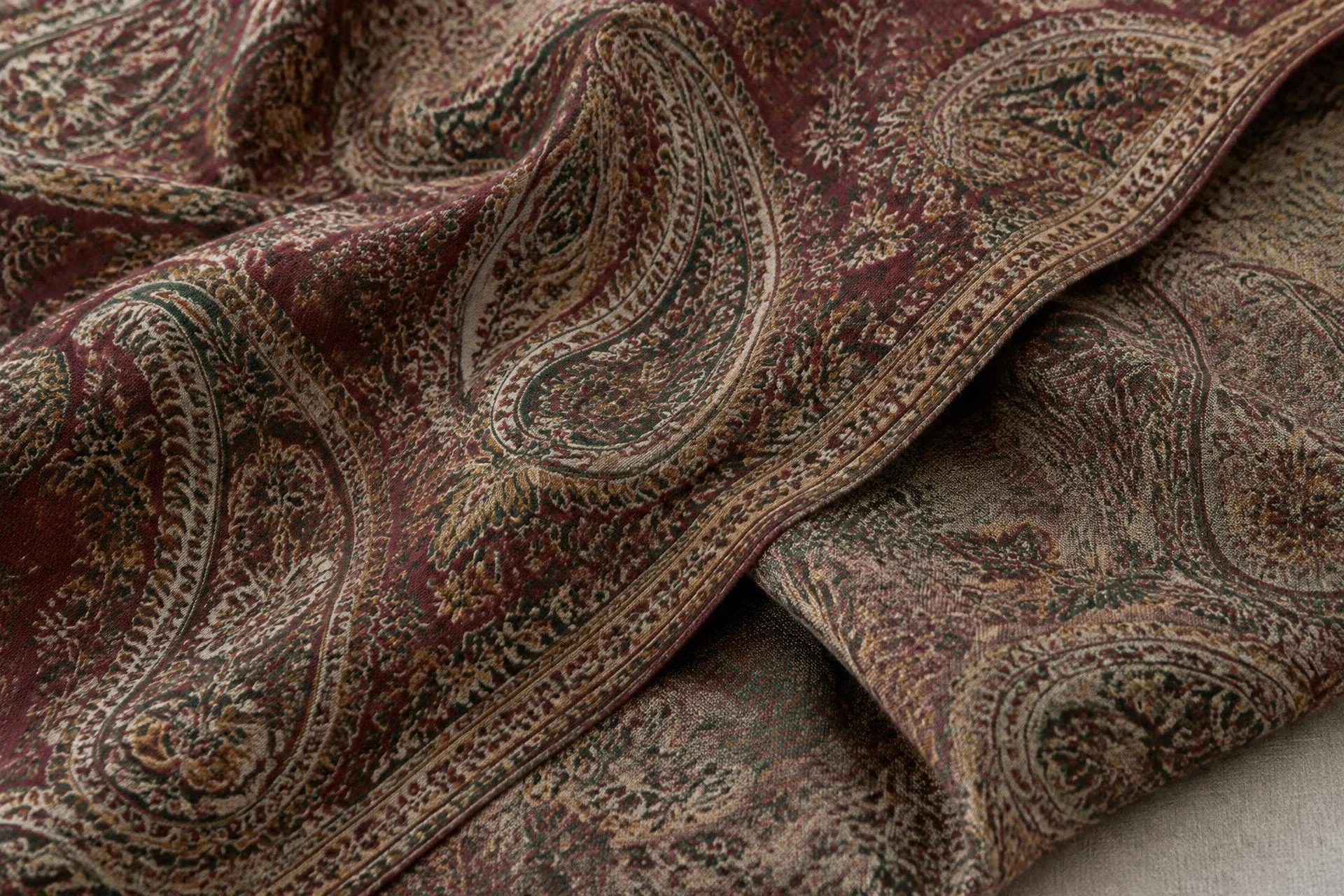
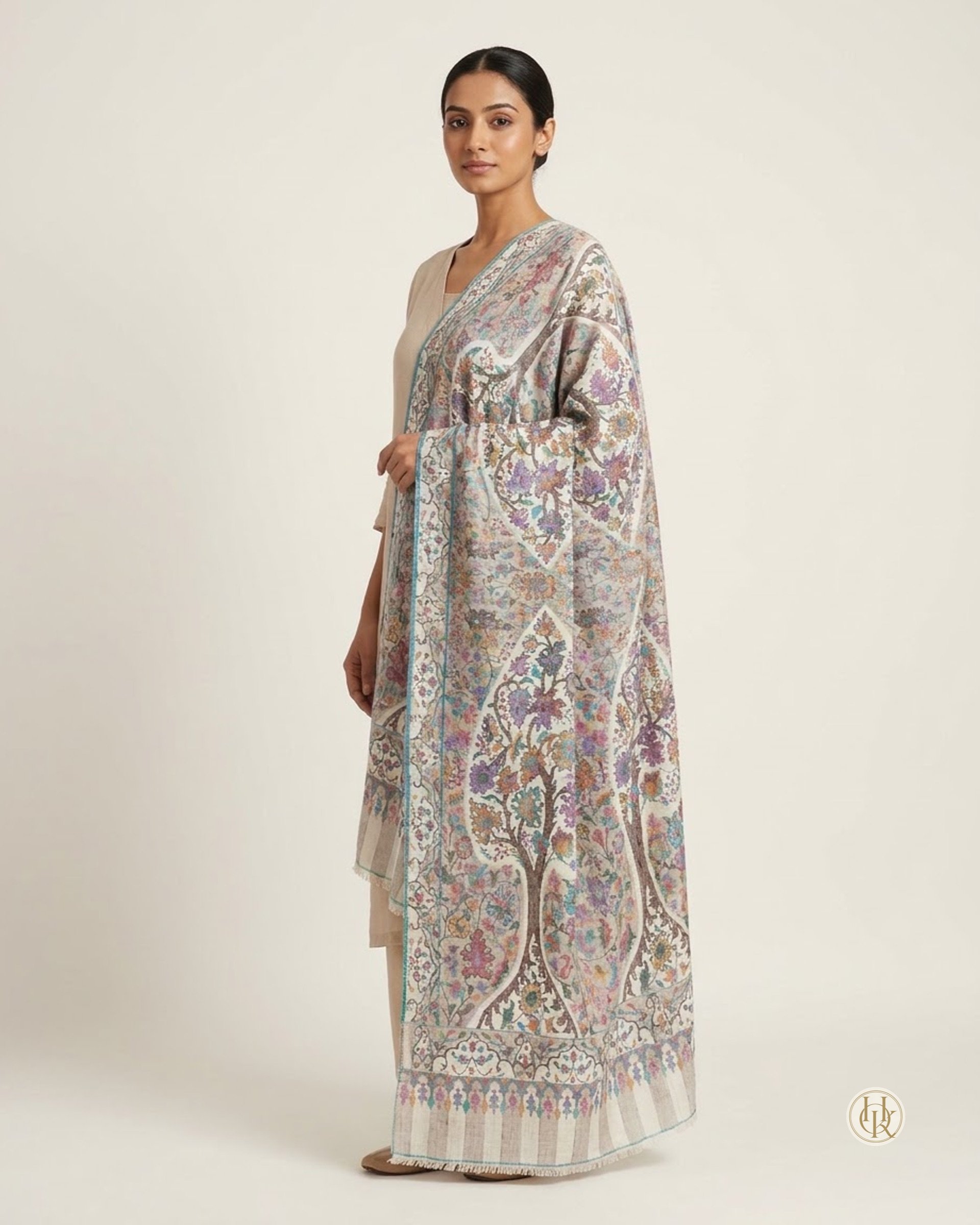
The fourth is pattern without a reason. A Kani or Sozni shawl is a beautiful object and a demanding one; it wants a plain coat, a plain shirt and a reason to be worn. Our Kani weaving pages page shows what the woven patterns look like at their best. If your wardrobe is already busy, a solid colour will be worn far more often.
Care, packing and travel
A shawl worn over a coat picks up less soil than one worn against the neck, and it needs washing less often than people expect. Air it after wearing, fold it loosely and keep it out of direct sun.
Fold rather than hang. A fine shawl on a hanger takes the shape of the hanger at the shoulders and stretches at the fold. If you must hang it, use a wide padded hanger and only for a night.
For travel, fold along the length, then in three, and put it in a jacket pocket or the top of a bag. Creases from folding fall out within an hour of wearing, particularly in a warm room; a hanging in a steamy bathroom does the rest. Do not iron it flat with a hot iron, which flattens the weave and leaves a sheen.
The fibre itself is a cashmere, defined by the diameter of the undercoat rather than by the name on the label; the international definition sets a mean of no more than 19 microns with a limit on coarse fibres [2]. That is why a good shawl is warm for its weight, and why it should not be packed against abrasive things like zip pulls and keys.
If you travel often, our piece on the pashmina travel wrap covers the packing logic in more detail, including what to do about creases and cabin air.
If you are choosing a first men's shawl and would like to see the two sizes side by side, our pure Pashmina pages page shows the current pieces; ask us through where to buy for photographs against a measure, so the difference between 70 and 100 cm is visible before you decide.
Questions we are asked
Is a pashmina shawl too formal for everyday wear?
No, provided the colour is quiet and the size suits the coat. A charcoal stole with a wool overcoat is less formal than a scarf with a logo on it. Formality comes from the shine of the cloth and the pattern, not from the fibre.
Can a man wear a pashmina with a suit and no coat?
Yes, indoors and in transit. A 70 by 200 cm stole over a suit jacket, worn once around and low, works in a cold office or a station. The larger shawl over a suit reads as evening wear and is too much for a working day.
What is the difference between a men's pashmina and a women's one?
Size, usually. Kashmir Pashmina is a registered geographical indication [3], and nothing in its registered specification distinguishes by gender [1]. A gents shawl is traditionally longer — about 106 inches against about 81 for a ladies shawl [1] — and often wider.
How warm is a pashmina compared with a woollen scarf?
Warmer for its weight, and much lighter. A fine shawl traps air in the weave and blocks wind better than a loose knit, which is why it works as a layer under a coat rather than as a bulky outer scarf.
Will a light-coloured shawl show dirt quickly?
Ivory and camel show collar soil sooner than charcoal or navy, and they need more frequent cleaning. If you wear a shawl daily, choose a mid-tone and keep the pale piece for occasions.
If you are still deciding between the two sizes, tell us the coat you wear most and the climate you live in, and we will answer with the measurement and the weight we would choose. The private enquiry route reaches the house directly, and we answer questions about a single piece as readily as about an order.
Sources
- Craft Development Institute, Srinagar. "Quality Manual for Enforcement of Kashmir Pashmina GI," updated 2023. http://iictsrinagarcarpet-gi.org/documents/Quality%20Manual%20Kashmir%20Pashmina%20Updated%202023.pdf. Accessed 2026-11-07.
- Cashmere and Camel Hair Manufacturers Institute. "Definition of Cashmere, Fine and Superfine Wool" (archived copy). https://web.archive.org/web/20240523004544/https://www.cashmere.org/definition-cashmere-wool.php. Accessed 2026-11-07.
- Intellectual Property India, GI Registry. "Details — Kashmir Pashmina (GI Application 46)." https://search.ipindia.gov.in/GIRPublicSearch/Application/Details/46. Accessed 2026-11-07.