
Sozni Embroidery
The Needle Remembers the Garden.
Fine hand embroidery on woven Pashmina — a separate craft from Kani, with its own grammar, its own time and its own GI.
What Is Sozni?
Embroidery, Not Weaving.
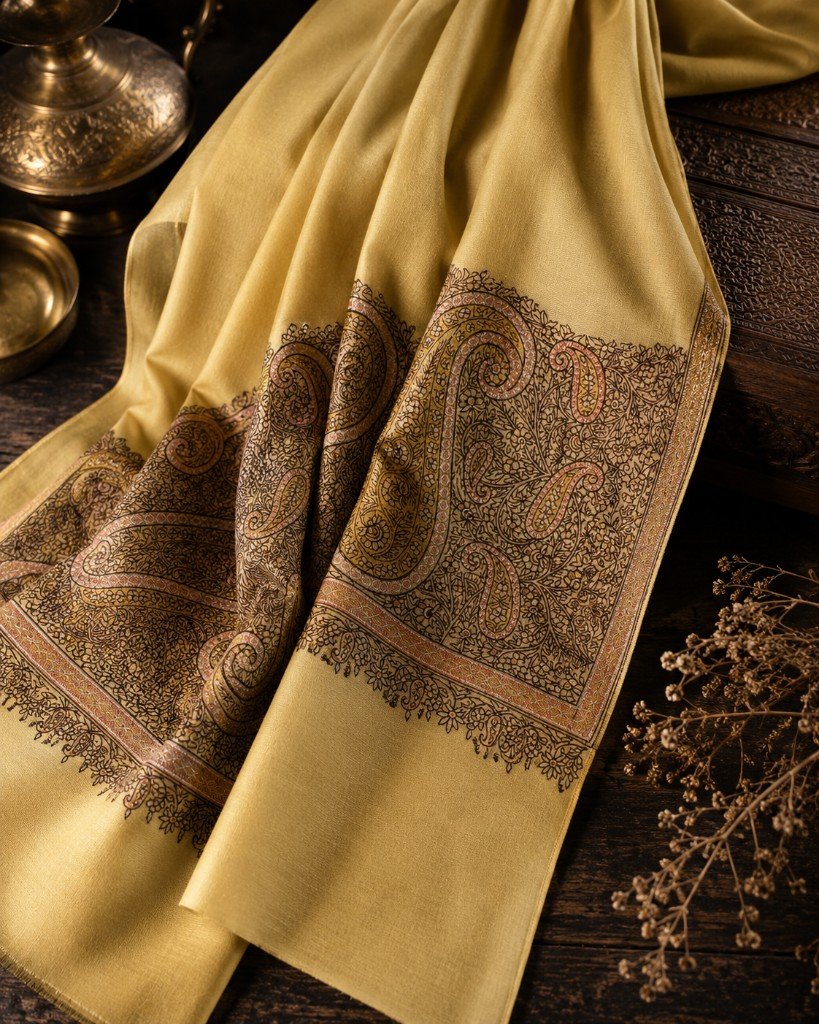
Sozni is the fine hand embroidery of Kashmir. It is worked on a woven Pashmina ground, after the cloth has left the loom. A sozankar draws the motif with a needle and fine silk or viscose thread: a border, a scattered buti, a field of vines or a surface covered edge to edge. The pattern sits on the cloth rather than inside it.
That distinction matters. Kani is woven; Sozni is embroidered. The two are often confused in the market, but they demand different skills and are protected by separate Geographical Indications. The Craft Development Institute in Srinagar records Kashmir Sozni as GI No. 48.
I
The design
A naqash draws the motif — a border, a scattered buti, a field of vines or an all-over composition. The drawing is the architecture the embroiderer will follow.
II
The tracing
The design is transferred onto the woven Pashmina. On a fine piece the lines must be faint enough to disappear under the needle and precise enough to keep the repeat true.
III
The stitching
The sozankar works the motif by hand with silk or viscose thread. The sozni stitch, darn stitch and stem stitch do most of the work; buttonhole, herringbone, chain, satin and knot stitches appear in smaller proportions.
IV
The finishing
The embroidered cloth is cleaned, pressed and checked. The reverse is inspected as closely as the front: it shows whether the work is hand-done and how carefully the threads have been carried.
The Hand
A Stitch Small Enough to Disappear.
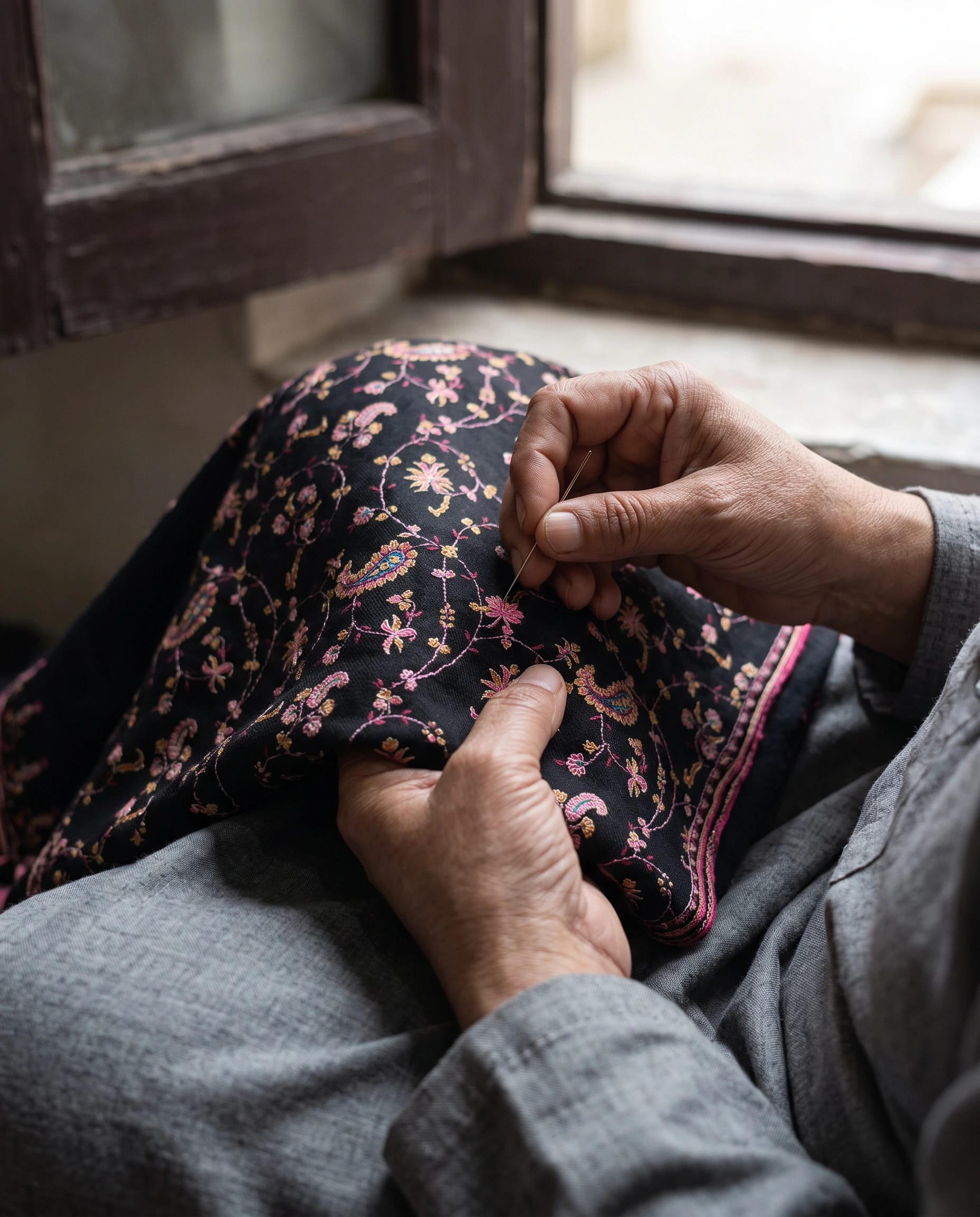
The finest Sozni is known as maheen kari — “fine work”. The thread is very thin, the stitches are tiny, and the motif is built slowly. At a distance the embroidery reads as a change in the surface of the cloth; close up, it resolves into thousands of decisions.
The sozni stitch, darn stitch and stem stitch do most of the work. Buttonhole, herringbone, chain, satin and knot stitches appear in smaller proportions, chosen for a particular line, leaf or flower.
Hand or Machine?
How to Recognise Hand-Worked Sozni.
Machine embroidery has made “Sozni-style” work common. These signs point to the real thing.
01
Look at the reverse
Hand embroidery shows small, slightly uneven stitches on the back. Machine work is regular to the point of monotony, and may show long floating threads.
02
Read the stitch
Fine Sozni is worked with very thin thread and tiny stitches. The motif should have a slight living variation, not the dead uniformity of a printed or machine-embroidered pattern.
03
Ask about the GI
Kashmir Sozni is a registered Geographical Indication (GI No. 48). A GI label is issued after testing in Srinagar, and carries a unique code. We arrange GI certification on request.
04
Know the motifs
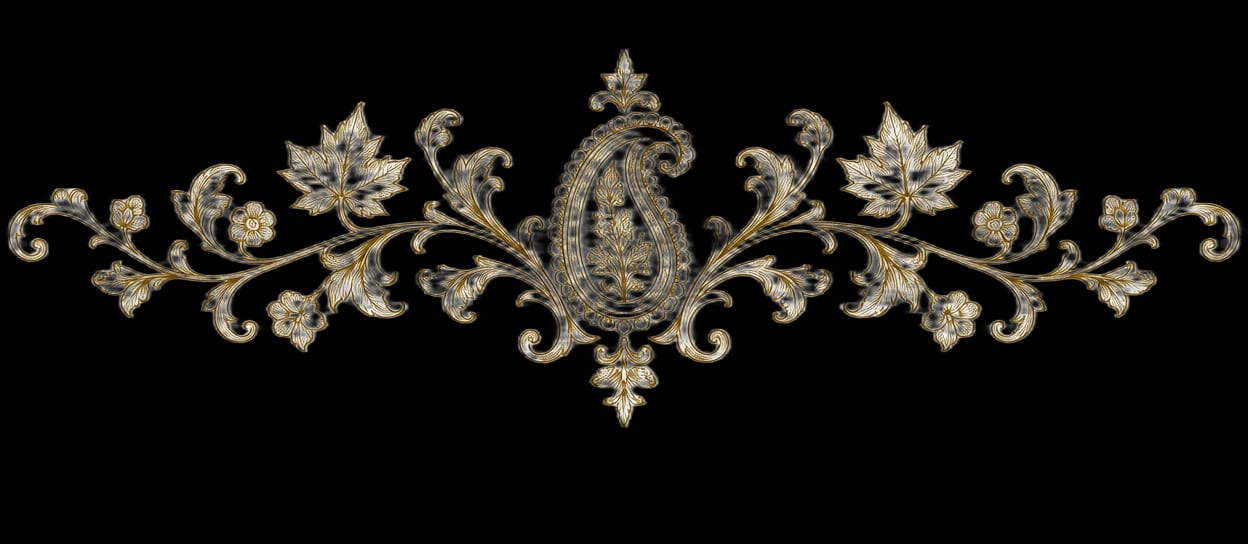
The established vocabulary includes the chinar leaf, cypress, almond, vine and flower. A good piece uses them with rhythm and space, not as a repeating wallpaper.
The Motif
The Garden, Worked in Thread.
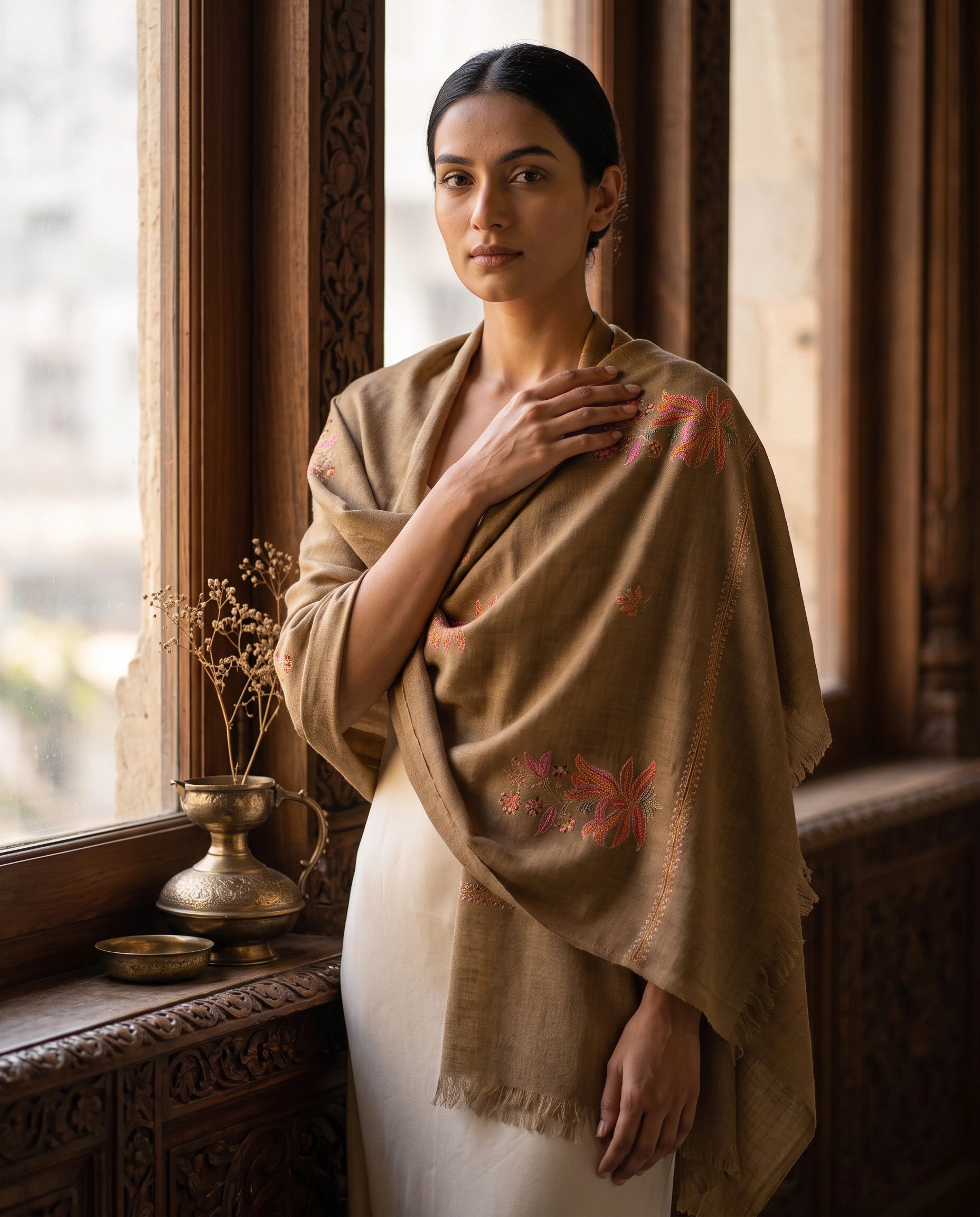
Sozni draws on the same visual world as Kani: the chinar leaf, the cypress, the almond, the vine and the flower. The difference is the hand. A woven motif is built into the structure of the cloth; an embroidered motif sits on its surface, catching the light differently as the shawl moves.
The best pieces leave space around the motif. Embroidery is not a wallpaper; it is a composition, and the ground is part of the design.
Common Questions
Sozni, Plainly.
Is Sozni the same as Kani?
No. Kani is woven: the pattern is formed on the loom with small wooden bobbins and a coded talim. Sozni is embroidered after the cloth is woven, with a needle and fine thread. They are separate crafts with separate GI registrations.
What is maheen kari?
Maheen kari means “fine work” in Kashmir. It describes the finest grade of Sozni, worked with very thin thread and tiny stitches. A densely worked maheen kari piece can take months to complete.
How long does Sozni take?
A narrow border can be worked in weeks. A scattered motif takes longer. An all-over composition, especially in fine maheen kari, can occupy an embroiderer for months. The time is part of what the piece costs.
How should I care for a Sozni shawl?
Dry clean only, with a cleaner who handles fine wool and embroidery. Store it folded in a cotton or muslin cover, away from direct sun, and air it between wears. Do not hang it for long periods; the weight can distort the cloth.
Does Sozni have GI protection?
Yes. Kashmir Sozni has its own Geographical Indication, No. 48, separate from Kashmir Pashmina and Kani. The Craft Development Institute in Srinagar publishes the registered specification and the testing process.
A woven pattern is built into the cloth. An embroidered pattern is a conversation between the cloth and the hand.