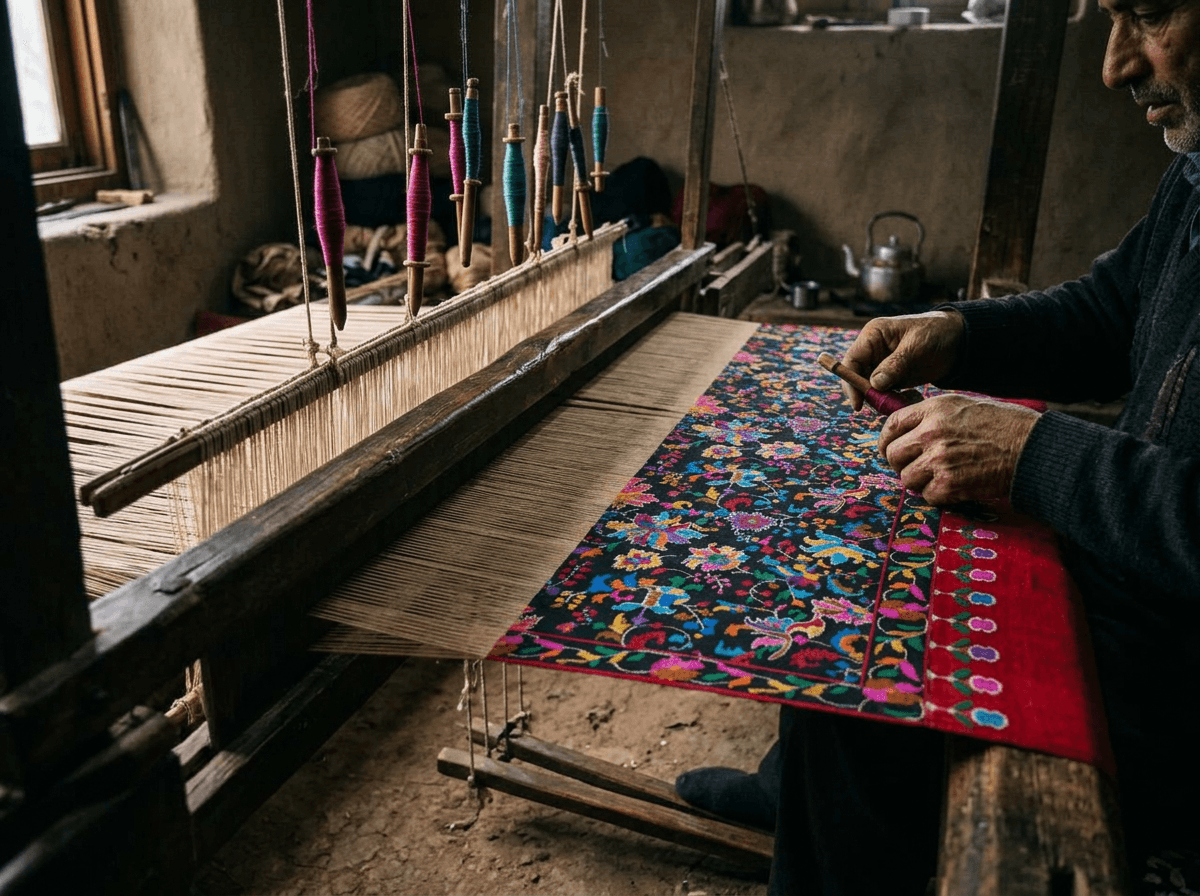
Pashmina · 13 min read
The GI Tag on Kashmir Pashmina: What It Certifies
The pashmina GI tag is not a quality score. What the Kashmir Pashmina, Kani and Sozni registrations protect, and how to check a certificate.
By Timothy V. Manley
7 November 2026
A pashmina GI tag is a statement about where and how a shawl was made. It certifies that the piece meets the registered Kashmir Pashmina specification — pure pashm, yarn spun by hand, cloth woven by hand in Kashmir — and it does not grade the fineness within that range, the finish, the colour or the skill of a particular weaver.
Most buyers meet the tag at the end of a shop conversation, when a certificate is laid on the counter beside a folded shawl. The certificate is treated as a verdict: this piece is genuine, that one is not. The reality is narrower and more useful. A geographical indication protects a definition, and a definition can be examined. Once you know what the registration covers, the useful question stops being whether a shawl is certified and becomes which registration, under which number, tested when, and by whom.
That distinction matters most in Srinagar. Anyone buying a pashmina shawl in Srinagar will meet the tag within an hour, and a certificate can be printed by anyone. It matters just as much abroad, where a buyer sees a photograph of a certificate rather than the document. This guide sets out what the Indian registrations actually protect, how the fibre is tested, what a label cannot tell you, and how to check one without a laboratory of your own.
What a geographical indication actually is
The World Intellectual Property Organization lists geographical indications among the ways a product's origin can be protected, alongside their use for agricultural products, foodstuffs, wine and spirit drinks, handicrafts and industrial products [1]. A woven shawl is a handicraft, which is why the mechanism applies to cloth at all. A geographical indication identifies goods from a place whose qualities or reputation are tied to that origin.
Two consequences follow. The first is that a GI belongs to a place and its producers rather than to a single company. It is not a trademark owned by one workshop and licensed at will. The second is that the indication is tied to a written specification. Registration is not a compliment paid to a craft; it is a document that says what the product must be, and testing exists to check whether a sample meets it.
In India, each registration is recorded with an application number, a certificate number and a validity date [2]. Those three details, rather than the design on the label, are what a buyer can verify.
The three Kashmir registrations
Three registrations cover the shawl crafts of the valley. Kashmir Pashmina was filed in December 2005 and certified as certificate 97 in September 2008 [2]. The Kani Shawl was filed in February 2006 and certified as certificate 83 in November 2008 [3]. Kashmir Sozani Craft was filed in January 2006 and certified as certificate 98 in November 2008 [4]. All three name the same applicant, TAHAFUZ, which is the registered holder rather than a retail brand.
The three are not interchangeable, and this is where most confusion begins. One protects a cloth, one protects a woven technique and its product, and one protects an embroidery craft. A single shawl can sit inside two of them at once — a Kani shawl woven from pashm, for example — but a label usually names only the registration the seller has chosen to invoke.
Registration · Product · Core criteria · What it does not prove
Read the table from the right-hand column. Each registration is a limit on what can be claimed, not an endorsement of everything the piece happens to be.
- Kashmir Pashmina (46/97) Product: Shawl cloth; Core criteria: Pure pashm, 16-micron ceiling, hand-spun yarn, handwoven in J&K [5]; What it does not prove: Fineness below the ceiling, finish, colour or design
- Kani Shawl (51/83) Product: Woven patterned shawl; Core criteria: Handwoven with kani bobbins in place of a shuttle, twill weave with interlocked wefts, woven from talim instructions [6]; What it does not prove: Yarn count, dye quality or the identity of the specific piece
- Kashmir Sozani (48/98) Product: Needlework; Core criteria: The embroidery craft itself [4]; What it does not prove: The fibre or quality of the cloth beneath the needlework
What the pashmina GI tag requires
The registered specification for Kashmir Pashmina has four working parts. The cloth must be pure pashm, taken from the under fleece of Capra hircus, with a fineness ceiling of 16 microns; it must be woven by hand in Jammu and Kashmir, from yarn that was spun by hand [5].
Take the clauses in turn. "Pure pashm" excludes silk, viscose, acrylic and sheep's wool, which are the fibres most often blended into shawls sold as pashmina. The 16-micron figure is a ceiling rather than a target. A shawl measured at 12 microns and a shawl measured at 15.5 microns can both comply, so the certificate does not tell you which of the two you are holding. That is the single most common misreading of the tag: buyers assume the registration certifies the finest possible fibre, when it certifies a boundary.
"Handwoven by artisans of Jammu and Kashmir" ties the cloth to a place and a process. A machine-woven shawl cannot meet the specification however fine its yarn, because the loom is part of the definition. "Hand-spun" is the clause with the most practical force, because hand spinning leaves a measurable signature in the yarn.
The word itself is older than the registration and means less on a label than buyers expect; our guide to what is pashmina sets out the definition clause by clause. Put together, the four clauses describe authenticity rather than excellence. They answer the question "is this the thing the word claims?" and leave open the question "is it a good example of the thing?" Those are different questions, and a buyer needs both answers.
How a shawl is tested
The Craft Development Institute in Srinagar publishes the enforcement manual that sets out how the Kashmir Pashmina specification is checked. Four instruments do most of the work: a microscope, an optical fibre diameter analyser, a twist tester and a pick glass [5].
Microscopy identifies the fibre. Under magnification, goat cashmere has a characteristic scale pattern and a fine, usually non-medullated structure, which is how a laboratory distinguishes pashm from sheep's wool, silk or a synthetic blend. The fibre diameter analyser then measures the distribution of thickness across a sample, which is how a 14-micron claim is tested rather than believed.
The twist tester settles the spinning question: yarn spun by hand generally twists one way (S) and yarn spun by machine the other (Z), so twist direction is evidence of which process made it [5]. The pick glass counts ends and picks per inch, which is how the density and structure of the weave are recorded.
The manual matters because it shows the test is specific. A test report can tell you that a sample is goat fibre, that its mean diameter sits under the registered ceiling, that the yarn was hand-spun and that the cloth has a particular sett. It cannot tell you whether the embroidery is finely worked, whether the dye will hold its colour, or whether the piece in the shop window is the piece that was tested.
A certificate attaches to a tested sample or a described product, not to every shawl that later leaves the same workshop.
What the label does not prove
A GI label is not a quality score. It does not rank one certified shawl above another, because the registration contains no ranking to rank with. Two pieces can both comply while differing in handle, finish, design and the months of work in them.
It does not prove that the shawl in front of you is the shawl described. Labels and certificates can be photographed, copied and reprinted. The number on the paper is only useful if someone checks it against the registry and against the piece.
It does not certify the cloth under a Sozni label. The third registration covers the Sozani craft — the needlework — rather than the fabric it is worked on [4]. A shawl can carry honestly certified embroidery on a base cloth that is not pure pashmina, and the certificate would still be accurate about the embroidery. Read the two claims separately.
It says nothing about fibres outside pashm, including the shahtoosh shawl, which belongs to a different material and a different legal regime.
It does not last forever without renewal. The registry record for Kashmir Pashmina shows a registration valid up to 08-12-2025, with renewal details filed on 30-06-2025 [2]. That filing is evidence that renewal was in hand; it is not a substitute for checking the current entry. The Kani record runs to 12-02-2036 and the Sozani record to 18-01-2036 [3][4]. A certificate quoted in 2026 should therefore be read with its dates, not as a permanent fact.
How to verify a certificate
Verification is a sequence of small checks, and each one is cheap.
Start with the paper. A usable certificate carries the application number, the certificate number, the registered product name, the holder and the validity date. If any of those is missing, the document is decorative rather than evidential.
Then match the description. The certificate should describe the piece closely enough to be identifiable — fibre content, dimensions, structure, and where relevant the design. A certificate that could describe any shawl in the shop describes none of them.
Ask who tested the piece and when, and ask for the report reference. A test report is a different document from a registration certificate, and the second does not imply the first. In our experience, a workshop that has paid for testing knows exactly which laboratory did it and can produce the paperwork without a telephone call.
Check the registry entry against the numbers you have been given [2]. Where a validity date has passed, ask for the renewal record rather than accepting the old certificate. The Pashmina entry is the one to watch here, because its recorded validity date fell in December 2025 and the renewal filing is dated June 2025 [2].
Finally, look at the cloth. Certification is a claim about process, and process leaves traces: the reverse of a handwoven shawl, the direction of the twist at a cut fringe, the slight irregularity of a hand-spun weft. A certificate that agrees with those traces is worth more than one that does not.
If you are comparing a certificate with the cloth itself and want a second pair of eyes on the paperwork, we are glad to go through a specific piece with you during a private client appointment appointment, document by document.
Where enforcement stops, and what to do instead
A registration does not inspect the shelf it sits on. Enforcement needs a complainant, a sample, a laboratory and the will to pursue a case, and the rights holder or an authorised user is usually the party who must act. Testing costs money; a single disputed shawl rarely justifies it. That is one reason a certificate is not the end of the story in a market where the registration is well known.
For a buyer, the practical response is to use the tag as one strong signal among several rather than as a verdict. The registration tells you what the word is supposed to mean. The weave, the reverse, the finish, the hand-feel and the price logic tell you how well this particular piece lives up to it. Our own pure pashmina shawls are sold with that conversation attached, because a certificate on its own has never been enough to judge a shawl.
None of this makes the tag weak. It makes it precise. A GI answers a question about origin and process that no amount of marketing language can answer, and it does so in a form that can be checked by anyone with the numbers. Treat the pashmina GI tag as the beginning of an inspection, not the end of one, and it becomes the most useful document in the shop.
The same logic applies to the other registrations. A certificate for a handwoven Kani shawl speaks to the loom and the talim; a piece of Sozni embroidery work speaks to the needle. Neither speaks to the other. When a seller offers one document as proof of everything, the useful reply is to ask which registration it is, and to read the specification for that registration before the piece is folded back into its box. If you would like to see how we match paperwork to a particular shawl, the pieces we hold can be seen by appointment; ask about a piece.
Questions we are asked
Does a GI tag mean the shawl is better quality?
No. The registration certifies that a piece meets a written specification for fibre, fineness ceiling, spinning and weaving by hand [5]. It contains no ranking, so it cannot say whether one compliant shawl is finer than another. Quality within the specification is judged by the cloth itself: the evenness of the weave, the finish of the edges, the drape and the work in any embroidery.
Is every genuine pashmina shawl certified?
No. The registry records registrations, not individual shawls, and certification is a separate step from weaving [2]. Plenty of honest handwoven shawls are sold without a certificate, and plenty of certificates are quoted for pieces they do not describe. A missing certificate is a reason to look harder, not proof of a blend.
Can a GI label be copied?
A printed label can be copied as easily as any other printed object. What cannot be copied is the registry entry behind it. Check the application and certificate numbers against the record, confirm the validity date, and match the description to the piece [2][3][4]. A copied label usually fails one of those three checks.
Does the GI cover machine-woven shawls?
No. The Kashmir Pashmina specification requires handwoven cloth and hand-spun yarn [5], so a machine-woven piece cannot comply however fine its fibre. The Kani registration is likewise built around handweaving with kani bobbins and a written talim [6].
How long does the registration last?
The registry lists validity dates rather than indefinite protection. Kashmir Pashmina is recorded as valid up to 08-12-2025, with renewal details filed on 30-06-2025 [2]; Kani runs to 12-02-2036 and Sozani to 18-01-2036 [3][4]. Check the current entry at the time you buy rather than relying on a date printed years earlier.
Sources
- World Intellectual Property Organization, "Geographical Indications" — Accessed 2026-11-07.
- Intellectual Property India, GI Registry, "Details — Kashmir Pashmina (GI Application 46)" — Accessed 2026-11-07.
- Intellectual Property India, GI Registry, "Details — Kani Shawl (GI Application 51)" — Accessed 2026-11-07.
- Intellectual Property India, GI Registry, "Details — Kashmir Sozani Craft (GI Application 48)" — Accessed 2026-11-07.
- Craft Development Institute, Srinagar, "Quality Manual for Enforcement of Kashmir Pashmina GI", updated 2023 — Accessed 2026-11-07.
- Craft Development Institute, Srinagar, "Quality Manual for Enforcement of Kani Shawl GI", updated 2023 — Accessed 2026-11-07.