Kashmir · 13 min read
Where to Buy a Pashmina Shawl in Srinagar: A Local Guide
Where to buy a pashmina shawl in Srinagar: the market, the workshops, the GI label and the questions that separate a real shawl from a convincing blend.
By Timothy V. Manley
7 November 2026
Pashmina in Srinagar is bought in three kinds of place: the state emporia, the family workshops and the retail boulevards. Each can sell you a genuine shawl, and each can sell you a blend. Ask to see the reverse, ask for the GI certificate, and judge the cloth before the price.
The city has been a textile market for longer than any of its shops have existed. Shawls were made here for courts and for export when the boulevards were orchards, and the trade has survived wars, borders and floods. What survives is a way of selling built on conversation: cloth is unfolded on a counter, you ask questions, and the price arrives at the end.
For a visitor, that is either the pleasure of the place or the difficulty of it. This guide is written from inside the market. We are a family house in Hazratbal with our own looms, and we buy and sell in the same city. What follows is how we would advise a friend to spend a day.
Three routes to a pashmina shawl in Srinagar
The state emporia are the simplest introduction: fixed prices, a receipt, and a range that runs from inexpensive souvenirs to serious shawls. For a first visit, and for anyone who does not want to negotiate, they remove the awkwardness. The trade-off is a broad range sold by staff who sell rather than weave, so you get an honest label more often than an education.
The family workshops are where the cloth is made. Some run from the same house as the loom; others are a shop in front and a workshop behind. The best show you the reverse without being asked, explain the difference between a plain weave and a Kani, and quote a price that reflects labour rather than footfall. They are also the hardest to find.
The retail boulevards — the roads around Dal Gate, Lal Chowk and Polo View — are the commercial middle: large showrooms, smaller shops, fixed prices and negotiable ones, and wide variation in what is on the shelf. This is where most visitors buy, and where most bad purchases happen, not because the shops are dishonest but because the volume is high and the questions are rarely asked.
In our experience, the route matters less than the questions. A fixed-price emporium with a good buyer can beat a workshop with a poor one, and a boulevard showroom with a certificate and a straight reverse is a better buy than a charming shop with neither.
What each route can and cannot prove
Route · What it can prove · Price level · Experience
No route proves authenticity on its own. A receipt proves a transaction happened, not that the shawl is 100% pashm. A loom in the back proves someone weaves there, not that the piece in your hand came off it. A certificate proves what it says, which is why the next two sections deal with the reverse and the label.
- State emporium What it can prove: A receipt, a fixed price, a stated fibre content; Price level: Middle to high; Experience: Calm, unhurried, little technical detail
- Family workshop What it can prove: The loom, the maker, the reverse of the cloth; Price level: Wide, often the best value at the top; Experience: Conversational, slow, sometimes improvised
- Retail boulevard What it can prove: A wide choice, a visible address, a return if the shop is established; Price level: Low to high, negotiable; Experience: Busy, persuasive, variable quality
How to inspect a pashmina shawl in Srinagar
The reverse is the most useful thing you can look at, and asking for it is a normal request rather than an accusation. Say that you would like to see the back of the piece. A shop that handles real pashmina will turn it over without hesitation.
On a plain piece, the back should mirror the front, with the weave a little looser: even tension, no long floats of yarn across the back, no machine stitching at the edges. On a Kani the reverse is where the work shows — colour joins appear as a mosaic of interlocked wefts, and the back of a handwoven piece is rarely as tidy as the front. On a Sozni shawl the embroidery should pass through the cloth rather than sit on it.
Ask what the piece is. A seller who says "pashmina" to everything is not distinguishing between 100% pashm, a wool blend, a viscose mix and a machine-made imitation, and that distinction is the whole purchase. Our guide to what is pashmina sets out the fibre; in a shop the question is simpler: what percentage of this cloth is pashm, and how do you know?
Then ask to see the same design at two prices. The difference is usually the fibre and the handwork, and a seller who can explain it is worth staying with. If the answer is "better quality" with no detail, you have learned what you needed to know.
The GI label, and what it answers
Kashmir Pashmina holds GI registration 46, certificate 97, granted in 2008 [2]. Kani (application 51, certificate 83) and Sozni (application 48, certificate 98) are separately registered, which matters because a shawl can be genuine pashmina without being a Kani [5]. A geographical indication identifies goods whose quality or reputation is attributable to a place, and handicrafts fall within its scope [4].
The registered specification is specific: 100% pashm no coarser than 16 microns, taken from the goat's under fleece, handwoven in Jammu and Kashmir from yarn spun by hand [3]. Testing examines the fibre under microscopy, measures diameter distribution, uses a twist tester to separate the S twist of hand-spun yarn from the Z twist of machine-spun yarn, and counts threads with a pick glass [3].
What the label does not do is grade the piece. A certificate says the shawl meets the origin and process specification; it does not say the weaving is beautiful, the dye even or the embroidery fine. Two certified shawls can differ widely in handwork and price. Treat it as a floor, not a ceiling.
Ask to see the certificate for the piece in your hand, not for the shop, and check that the description matches what you are being sold. The registry record shows a renewal filing in 2025, so if a certificate is old, ask whether it is current rather than assuming [2]. If a shop cannot produce one but insists the shawl is GI-certified, that is a claim without evidence. Our article on the pashmina gi tag explains what certification covers.
How price is built here
Price in Srinagar is a stack of labours, and each one is visible if you ask.
The fibre is the floor. Pashm is combed from the undercoat of the Changthangi goat on the high plateau and dehaired by hand, and the yield is small against the raw fleece. Spinning is slow: a fine yarn is spun on a traditional spindle, with a twist light enough to keep the cloth soft and strong enough to weave. Weaving sets the calendar. A plain shawl can take weeks; a Kani, where each colour is laid in with a small wooden bobbin, can take months. Embroidery is a second labour bill, and a densely worked Sozni piece can carry more hours in the needle than in the loom. Then come finishing, testing, the certificate, rent and staff.
That is why a price quoted per piece is more honest than a price per gram. Two shawls of the same weight can differ by a factor of several because one is plain and one is Kani. When a price seems low, the question is not whether the seller is generous; it is which of these labours has been removed. The answer is usually the fibre, the spinning, or both. The cheap end of the market is cheap for a reason you can usually find by looking at the reverse.
Bargaining, and the questions worth asking
Bargaining is normal in the boulevards and unusual in the emporia. In our experience the first price is an opening, the second is a real number, and the third is close to the floor. The mistake visitors make is to bargain hard on a piece they have not examined, which rewards the shopkeeper who started high and will meet you anywhere.
Ask your questions first, agree what the piece is, then discuss the price. If the answers change when you ask for a discount — the fibre becomes "a blend, but very fine", the Kani becomes "Kani-style" — you have your answer.
A short list of questions that separate a good shop from a convincing one:
That last question is the one that changes the conversation. A shop that will put the claim in writing is making a promise it expects to keep.
Bargaining etiquette, briefly: do not disparage the cloth, do not compare the price to an online listing in front of other customers, and do not walk out and return as a tactic. A straightforward conversation about what you can afford is respected; a performance is tolerated and priced in.
- What is the fibre content of this piece, and what is the micron count?
- Is the yarn hand-spun or machine-spun?
- Is this Kani, Sozni or plain, and can I see the reverse?
- Is there a GI certificate for this piece, and does the number match?
- What happens if I have it tested and it is not what you say?
- Will you write the fibre content on the receipt?
Visiting a loom
If you have time, ask to see a loom. Not every shop has one, and a shop without one is not thereby dishonest; many good retailers buy from weaving families. But a working loom changes what you understand about the cloth, and it is the part of a Srinagar purchase that cannot be replicated online.
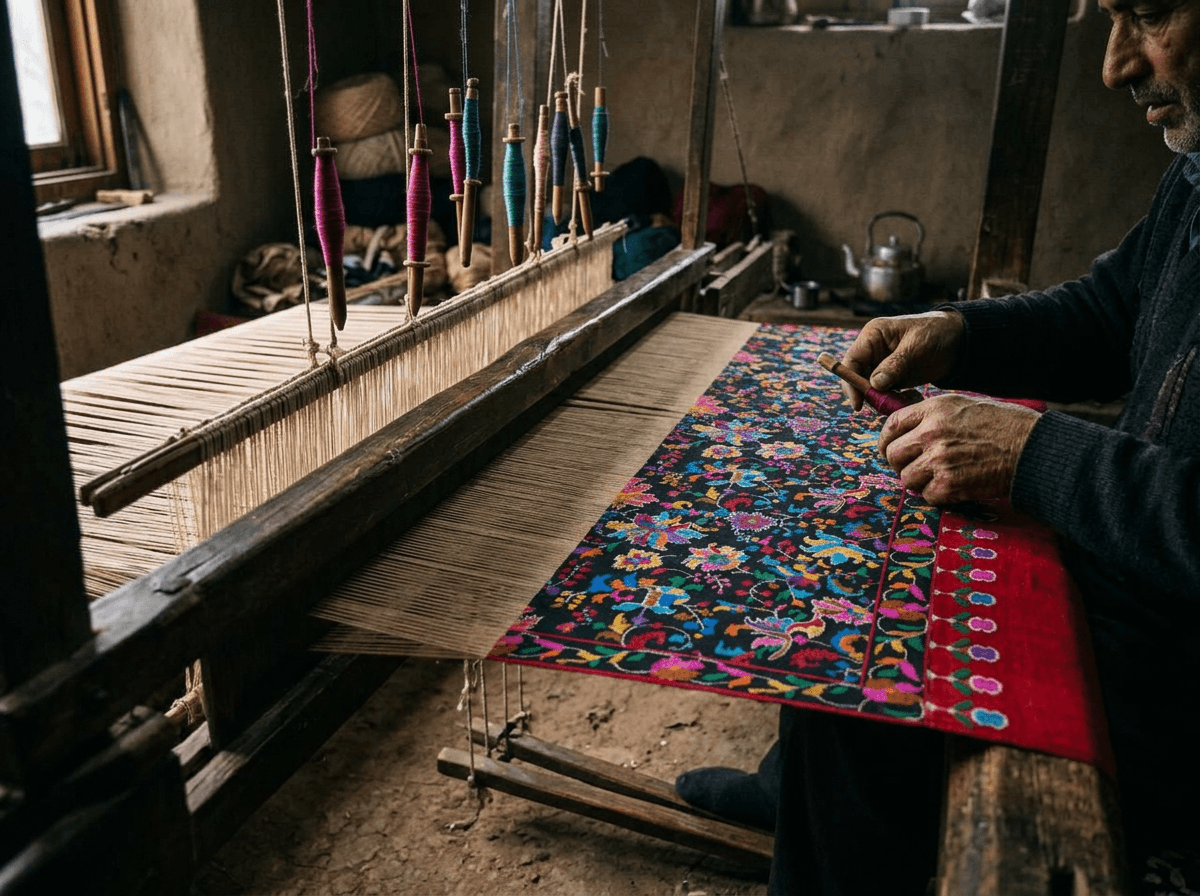
The J&K Handicrafts Department describes two shawl techniques: loom-woven Kani and needle-embroidered Sozni [1]. At a loom you see the difference in the first minute. A plain weave moves in a rhythm; a Kani is slower, with the weaver reading from a talim and laying colour in small sections. A Sozni piece may not be at a loom at all, but at a frame where the embroiderer works from the reverse.
Ask how long the piece has taken, and what part of it was done by the person in front of you. Ask whether the workshop spins its own yarn. These are ordinary questions in the trade and are usually answered plainly.
Do not photograph people without asking, and do not treat the workshop as an attraction. It is a workplace, often cold, and the person at the loom is paid by the piece. A short visit and a real question are a better exchange than a long tour.
A day in the city, in order
Start at a state emporium in the morning, before the staff are busy. Spend an hour learning the labels and the price bands with no intention of buying. It is the cheapest education in the city.
Then go to a workshop. If you have a contact, use it; if not, ask at the emporium or your guesthouse for a weaving family rather than a showroom. Midday is good: the light is even and the loom is running. Look at the reverse of three pieces at different prices and ask what accounts for the gap.
In the afternoon, walk the boulevards around Dal Gate and Lal Chowk with your questions ready. By now you have seen the range and can tell a good piece from a plausible one. Buy only what you have examined, and ask for the receipt to state the fibre content.
Leave the evening for a second visit. If a piece has stayed with you through the day, go back and make an offer. If it has not, buy nothing; the market will be there next year.
The seasons change the market. Winter is quiet and the light is low; summer is busy and prices are less flexible. A piece in the window in April may be gone by June.
If you would rather not spend the day testing shops, enquiries go through where to buy, and we will answer questions before you travel rather than after.
A purchase in Srinagar is a conversation with a place, and the place is not a showroom. If you leave with one piece you have examined, from someone who answered your questions, you have done better than most visitors. To see the loom, the reverse and the certificate in one visit, read about the house pages, look at the our craftsmanship pages page, or see the Kani shawl pages range, then arrange an appointment through private client appointment.
Questions we are asked
Pashmina shawl Srinagar: where should I buy one?
The three routes above are the practical answer: a government emporium, a family workshop or a retail boulevard. Ask to see the reverse and the GI paperwork before you discuss price.
Is it safe to shop for pashmina as a visitor?
Yes, with the ordinary care you would take in any market. Buy from a shop with an address, ask for a receipt that states the fibre content, and do not buy from someone who approaches you on the street with a bag of shawls. The risk is not violence; it is a confident story and a blend.
How much should I expect to pay in Srinagar?
We do not quote prices, and any range printed in a guide is out of date by the time you read it. Price follows fibre, spinning, weave and embroidery, and the same money buys very different things in an emporium, a workshop and a boulevard. Ask what the piece is before you ask what it costs.
Can I buy directly from a weaving family?
Often, yes. Many families sell from the house or through a shop attached to it. Ask for an introduction rather than turning up unannounced, and expect to see the loom rather than a showroom. Payment, shipping and paperwork are usually simpler through a shop, even when the weaving is domestic.
Do I need a GI certificate to be sure it is real?
It is the strongest single document available, but it is not the only test. A certificate confirms the origin and process specification; it does not grade the handwork. Look at the reverse, ask about the yarn, and treat the certificate as confirmation rather than as a substitute for examining the cloth.
Can I ship a shawl home from Srinagar?
Yes. Most established shops ship internationally and many handle the paperwork. Ask what carrier they use, whether the piece is insured in transit, and what the recipient will owe on arrival. Keep the receipt and certificate with the shipment details.
Sources
- Handicrafts Department, Government of Jammu & Kashmir, https://dohh.jk.gov.in/ — Accessed 2026-11-07.
- Intellectual Property India, GI Registry, "Details — Kashmir Pashmina (GI Application 46)", https://search.ipindia.gov.in/GIRPublicSearch/Application/Details/46 — Accessed 2026-11-07.
- Craft Development Institute, Srinagar, "Quality Manual for Enforcement of Kashmir Pashmina GI", http://iictsrinagarcarpet-gi.org/documents/Quality%20Manual%20Kashmir%20Pashmina%20Updated%202023.pdf — Accessed 2026-11-07.
- World Intellectual Property Organization, "Geographical Indications", https://www.wipo.int/geo_indications/en/ — Accessed 2026-11-07.
- Intellectual Property India, GI Registry, "Details — Kashmir Sozani Craft (GI Application 48)", https://search.ipindia.gov.in/GIRPublicSearch/Application/Details/48 — Accessed 2026-11-07.