Craft · 13 min read
The Boteh and the Paisley Shawl: A Kashmir Motif's Journey
How the boteh travelled from Kashmir looms to the European paisley shawl: the motif's meaning, its grammar in Kani shawls and how to read a woven pattern.
By Timothy V. Manley
7 November 2026
The boteh is the teardrop motif with a curved tip that Kashmiri weavers built into shawl design, and the paisley shawl is its European afterlife, named after the Scottish weaving town that copied it. On a Kani shawl it is not printed or embroidered but woven into the cloth from coded instructions called a talim.
Two words, one shape, and a continent between them. The journey is worth following because it explains something a photograph cannot: why a motif that looks decorative is a system of drawing, counting and weaving, and why the same shape appears on a nineteenth-century Kashmiri shawl, a Victorian mill town's product and a modern printed scarf with equal confidence.
A woven boteh is not an image applied to cloth. It is built row by row, in coloured yarn, at the same time as the cloth itself. That single fact changes how the motif should be read.
This article follows the shape from the loom outward: what it is, what it may have meant, how it crossed into Europe, and how to read the grammar of a woven field. It does not repeat the garden essay or the account of Kani weaving as a process; both are worth reading on their own terms.
What a boteh looks like, and what it is made of
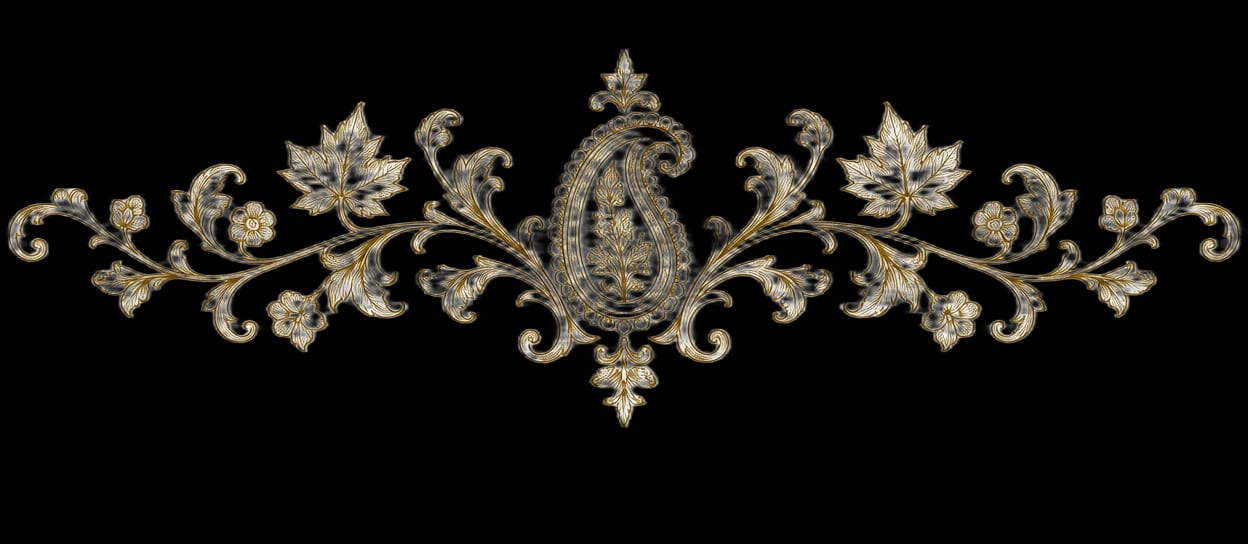
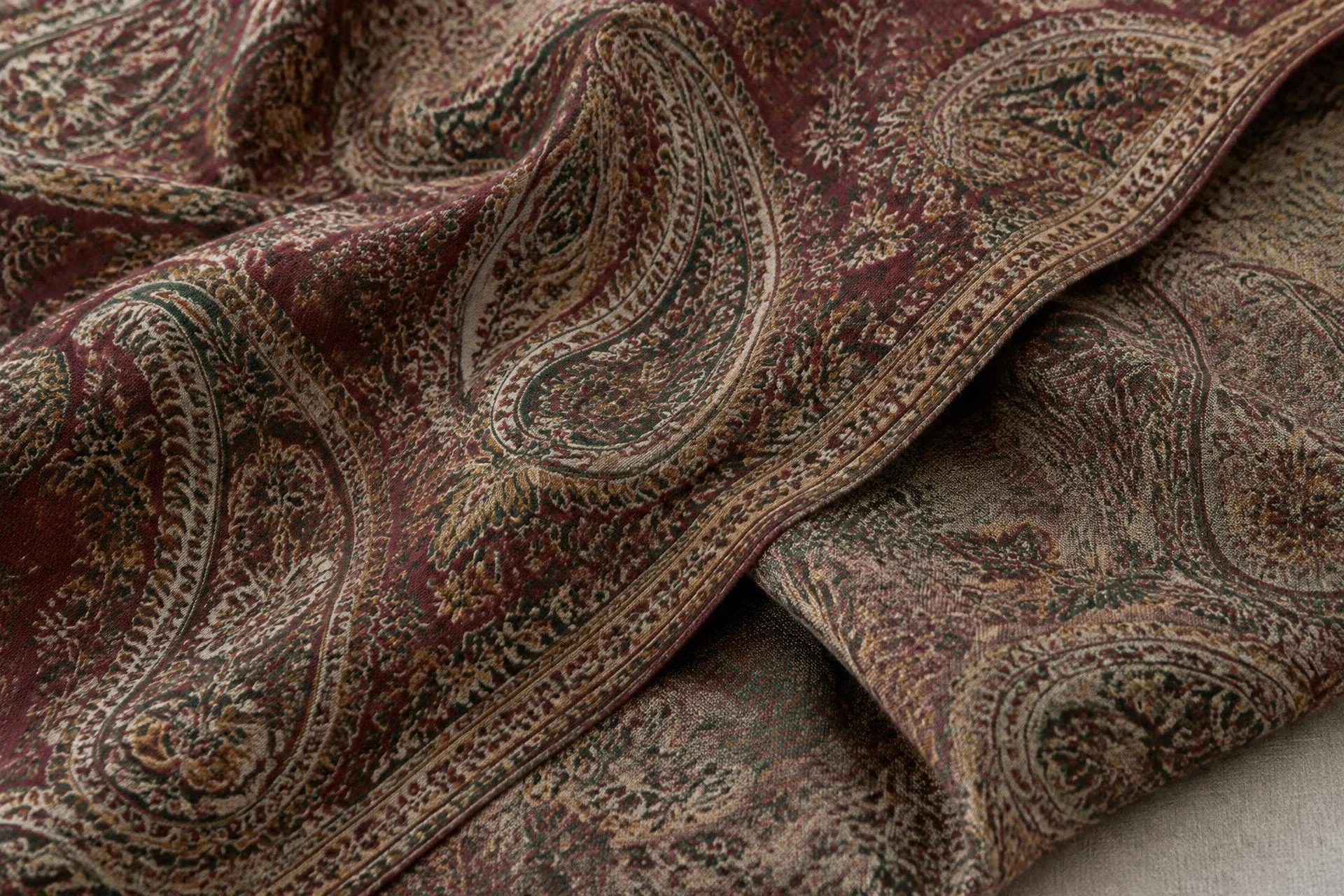
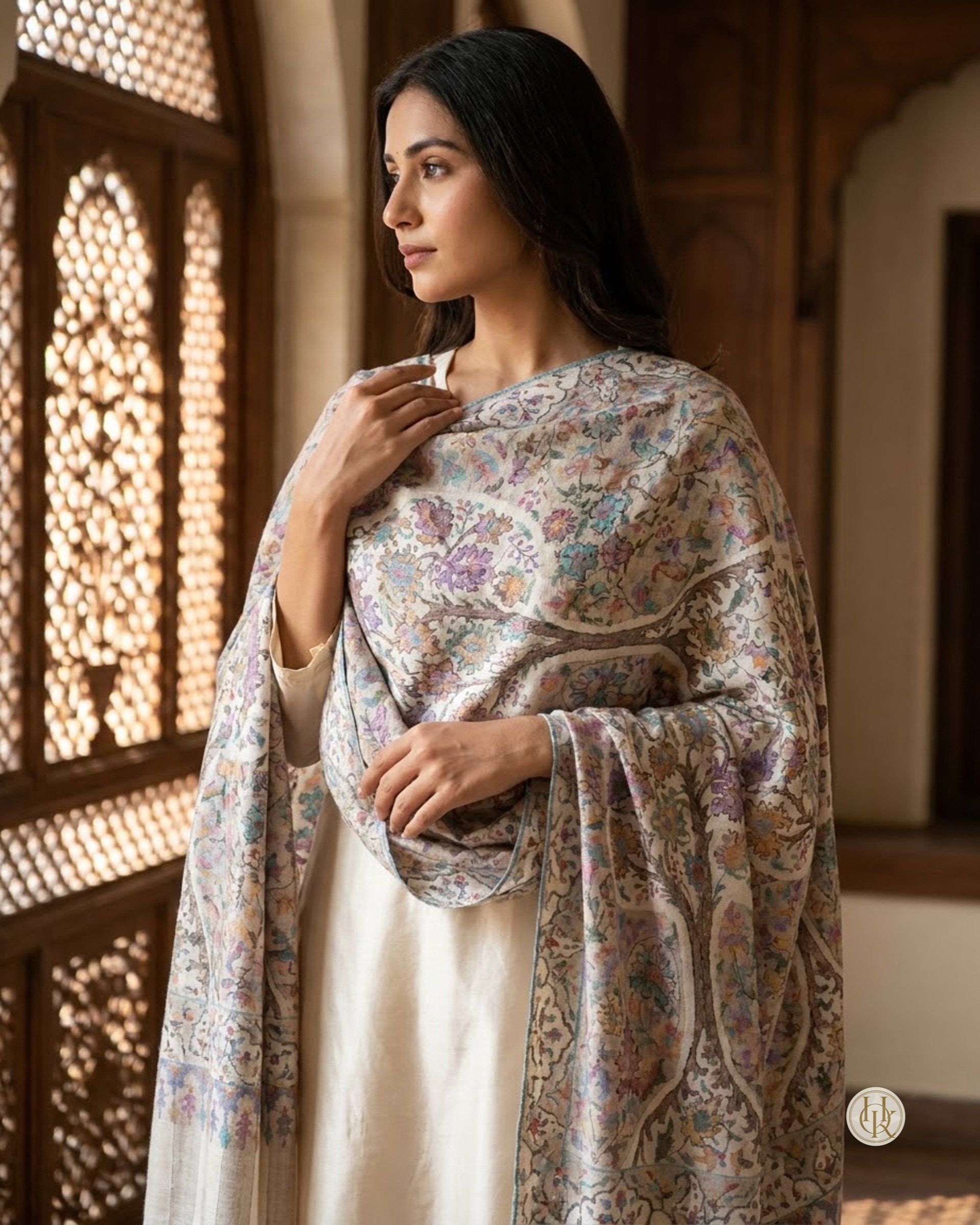
The shape is a drop or teardrop, wider at the base, narrowing to a tip that bends to one side. Fill it with flowers, outline it, mirror it, stack it, scatter it: the silhouette stays recognisable, which is why it survived translation into print, embroidery, wallpaper and a brand logo.
Look closely at a woven example and the outline is not a drawn line at all. It is a series of small steps, because the curve is built from the ends of weft passes at the boundary between two colours. The V&A holds a nineteenth-century Kashmir shawl of woven goat-hair pashmina with a plain undyed centre and attached woven borders carrying a large floral boteh design in panels of different colours, in a 2x2 twill at 84 warps to the inch [1]. Eighty-four warps to the inch is the resolution available to the designer: fine, but finite, and visible as a slight stair-stepping along the steepest part of a curve.
That physical constraint is the reason a woven boteh reads differently from a printed one. The print can be smooth. The weave has grain. Collectors look for that grain, and forgers work hard to imitate it.
Meanings, and why they are disputed
Ask what the boteh means and you will get several confident answers, most of which cannot be traced to a contemporary source. The readings are many and none is settled.
One reading treats the shape as a cypress, the upright tree that appears in Persian garden design and in Kashmiri visual culture, bent rather than straight. Another reads it as an almond, or a pine cone, or a flame, or a droplet. A third reads it as a cluster of flowers seen from above, which would make the internal fill the subject and the outline merely its container. A fourth treats it as a woven signature of a particular workshop rather than a symbol at all.
The honest position is that the motif was used for centuries across a wide geography — Persian, Mughal and Kashmiri workshops among them — and that a single original meaning is unlikely to have survived intact across all of them. What can be said with more confidence is that the shape was valued for its flexibility. It scales, it mirrors, it accepts any fill, and it composes into borders and fields without losing its identity. A motif with that many uses does not need a fixed meaning to do its work.
Where meaning is asserted, it is usually a later reading projected backwards. Treat those readings as interpretation rather than fact, including the ones that flatter the object most.
The shawl trade that carried the motif
The boteh travelled because the shawls travelled. Kashmir shawls were woven for courts and for export, and the finest were made from pashm, the fine underfleece of Changthangi goats combed on the high plateau, spun into exceptionally fine yarn and woven by the Kani technique [2].
Kani is a twill weave in which the weft is carried by small eyeless wooden bobbins — kanis or tujlis — inserted around a specified number of warp threads according to the design, with the weft yarns interlocked at every colour join [3]. The Kani Shawl is a registered Indian Geographical Indication, application 51, certificate 83, issued in 2008 and valid to 2036 [4].
Two consequences follow for the motif. The first is that pattern and structure are the same thing: the colour boundaries are the design, and there is no separate printing or embroidery step that could produce them. The second is that the pattern had to be transmitted as instructions rather than as an image, because a weaver working a colour join cannot see the whole field. That transmission is the talim.
The result was a textile that European buyers found almost impossibly desirable, and a design vocabulary that arrived with it: the boteh, the vine, the flowering plant, the mirrored field. When the shawls reached Europe, the motifs came too, detached from the looms that made them.
From Kashmir to the paisley shawl
European manufacturers did what manufacturers do with a desirable import: they made their own version. European mills produced their own versions of the shawl, and the English name for the shape came from that industry rather than from Kashmir. The word paisley now describes the motif in English, and it describes it everywhere — including on Kashmiri shawls, where it is a foreign name for a local form.
The translation changed the object in ways worth noticing. A handloom Kani boteh is built from interlocked weft at a fixed warp count, so its curves carry the grain described above. A jacquard-woven or printed European version can reproduce the silhouette at a much finer resolution and with perfect regularity, which is a technical achievement and a different thing.
This is the point at which the words separate usefully. Boteh names the motif as it is drawn and woven in its place of origin. Paisley names the European afterlife of that motif, and the industry that reproduced it. A paisley shawl is not necessarily a Kashmiri shawl, and a Kashmiri shawl with botehs is not usefully described as paisley unless you are speaking English about its pattern rather than its origin.
For buyers, the practical value of the distinction is that it forces the right question. Not "is this paisley" — most patterned shawls are, in the loose English sense — but "was this motif woven on a loom in Kashmir, and by which technique".
Motif grammar: cypress, chinar, almond, vine
A single boteh is a motif. A field of them is a language, and the language has rules that a buyer can learn in an afternoon.
The established vocabulary of Kashmiri design includes the cypress, the chinar leaf, the almond, the vine and the flower, and a good piece uses them with rhythm and space rather than as a repeating wallpaper. The motifs are not interchangeable decoration: each has a characteristic form and a usual position in the composition.
Motif · Form · Usual role in a composition
Read a shawl by asking which of these is carrying the composition. A border built from a scrolling vine with botehs set into it is doing something different from a field of scattered buti, and a single large flowering plant in the centre with a narrow border is a third design entirely. None is better; each is a different answer to the same problem of covering a rectangle with rhythm.
- Boteh Form: Teardrop with a curved tip, filled with floral or geometric detail; Usual role in a composition: Border panels, scattered buti, the centre of a large composition
- Cypress Form: Tall, narrow, upright tree, often slightly bowed; Usual role in a composition: Vertical accent, edge of a border, paired with a flowering plant
- Chinar Form: Broad, lobed leaf, drawn with visible veins; Usual role in a composition: Field motif, corner treatment, a large single element
- Almond Form: Small pointed oval, often within a boteh; Usual role in a composition: Fill inside a larger motif, seeding across a field
- Vine Form: Continuous scrolling stem with leaves and tendrils; Usual role in a composition: Connecting line between motifs, border spine
- Flowering plant Form: A stem with a bloom and leaves, drawn as a specimen; Usual role in a composition: The principal motif of a large panel or shawl centre
Talim: how a motif becomes an instruction
The talim is the most interesting object in the whole process and the least photographed. It is a written code: the design is transcribed into a sequence of instructions that a weaver can follow without seeing the pattern.
The registered specification describes Kani as woven with the help of written instructions in the form of a talim [3], and that phrase repays attention. The weaver at the loom is not copying a picture. They are executing a line of code in which the position of a colour, the number of warp threads it covers and the sequence of bobbins are all recorded, row by row, across the width of the cloth.
This is why a Kani pattern can be reproduced by a second weaver, and why the talim is a document with value. It is also why the motif's geometry has to be exact: a shape that is merely suggestive on paper cannot be encoded. The boteh survives because it is a precise figure, not because it is a pretty one.
For a buyer, the talim explains a physical detail. Where two colours meet, the weft is interlocked, and the reverse of the cloth shows those joins as a line of small changes rather than a smooth surface. On a machine-woven imitation the colour boundary is achieved differently, and the reverse looks correspondingly uniform. That difference is visible in daylight and needs no expertise beyond patience.
Reading repeat and symmetry
The last skill is the easiest to acquire and the most useful at a counter: reading how a design repeats.
Start with the mirror. Many Kashmiri compositions are built on a central axis, with the two halves of the field mirrored, and the border carried round in a continuous frame. A mirrored field is a demanding design because any error in the drawing is doubled; a hand-drawn repeat will show tiny asymmetries where the naqash's hand was not perfectly even, and those asymmetries are evidence of drawing rather than tracing.
Then follow a single motif across the cloth. In a handwoven piece the same boteh will vary slightly from one repeat to the next, because each is built from an encoded instruction executed by hand. Variation is not a defect. Mechanical identity across a wide field is the signature of a jacquard or a print.
Then check the corners. A border that turns a corner has to solve a problem the straight run does not, and the solution tells you how much thought went into the design: a motif cut off mid-form at the turn is a cheaper answer than a corner resolved with a separate element.
Then check the scale against the cloth. A large boteh needs ground around it. When a design is enlarged to fill a wider shawl without redrawing, the negative space disappears and the field becomes a pattern of edges.
To see how the woven version differs from the printed one in the hand, our Kani pages show the loom and the reverse, and the our craftsmanship notes follow the fibre from combing to finished shawl. The our heritage pages place the motif in the valley's wider textile history. For the comparison that most often confuses buyers, Kani vs jamawar sets the two traditions side by side, and what pashmina is starts at the fibre.
Questions we are asked
Is paisley the same as boteh?
The shape is the same; the words are not. Boteh is the motif as it is drawn and woven in its place of origin, and paisley is the English name it took from the Scottish weaving town that reproduced it in the nineteenth century. A paisley shawl may be European, Indian or anything else; a boteh on a Kani shawl is woven into the cloth.
What does the boteh symbolise?
The readings are many and none is settled: a cypress, an almond, a pine cone, a flame, a droplet, a floral cluster seen from above. The motif was used across a wide geography for centuries, so a single original meaning is unlikely to have survived intact. Where a meaning is asserted, treat it as interpretation rather than fact.
How can I tell a woven boteh from a printed one?
Turn the cloth over. A woven motif is built from interlocked weft at each colour join, so the reverse shows a line of small changes along every boundary, and the curve carries a slight stair-step at the warp resolution. A print sits on the surface and the reverse shows the ground, sometimes with a faint show-through of the design.
Why does a Kani shawl need a talim?
Because the weaver cannot see the whole pattern while working a colour join. The design is transcribed into written instructions recording colour, position and warp count row by row, and the weaver executes them. The Kani Shawl registration describes the technique as woven with the help of written instructions in the form of a talim [3].
What is the difference between a paisley shawl and a Kani shawl?
A Kani shawl is defined by its technique: handwoven with small wooden bobbins and interlocked weft, under a registered Geographical Indication [4]. A paisley shawl is defined by its pattern. One describes how the cloth was made; the other describes what it looks like.
The shape has outlived every economy that produced it, which is usually the mark of a good piece of design. But the version worth owning is the one where the motif and the making are the same act: a boteh that exists because a weaver interlocked two colours at a specified warp, following a line of code written by someone else. If you would like to see that at close range, enquire with the house and we will show you the reverse as well as the face. Buyers who prefer to begin with a conversation about a specific piece can use our private client service.
A woven motif is a record of decisions, and the decisions are what you are buying. The boteh is only the most legible of them.
Sources
- Victoria and Albert Museum. "Kashmir Shawl," collections record. https://collections.vam.ac.uk/item/O478533/kashmir-shawl. Accessed 2026-11-07.
- Prinseps. "The Kashmiri Jamawar: Cloth, Craft, and Cultural Memory." https://prinseps.com/research/jamawar-cloth-craft-and-cultural-memory. Accessed 2026-11-07.
- Craft Development Institute, Srinagar. "Quality Manual for Enforcement of Kani Shawl GI," updated 2023. http://iictsrinagarcarpet-gi.org/documents/Quality%20Manual%20Kani%20Updated%202023.pdf. Accessed 2026-11-07.
- Intellectual Property India, GI Registry. "Details — Kani Shawl (GI Application 51)." https://search.ipindia.gov.in/GIRPublicSearch/Application/Details/51. Accessed 2026-11-07.