Style · 12 min read
Pashmina Shawl Gifts: How to Choose One They Will Wear
Pashmina shawl gifts: how to choose one they will wear, by occasion, size, colour and technique, with presentation and care advice that avoids a drawer.
By Timothy V. Manley
7 November 2026
A pashmina shawl gift works when it matches the recipient's wardrobe, climate and habits. Choose the size for how they will wear it, the colour for what they already own, and the technique for the occasion. Presentation, a care card and a clear return path decide whether it is worn or stored.
Most gift shawls fail for a boring reason. They are the wrong size for the way the recipient dresses, or the wrong colour for the coats already in the hall, or so precious that they never leave the tissue paper. A well-made piece in a shade that does not suit its owner still stays in a drawer.
This guide is about reducing that risk. It is written from a house that sells shawls and also repairs them, so we see both endings: the shawl worn every winter for twenty years, and the one that comes back with the fold still in it. The difference is almost always a decision made when choosing.
Start with how they will use it
The first question is not what to buy but what the recipient does. A person who commutes by car and works indoors has different needs from someone who walks to a station in a wet city, and a person who travels for work has different needs again. A shawl chosen for the wrong life will be admired and then folded away.
Ask three things, indirectly if you must. Do they feel the cold? Do they wear coats with collars, open jackets or dresses? Do they carry a bag large enough for a folded piece? The answers narrow the choice faster than a list of colours.
Then consider the climate they live in, not the climate you live in. A fine pashmina is warm for its weight, but it is not a coat. In a mild city it may be the outer layer for eight months of the year; in a cold one it is a layer under a coat and a cover indoors. Both are good uses, and they call for different sizes.
Finally, think about how they receive gifts. Some people love a piece that is obviously expensive and will wear it with pleasure. Others find expensive gifts awkward and wear them carefully, which means rarely. If you suspect the second, choose a smaller piece in a quieter colour. The gift is more likely to be used, and that is the point.
A pashmina shawl gift: occasion, recipient and size
Recipient or occasion · Size · Colour direction · Technique
The table is a starting point. Its logic: the more public the occasion, the larger the piece and the more visible the colour; the more private the gift, the more it should defer to what the recipient already wears.
- A wedding, for the couple or a guest Size: 100 × 200 cm shawl; Colour direction: Ivory, deep red, or a shade from the invitation; Technique: Sozni, or a fine solid
- A parent or grandparent Size: 100 × 200 cm shawl; Colour direction: Warm neutrals, soft green, muted blue; Technique: Solid, or light Sozni
- A partner Size: 70 × 200 cm stole; Colour direction: Their existing coat colour, one step deeper; Technique: Solid, or a fine Kani
- A colleague or a corporate gift Size: 70 × 200 cm stole; Colour direction: Charcoal, navy, camel, grey; Technique: Solid, unbranded
- A frequent traveller Size: 110 × 250 cm wrap; Colour direction: Mid-tone or dark, forgiving in transit; Technique: Solid
- A man new to shawls Size: 70 × 200 cm stole; Colour direction: Charcoal, navy, camel; Technique: Solid, no visible pattern
Size by lifestyle
A 70 × 200 cm stole is the most reliable gift size. It suits almost any frame, it folds into a bag, it works on the shoulders and at the neck, and it does not look extravagant on someone who is not used to shawls. If you know nothing about the recipient's wardrobe, this is the size to choose.
The 100 × 200 cm shawl suits someone who attends ceremonies, feels the cold, or already owns coats and wraps. It covers the back and shoulders, which makes it usable in a way a narrow piece is not. It is also the size that reads as a proper gift when it is opened, because there is enough cloth to see the pattern and the finish.
A 110 × 250 cm wrap is the traveller's piece and the sofa piece. It is generous, it doubles as a blanket, and it is the one people reach for at home in the evening. It is a poor first gift for someone who dresses formally, because it is too much cloth for a dinner; for the traveller, the travel scarf guide reasoning applies.
A 45 × 180 cm scarf is the safest small gift and the least memorable. It is useful, it fits, and it will be worn. If the budget is modest, a scarf in an excellent fibre is a better present than a shawl in a poor one. Our guide to pashmina shawl size sets out the measurements in centimetres and inches if you want to compare with something they already own.
Colour by wardrobe
Colour is where most gifts go wrong, and it is the easiest thing to get right with one question: what coat do they wear most? A shawl is usually worn against a coat, a jacket or a dress, and the coat is the colour that will either carry it or fight it.
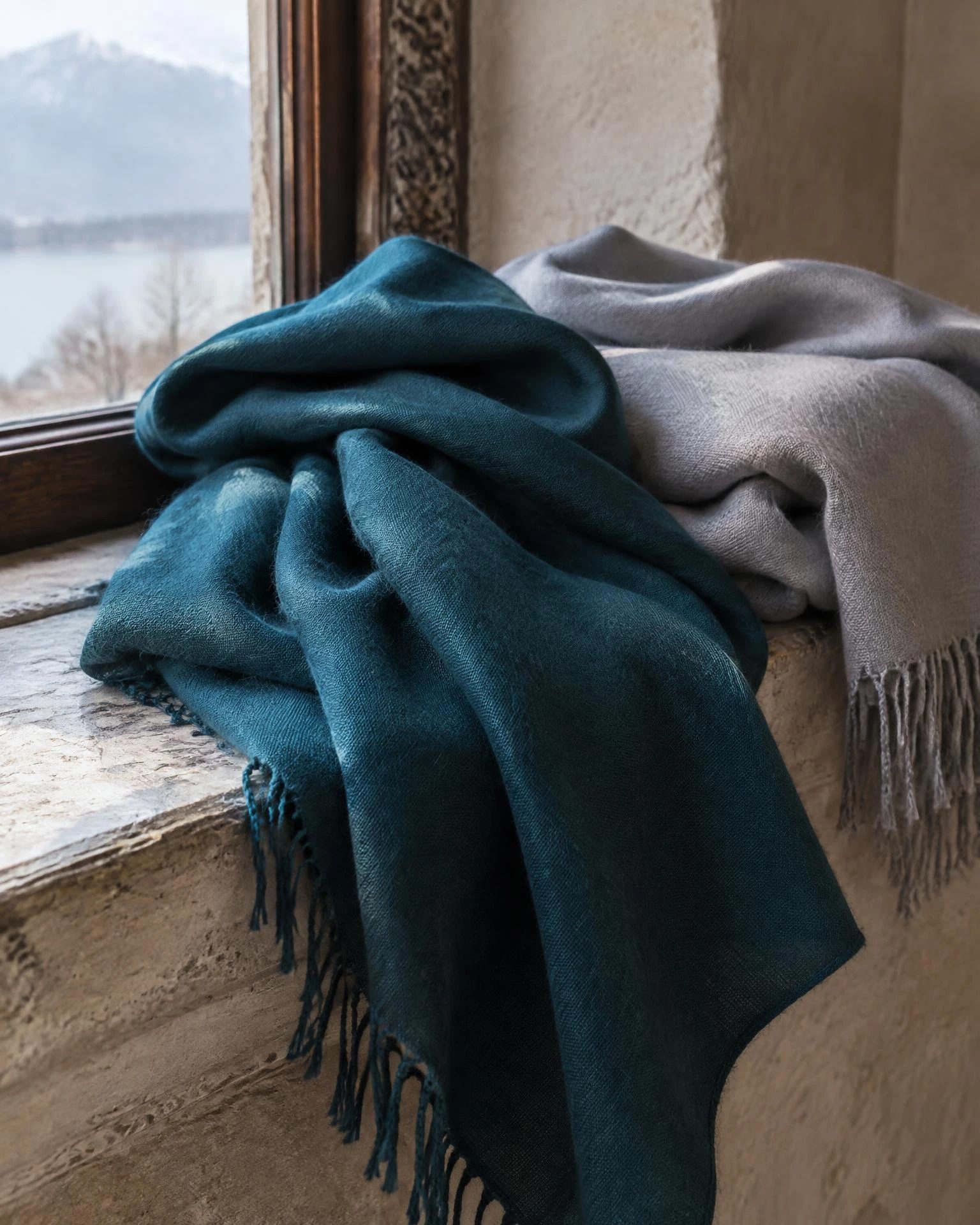
Charcoal, navy, camel, grey and ivory are the five colours that survive a decade of changing wardrobes. They are not exciting, and they are the ones people wear. If the recipient already owns a camel coat, a camel shawl will look intentional; a black shawl will look like a separate decision. Neither is wrong, but the first is easier to wear.
For a gift that should feel like an occasion, choose a deeper version of a colour they already wear rather than a colour they have never worn. A deep green, a wine, a slate blue: these read as gifts and still work with a winter wardrobe. Bright shades are wonderful on the right person and difficult to give blind.
Skin tone matters, but less than most guides suggest. What matters more is contrast: a shawl that is close to the wearer's skin tone can look washed out in winter light, and one that is much darker or much lighter frames the face. If you are choosing without seeing the person, a mid-tone is the safer bet.
Our 279-shade card page holds 279 solid shades, which is more choice than a gift decision needs. Use it to find the family — ivory, stone, camel, green, blue, red, plum, black — and then choose within it. The pashmina colour guide goes further into undertone and winter light.
Technique by budget: solid, Sozni, Kani
The three techniques carry different amounts of labour, and the price follows the labour rather than the size. A plain shawl is the least expensive way to own the fibre. A Sozni shawl adds the embroiderer's hours. A Kani shawl adds the weaver's months.
A solid piece is the right gift for someone who will wear the shawl rather than admire it. The cloth is the point: 100% pashm no coarser than 16 microns, spun and woven by hand under the Kashmir Pashmina specification [1]. There is no pattern to date, no embroidery to catch on a bag, and nothing to explain. It is also the easiest piece to care for and the easiest to replace in a different colour if the first choice is wrong.
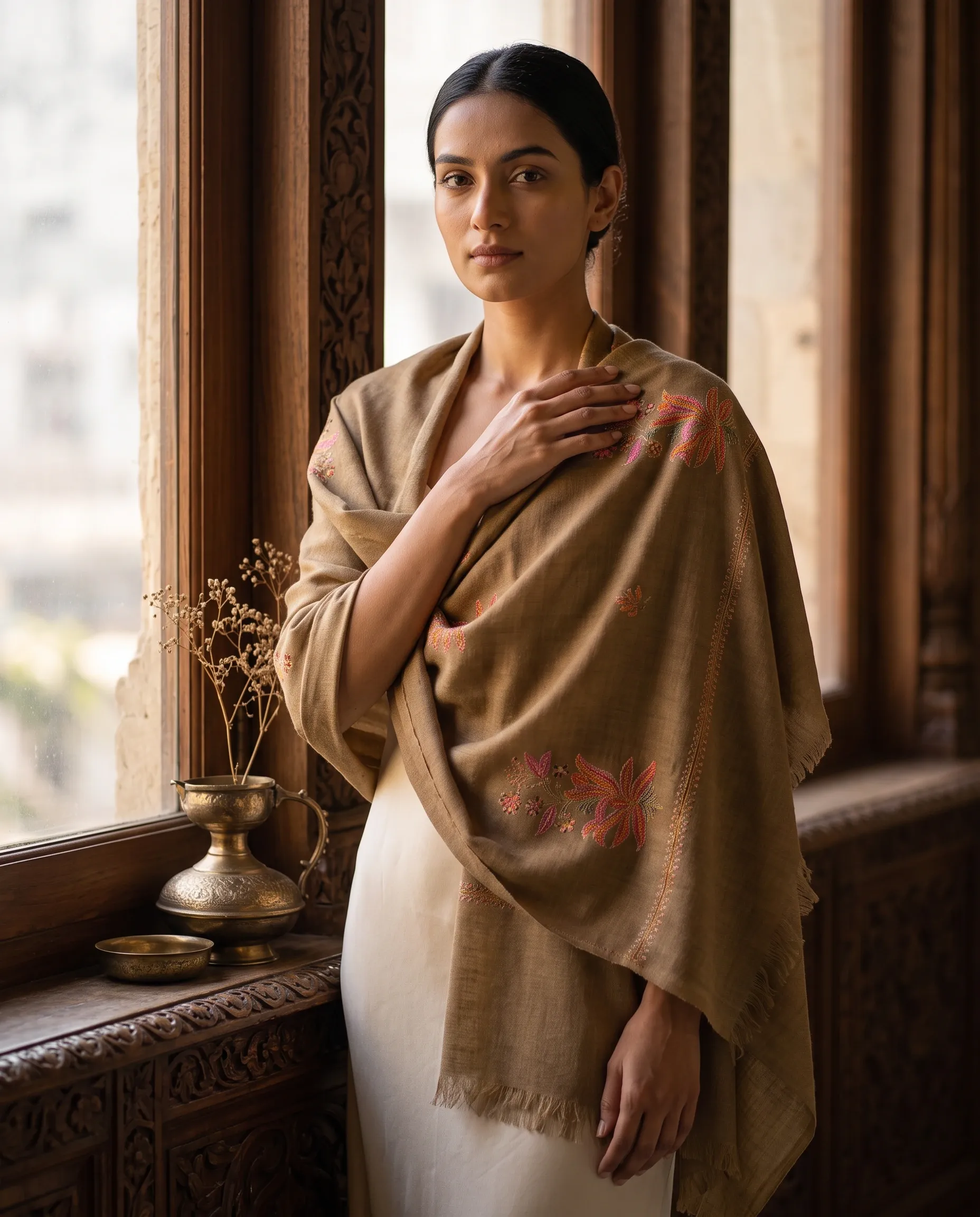
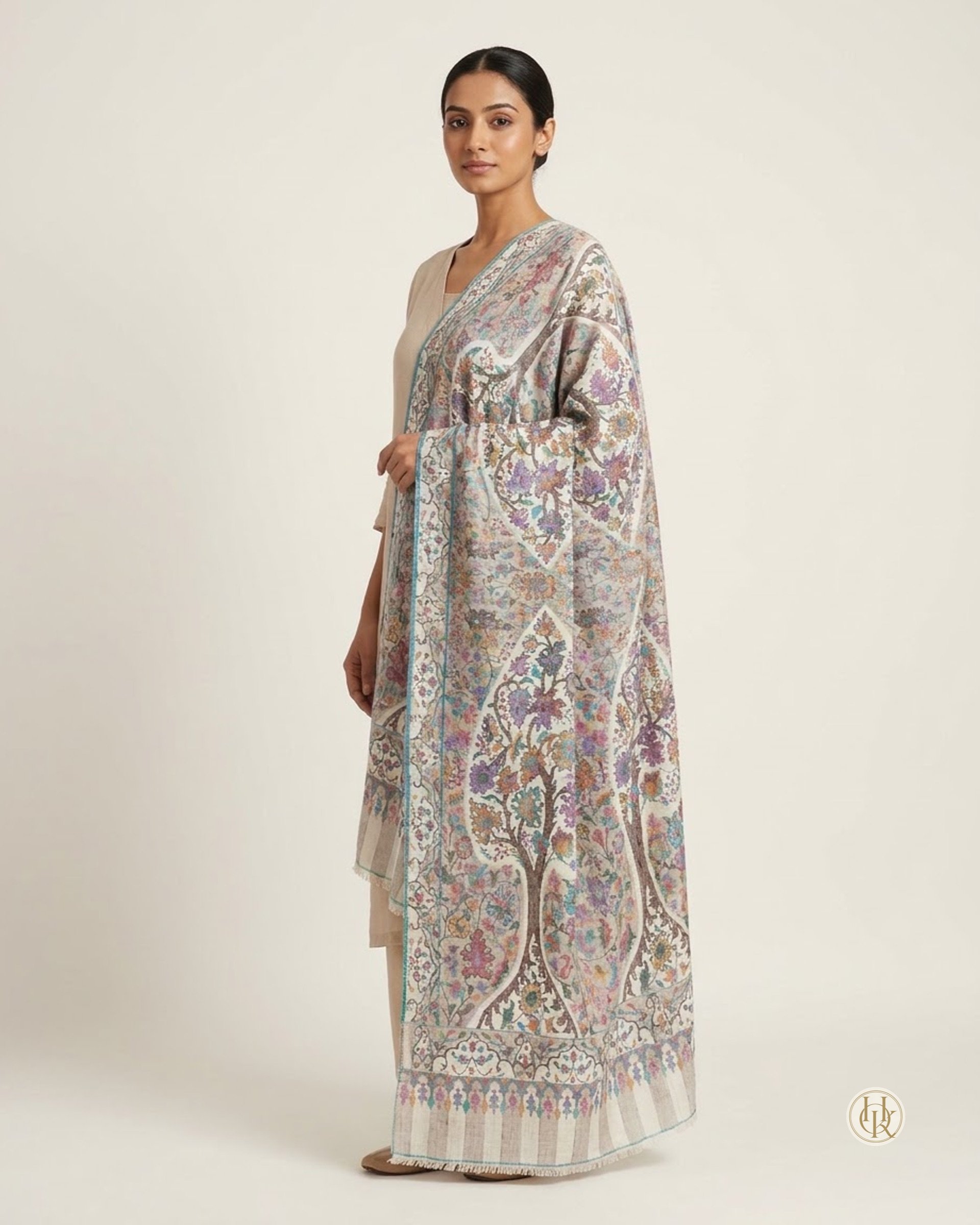
Sozni is hand embroidery worked on woven pashmina, and the registered specification names the stitches: sozani, darn and stem dominate, with buttonhole, herringbone, chain, satin and knot stitches used in smaller proportions [3]. A lightly worked border is a good gift for someone who dresses simply; a densely worked all-over piece is a gift for someone who collects. The difference in labour between the two is large, and so is the difference in price.
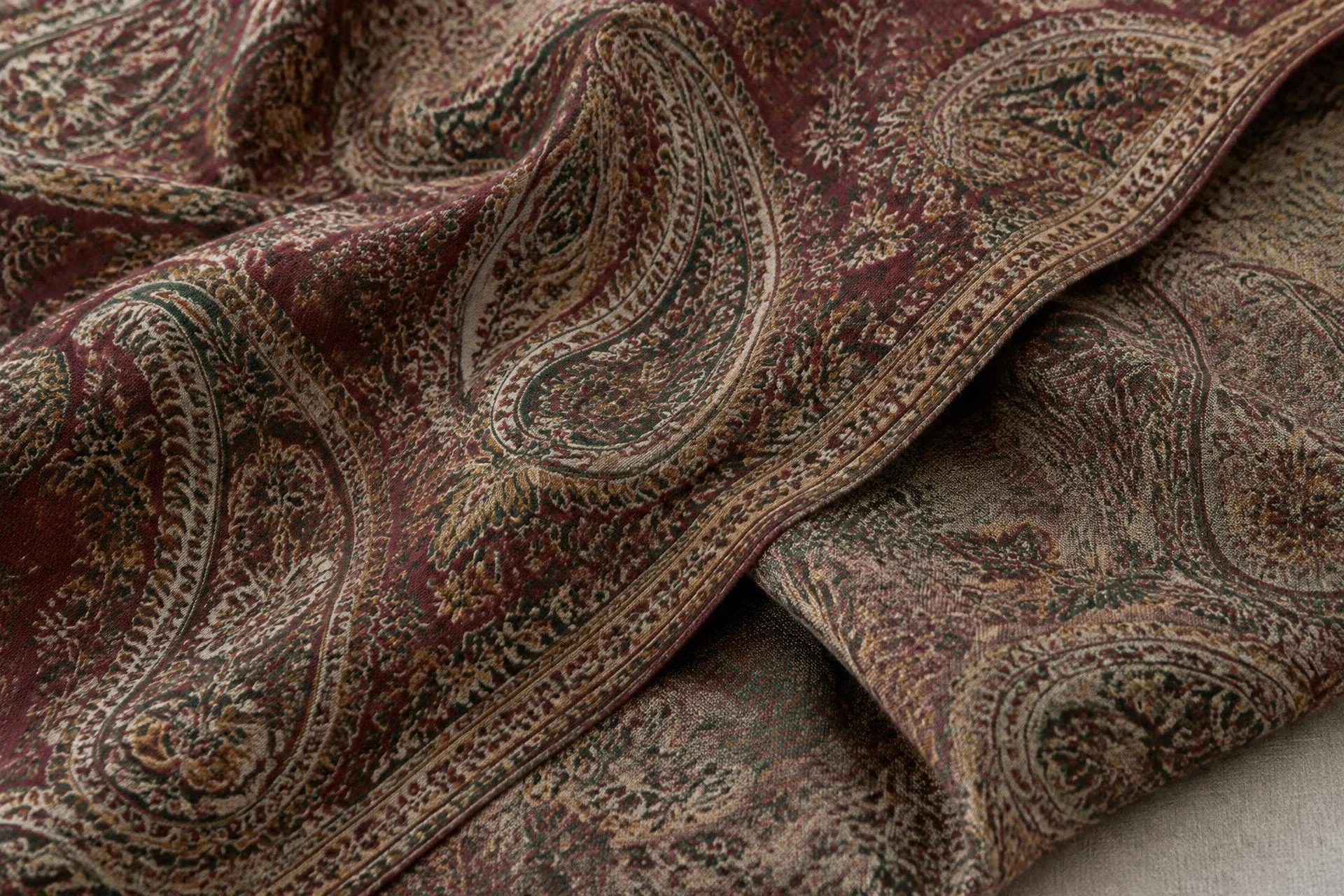
Kani is the collector's gift. The weaver uses small eyeless wooden bobbins in place of a shuttle, works a twill tapestry weave with the weft interlocked at every colour join, and follows written talim instructions [4]. A Kani shawl can take months, and it is the piece to give when the recipient already has everything and would recognise the work. It is also the piece to give only when you are confident of the recipient's taste, because a patterned shawl is a stronger statement than a solid one.
If you want to feel the difference between a light Sozni border and a dense Kani before deciding, that is a five-minute conversation with the cloth in hand; an appointment can be arranged through private client appointment.
Pashmina and cashmere are not the same claim, and a gift is a bad place to blur them. Cashmere, by the CCMI definition, is dehaired undercoat with a mean diameter of 19 microns or less [2]; pashmina is the finer fibre from the Changthangi goat, and the Kashmir specification sets the ceiling at 16 microns [1]. If you are giving a piece described as pashmina, give one whose label says so.
Personalisation, presentation and the care card
A gift is two objects: the cloth and the way it arrives. The second one carries most of the message.
Presentation does not need to be elaborate. A cotton or muslin bag protects the shawl in storage and signals that the piece is meant to be kept. A card, written by hand, with the fibre and the shade named, saves the recipient from guessing. If the piece is certified, a copy of the certificate is a quiet way of saying what the gift is without a speech.
A care card is the most useful thing in the box. It should say three things: hand wash cool or dry clean, dry flat, store folded in the bag with moths in mind. A line pointing to the house's care notes is enough; the recipient will not read a leaflet.
Personalisation is a matter of restraint. An embroidered monogram on a fine pashmina is possible but permanent, and it dates the piece to one owner. A card does the same work and can be put away. If the piece will be inherited, leave the cloth alone.
For a wedding gift, the conventional route is the larger shawl in a shade from the wedding palette, presented with the certificate and a note. Do not choose ivory for a guest; it competes with the couple. Do choose something the couple can use in the season they marry. If the wedding is in summer, a lighter stole in a cool shade is more thoughtful than a heavy shawl that will sit in a box until December.
Shipping, returns and the awkward cases
A gift that arrives late or in the wrong colour is a problem, and a gift with no return path is a bigger one. We ship worldwide from Srinagar, offer a 14-day return and a money-back guarantee after inspection, and we would rather answer a question before a piece is sent than resolve a disappointment after.
If you are sending directly to the recipient, tell them it is coming and who it is from. A customs form that says "textile" and a parcel from a country they have never visited can look like a mistake. A short message in advance turns an unexplained parcel into a gift.
Duties and taxes are the recipient's responsibility in most countries, and the amount depends on where they live and the value declared. We will tell you what we know about the destination; we will not promise a figure, because the rate is set at the border.
The awkward cases are worth naming. A gift for someone who has everything is usually best as a solid in an impeccable fibre, because the cloth rather than the pattern will persuade them. A corporate gift should be unbranded and neutral, in a size that suits a stranger. A gift to a household is best as the large wrap, which anyone can use.
And if you have been given a pashmina that is not right, say so early. A shawl kept in its bag for two years is harder to exchange than one returned in the first month. A good seller would rather swap it.
If you are choosing between two pieces and cannot decide, tell us who the gift is for and how they dress, and we will narrow the choice rather than widen it. A gift should be a decision made once, well. Enquiries go through where to buy, and we will answer with a recommendation rather than a catalogue.
Questions we are asked
Which size makes the best pashmina gift?
A 70 × 200 cm stole is the safest: it suits almost any frame and folds into a bag. A 100 × 200 cm shawl is better for someone who attends ceremonies or feels the cold. Choose the wrap only for a traveller or for use at home.
Is a pashmina shawl a good wedding gift?
Yes, particularly in the 100 × 200 cm size and in a shade drawn from the wedding palette. Avoid ivory if you are a guest, and choose a weight that suits the season of the wedding rather than the season you are shopping in. Include the certificate and a care card.
How do I choose a colour without knowing their wardrobe?
Start from the coat they wear most and choose a shade one step deeper or lighter. If you have no idea, a mid-tone in camel, grey, navy or stone is the safest. Avoid bright shades and very pale ivories unless you know they suit the recipient.
Is Sozni or Kani worth the difference in price?
If the recipient collects textiles or already owns good shawls, yes. A Kani is a piece to be recognised and kept. For someone who will wear the shawl daily, a fine solid or a lightly worked Sozni will be used more often.
Can I return a pashmina gift if it is not right?
With us, yes, within 14 days, and the piece is inspected on return; the guarantee is a refund after inspection. Check the seller's terms before you buy, keep the packing and the certificate, and do not remove any labels until you know the gift is staying.
Sources
- Craft Development Institute, Srinagar, "Quality Manual for Enforcement of Kashmir Pashmina GI", http://iictsrinagarcarpet-gi.org/documents/Quality%20Manual%20Kashmir%20Pashmina%20Updated%202023.pdf — Accessed 2026-11-07.
- Cashmere and Camel Hair Manufacturers Institute, "CCMI Definition of Cashmere, Fine and Superfine Wool" (archived), https://web.archive.org/web/20240523004544/https://www.cashmere.org/definition-cashmere-wool.php — Accessed 2026-11-07.
- Craft Development Institute, Srinagar, "Quality Manual for Enforcement of Kashmir Sozani GI", http://iictsrinagarcarpet-gi.org/documents/Quality%20Manual%20Kashmir%20Sozani%20Updated%202023.pdf — Accessed 2026-11-07.
- Craft Development Institute, Srinagar, "Quality Manual for Enforcement of Kani Shawl GI", http://iictsrinagarcarpet-gi.org/documents/Quality%20Manual%20Kani%20Updated%202023.pdf — Accessed 2026-11-07.