Style · 8 min read
Pashmina for Weddings: What to Wear and Give
Which shawl to carry to a wedding, how to choose its colour and size, and how to wear it through the ceremony without spoiling the line of a dress.
By Timothy V. Manley
2 November 2026
The ceremony is warm and the reception is not. Stone floors, high ceilings and doors held open all evening draw heat out of a room, and a dress that felt right at four o'clock feels thin by nine. A shawl answers this without changing the outfit beneath it, and it is the only layer that can come off at dinner and go back on for the walk to the car.
Coverage is the other reason. Some ceremonies ask guests to cover their shoulders, and a few ask for the head as well. A large wrap meets that request where a jacket cannot, because it can be arranged and removed in a moment.
Start with the role, not the colour
Guests have the widest latitude and should use the least of it. The couple's palette sets the register, and a shawl in a quiet version of it will look considered without asking for attention.
Mothers of the bride and groom sit closer to the centre of the photographs, so their shawl can carry more colour and a stronger pattern. Bridesmaids usually work within a palette chosen months earlier, which makes a fine stole in the same family safer than a contrasting shawl. The officiant's family should read as formal and neutral: navy, grey, deep green, and no competing print.
Colour by season
Spring and summer weddings favour a light palette and restrained contrast: sage, soft blush, dove grey, a pale gold. The shawl is often needed only after sunset or in an air-conditioned room, so it can be light in weight as well as tone.
Autumn asks for deeper colour, and this is the season when a shawl earns its place in daylight: rust, bronze, wine, forest green. Winter is the most forgiving of all, because dark saturated colour looks correct against coats and candlelight. In every season, the test is whether the shawl reads as part of the outfit rather than a second focal point; texture does more work than brightness.
The ivory question
Pure white and bridal ivory belong to the bride unless she asks otherwise. That is the simplest rule and the one most often stretched by a guest who thinks her shawl is close enough. The rule is not arbitrary: in photographs, a white wrap beside a white dress pulls the eye and blurs the edge of the bridal silhouette.
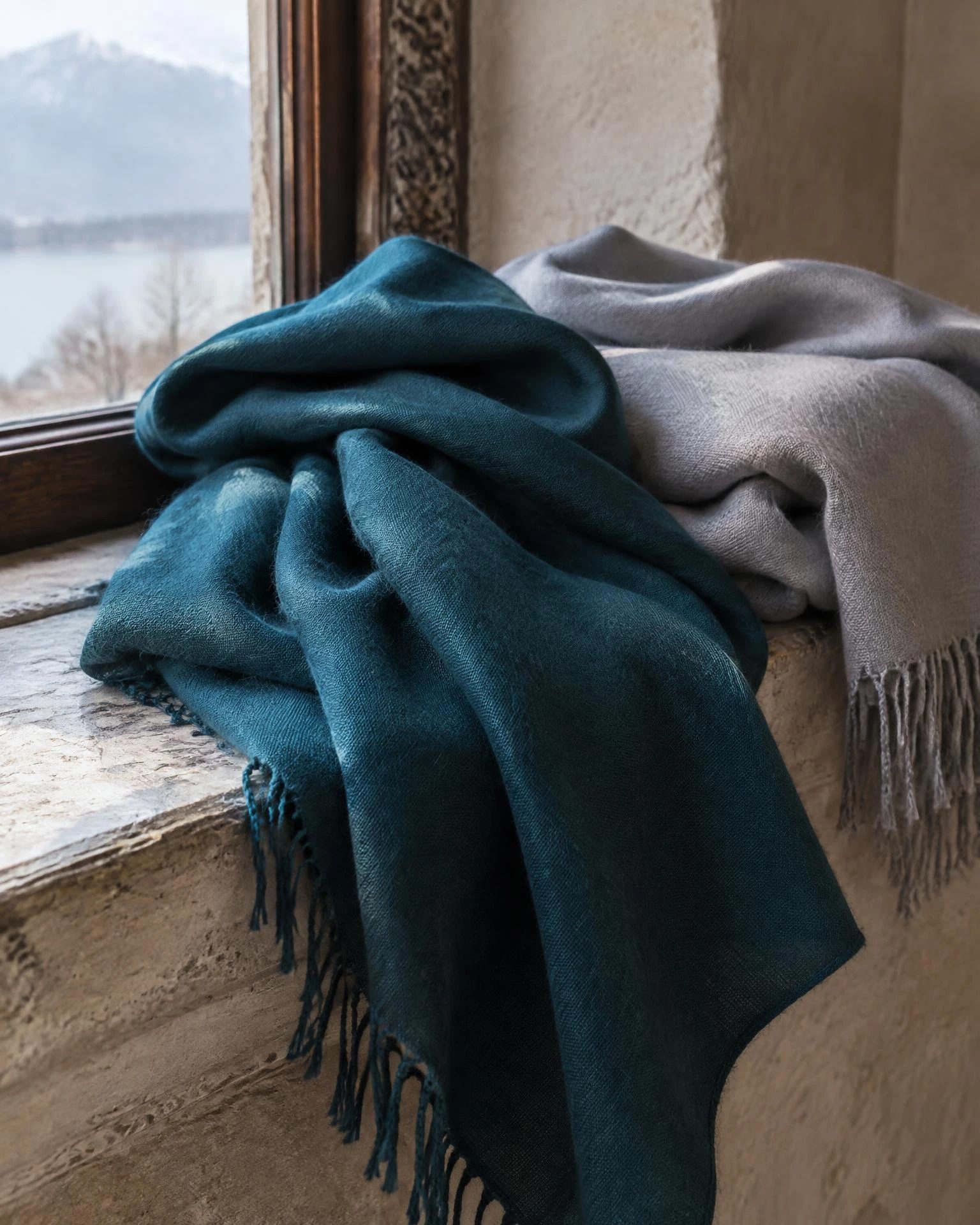
Safer ground includes oyster, dove, champagne, blush, sage, deep green, wine and navy. Champagne sits warm enough to separate from ivory, oyster reads grey, and blush can photograph close to white under flash, so it is worth seeing the piece in artificial light before committing. If the couple has asked guests to avoid a colour, follow that request over any general rule. Our shade card sets out the tones we work with, though the final choice should be made against the dress itself.
Colour by outfit
There are three workable approaches: match the dress, match an accessory, or contrast on purpose. Matching the dress makes the shawl disappear into the silhouette, which suits a mother of the bride who wants a continuous line in photographs. Matching an accessory, a bag, a shoe or a piece of jewellery, gives the colour a reason to be there without repeating the dress.
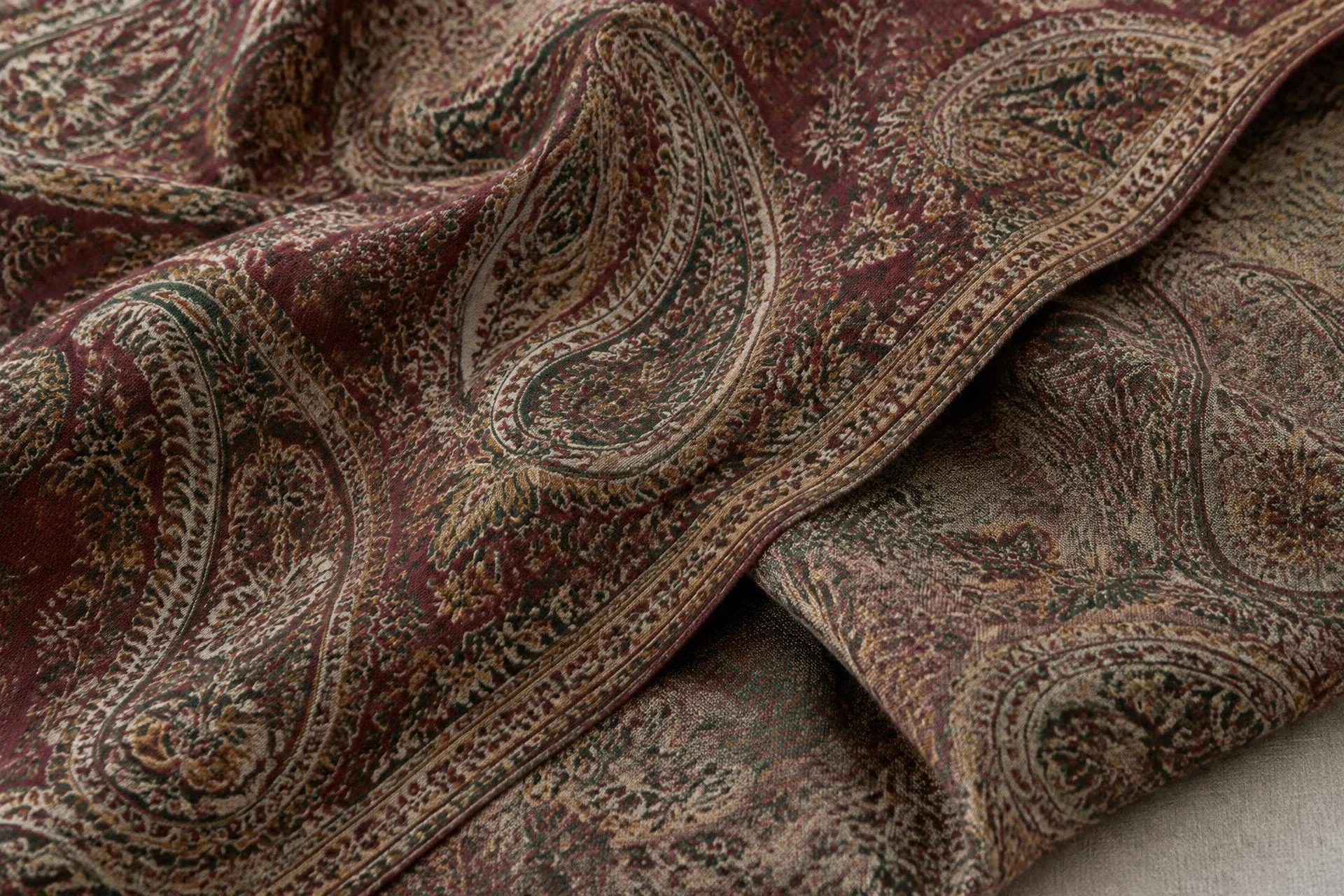
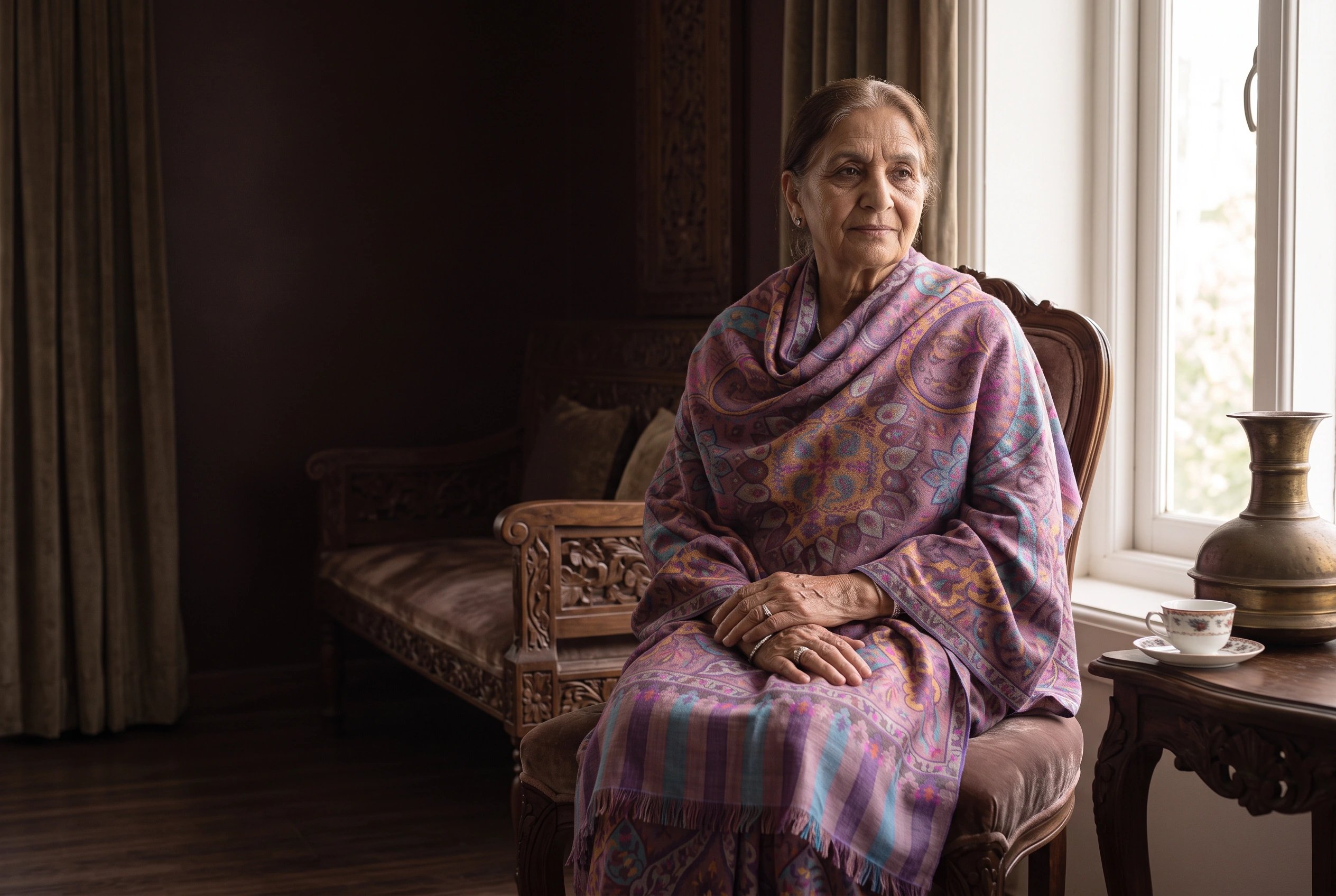
Contrast is the more confident choice and the easier one to get wrong. A patterned Kani shawl wants a plain dress. Its colour is woven into the cloth rather than printed onto it, so against a floral or heavily beaded outfit it becomes noise. If the dress is the patterned element, choose a solid shawl in a tone drawn from it.
Size, drape and keeping it in place
The ceremony sets the first requirement. A large shawl covers the shoulders and upper arms, which is what a church or a mosque may ask for, and it can be brought forward over the head where that is customary. The same size is awkward at a seated dinner, where it pools on the chair and slides from the shoulders.
A stole is easier to manage at the table. It can be folded once along its length, laid across the back, and gathered when the room cools. If only one piece is being chosen, a wide stole covers almost as much as a shawl and takes less room in a bag; our guide to how to wear a pashmina covers the basic drapes.
Fine wool does not forgive a pin. A brooch, however light, concentrates weight on a small area of the weave and can leave a permanent distortion; a pin pushed through the cloth can leave a mark that does not close. Hidden clips are the better answer, provided they grip the fold, not the face of the weave, and are attached to the dress seam where possible.
Sitting and rising cause much of the damage. Gather the ends into the lap before sitting, and rise by holding the front edge with both hands, not by one corner.
Choose the shawl for the hour it will be needed, not the hour it is bought.
How to wear it with different dress shapes
With a strapless dress, the shawl does the work the bodice cannot: drape it across the back and let the ends fall over the upper arms, then tuck the ends loosely at the elbow rather than clutching them at the chest. A sleeveless dress with straps gives more room to drape, and a single-shoulder drape looks deliberate where a symmetrical wrap can look borrowed.
Long sleeves need less volume. A fine stole laid along both arms adds warmth without bunching at the wrist, and a wide shawl is better worn open than wrapped. Over a saree or lehenga, the pallu already provides a diagonal, so a light stole held at the elbows is usually enough; anything heavier competes with the embroidery. A suit takes a narrow stole inside the jacket collar or over one shoulder, not a large shawl that flattens the line.
The mother of the bride and groom
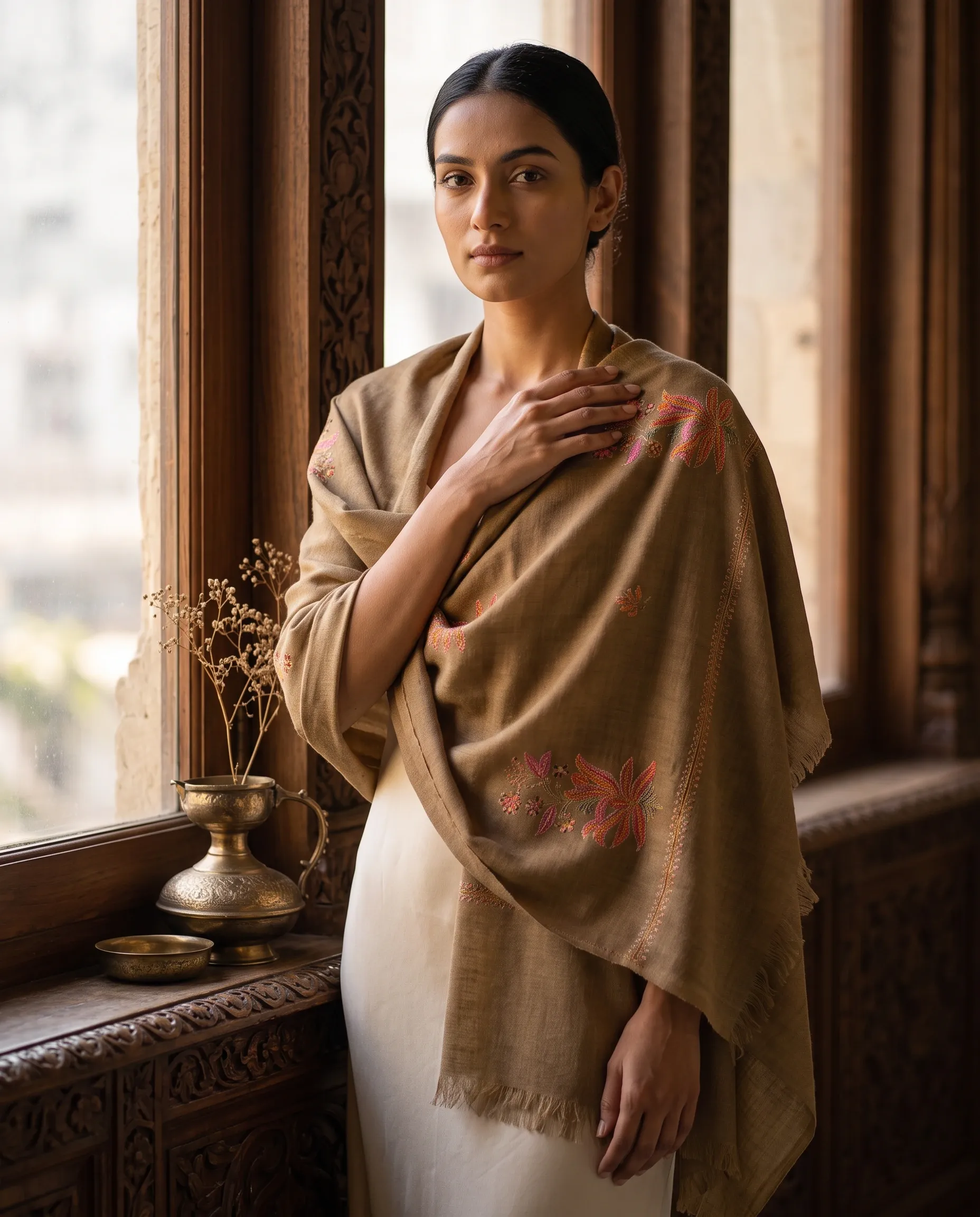
This is the one role where the shawl can be a considered part of the outfit rather than a practical extra. One strong piece is enough: a deep green or wine Kani over a plain dress, or a fine oyster or champagne wrap over a darker outfit. Two competing patterns rarely survive a group photograph.
Coordinate with the wedding palette rather than matching it exactly. Standing beside a bride in ivory, the mother's shawl should hold its own colour so the two silhouettes remain distinct. Texture photographs better than a flat pale tone, and a shawl worn on the shoulder rather than clutched in front keeps the line of the dress visible.
Giving a Pashmina as a wedding gift
A Pashmina is a good wedding gift because it is useful after the wedding, unlike most of the list. The fibre is the inner coat of the Changthangi goat, gathered in spring and spun before it reaches the loom, and that origin is part of the gift.
Certification matters here. Kashmir Pashmina is protected as a geographical indication in India, GI No. 46, with Kani registered at No. 51 and Sozni at No. 48; the Geographical Indications Registry holds the public record. A GI mark speaks to origin and to a defined process, not to a grade, so it should sit alongside a careful look at the cloth rather than replace it. In practice, look for an even selvedge, a light but not weightless hand, and a label that names the fibre and the place of origin.
Present the piece in a cotton or muslin bag with acid-free tissue, and keep the certificate with it. A date or initials can be embroidered, but ask first: a monogram in one corner is easier to live with than a date worked across the field.
The day itself
Steam the shawl a day or two before packing, holding a hand steamer at a distance or hanging it in a bathroom after a hot shower, rather than pressing it. Fold along different lines each time it is stored, so no single crease is repeated, and carry it in a cotton bag rather than plastic.
Perfume belongs on skin, not on wool. If something is spilled, blot at once with a clean cloth, work from the outside of the stain inward, and let the piece dry flat away from radiators and sunlight. A wedding is not the moment for home washing; a specialist cleaner who knows fine wool is the safer call, and the piece should be shown to them before any treatment.
Can I wear a Pashmina to a summer wedding?
Yes, and a fine stole is often the better choice than a large shawl. Outdoor ceremonies can be warm, while the reception is usually cooled for dancing; a light stole can be carried and worn only when needed. Choose a pale colour rather than a dark one if the outfit is summery.
Should the mother of the bride match the bridesmaids?
No. Coordination is useful; matching is not. The bridesmaids' palette belongs to the couple, and a mother's shawl should sit beside it in a related but distinct tone. If the couple has strong feelings about the group photographs, ask before buying.
Is a Pashmina an appropriate wedding gift?
It is, provided it is genuine and presented with care. A piece with GI documentation and a cotton storage bag will be understood as a considered gift rather than a generic one. Monograms are personal, so they are better offered as an option than assumed.
A wedding day is long, and much of it is spent in rooms built for other purposes. A shawl chosen for the hour after sunset will do more for the wearer than one chosen to match a photograph. Pieces can be viewed through where to buy, though the decision is usually made by holding the cloth against the dress in daylight.