Pashmina · 10 min read
How to Tell If a Pashmina Is Real: Nine Checks That Work
Nine practical checks, from the label and the ring test to the GI registry, that separate real Pashmina from a convincing blend, and show what each test can prove.
By Timothy V. Manley
4 November 2026
Pashmina is sold under a word that carries a GI in Kashmir and little legal weight almost everywhere else. In the trade it names a fibre, a style of shawl and, too often, any soft wrap with a Kashmir pattern. A wool-cashmere blend is not a fake; it is a different product, and it may be sold as long as the fibre content is declared. What is not acceptable is describing a blend or a synthetic as pure pashmina, and that is where price pressure does its work: substitution is profitable, testing is rare, and most buyers cannot compare one shawl with another.
No single test proves pashmina. The label states the claim and the GI record is the part you can verify; the ring, hand-feel and burn tests narrow the field but cannot certify species on their own.
The label, the word and the micron claim
A label that says 100% pashmina is a claim, not a test result. The registered specification for Kashmir Pashmina is stricter: 100% pashm (the fine down), a fibre fineness of no more than 16 microns, hand-spun yarn and handweaving in Jammu and Kashmir. A compliant label in the European Union should still give a percentage of cashmere, because the permitted fibre names include cashmere but not pashmina. If the composition panel is missing, there is no stated fibre content to hold anyone to.
The micron figure is more useful, but only when it is complete. Fibre diameter is measured in microns, or thousandths of a millimetre, and the number quoted is usually an average. An average in the low teens can hide a wide spread, a sample taken from the best bale, or a test paid for by the seller. Ask who tested it, by what method and on what sample. A number without those details is marketing.
What the micron figure does not tell you is species, origin or whether the piece was woven by hand. Fine wool can measure at cashmere fineness. The label and the micron claim are the start of the enquiry, not the end.
The ring test, and what it can show
Draw a corner of the shawl through an ordinary finger ring. A fine, loosely woven piece will pass with light resistance. A heavy or tightly woven one will bunch at the ring and stop.
The test reads two properties at once: fibre fineness and the openness of the weave. Fine down can compress through a narrow ring, and a loose weave gives it room.
That is also the weakness. A coarse, loosely woven shawl made from wool or a blend can pass easily, because the gaps do the work. A tightly woven pashmina of exceptional fineness can fail. The ring measures fineness and openness together, not species. A pass is one small piece of evidence; a failure is a reason to look again.
Hand-feel, warmth and the softness trap
Cashmere-goat down has a dry, faintly warm hand. It feels light in the palm and springs back when squeezed. Wool feels cooler and more resilient, with a faint prickle in coarser grades. Silk blends feel slick and cool, with a sheen along the fold.
Softness alone proves very little. Fabric softeners, silicone finishes and brushing can make a coarse wool or a viscose blend feel luxurious for the first few wears. Some finishes wash out; some do not. A shawl that feels clammy or slippery is worth turning over and reading.
Warmth-to-weight is harder to fake. Pashmina is valued because it holds warmth without bulk, so a piece that feels light in the hand but warm on the shoulders is behaving as the fibre should.
The weave, the reverse and the evidence on the back
Handwoven cloth usually carries small irregularities: a weft shot that sits a fraction wider, a slub in the yarn, a colour join that is not quite square. These are not defects. They are the record of a hand adjusting tension.
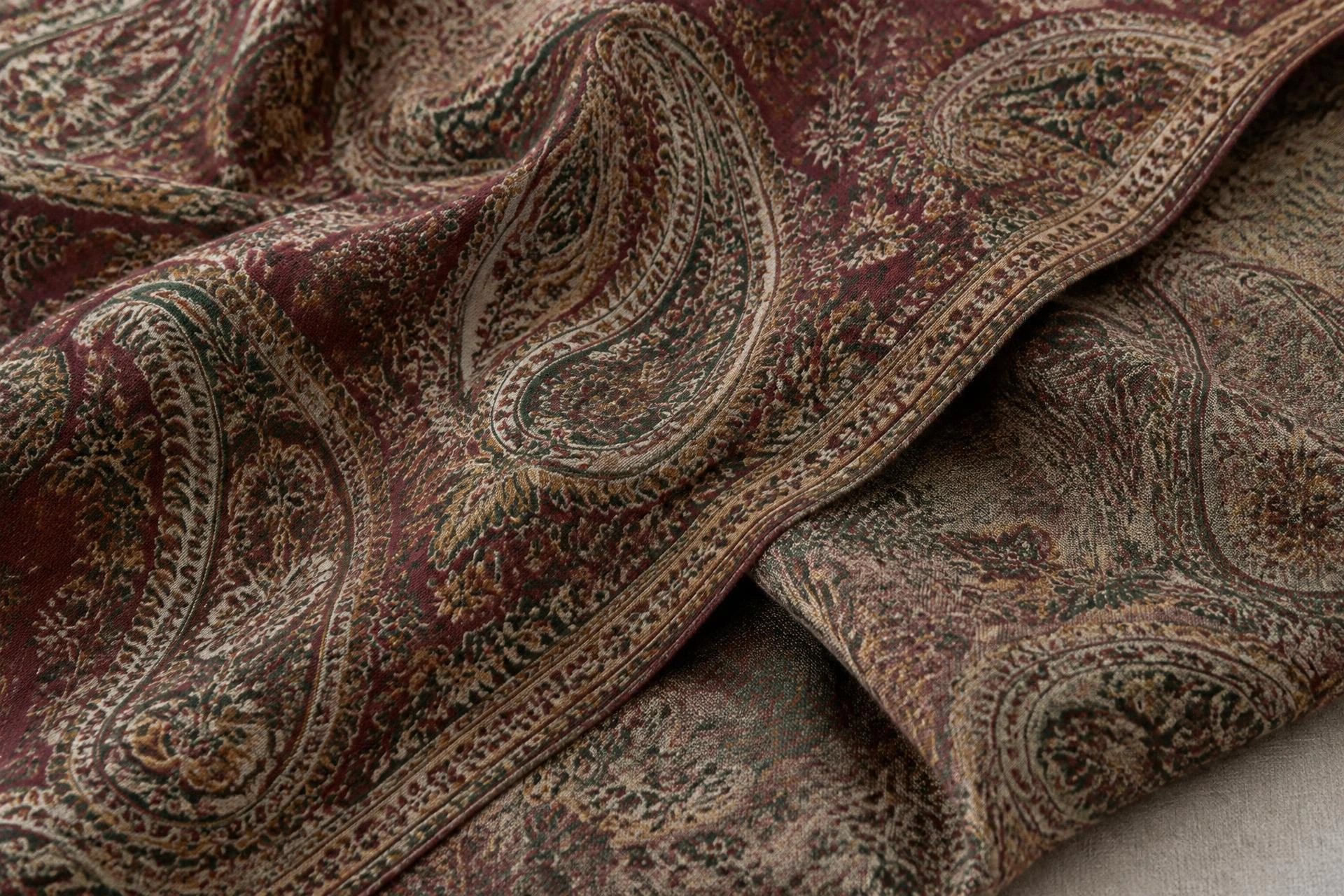
Kani is the clearest case, because the pattern is woven in rather than printed or embroidered. Turn it over and the design appears in mirror image, with many small thread ends where bobbins were changed. A machine jacquard produces a flat, mechanical reverse, often with long floats or a printed surface sitting on the cloth.
Sozni is embroidery on woven cloth. On the back the pattern appears in reverse, worked in small stitches of slightly variable length, with no stiff backing. Machine embroidery tends to show a uniform satin stitch, a stabiliser or cut-away backing, and a density that looks pressed into the cloth rather than worked through it.
Skill can make handwork look regular, so uniformity alone is not proof. Look for the small decisions: a thread carried a little further, a stitch that crosses a colour change, a place where the maker chose not to cut.
A printed label costs nothing; the reverse of a Kani records what the loom did.
Selvedge and fringe: reading the finish
The edges of a handwoven shawl are usually finished by hand: a narrow selvedge along the long sides, sometimes reinforced with a few extra threads, and a fringe twisted or knotted in small groups at the two ends. The work is slightly uneven because it is done by eye and by hand.
A cut fringe is usually the clearest shortcut. The ends are blunt and uniform, and the fringe hangs with no twist. A glued edge, or a dense overlock along the outer edge, is a machine finish chosen for speed. Neither proves a fake, but both lower the price the work can honestly command.
Turn a corner inside out. A hand-finished corner will show a small join, a tucked end or a repair. A glued corner is stiff and shines where the adhesive has dried. An overlocked seam inside a lining is normal. An overlocked outer edge deserves a question.
Drape and recovery: how the cloth falls
Hold the shawl by one corner and let it fall. Pashmina should drop into soft, narrow folds and settle, rather than standing out like paper.
The scrunch test is quicker. Gather a section in the fist, hold for a few seconds and release. Good pashmina opens again with shallow creases and a soft spring. A stiff, sized piece may crease sharply at first and relax after a wear; a cloth that stays crushed in hard lines has either a tight weave or a heavy finish.
Recovery is not a species test. Wool recovers well, and a fine silk blend may hang beautifully and recover slowly. Use the test to judge how it will wear, then the label and reverse to judge what it is.
The burn test, performed with care
A burn test can separate protein fibre from synthetic, and it is the only check here that damages the cloth. Use a single loose fibre: one strand from the fringe, or a thread already coming away at a seam. Never pull a fibre from the body of the shawl.
Take the strand outdoors, hold it with tweezers over a stone or a metal tray, and bring it to the edge of a flame. Keep water nearby and the flame away from children and anything flammable.
A protein fibre such as cashmere or wool chars and curls, smells of burnt hair or feathers, and leaves a soft ash that crushes between the fingers. A synthetic such as polyester or acrylic melts, shrinks from the flame, smells chemical and leaves a hard bead.
The result is indicative, not conclusive. A blend can smell of both. A seller may reasonably refuse, and for a dispute a laboratory test is the proper route.
The GI label: the check you can verify
A Geographical Indication is a collective right protecting a name tied to a place and a way of making. Kashmir Pashmina is registered in India as GI No. 46, Kani as GI No. 51 and Sozni as GI No. 48. The GI Registry records the proprietor and authorised users; the label is issued through them.
Because a GI label can be checked against a public record, it is stronger evidence than any hand-feel test. Ask for the certificate or label details, including the proprietor and the authorisation behind the mark. Then compare them with the registry entry.
Two limits matter. A GI certifies origin and compliance with a published specification; it does not grade an individual piece. A label can also be copied. The check works only if you verify the number and the party issuing it, not just the presence of a logo.
The Craft Development Institute in Srinagar publishes the specifications and appears in the registry records for Kashmir Pashmina. That record is a useful check when a certificate's wording is vague.
Price, provenance and the questions worth asking
Price is evidence of cost, not proof of fibre. A handwoven Kani can occupy a loom for months, and labour is a large part of what a buyer pays. A shawl sold far below the cost of that labour needs an explanation, and that explanation is usually the answer.
Ask where the fibre comes from. Changthangi herds in Ladakh are the usual source for Kashmir Pashmina, and a seller who cannot name a region or a supplier is guessing. Ask who spun the yarn, who wove or embroidered the piece, and how long it took. Ask whether GI certification can be arranged, and whether the fibre content will be put in writing on the invoice.
The last request is the most revealing. A seller who will not put the fibre content in writing is telling you something. So is a seller who answers every question with a story about heritage but cannot name the workshop.
None of these questions requires technical knowledge. They require a seller who knows the chain, and a buyer willing to walk away from a vague answer.
Sixty seconds at the counter
In a shop, with the piece in your hands and no time for a laboratory, four checks earn their place. Read the composition label first: it should name cashmere and give a percentage, not just pashmina. Turn the shawl over and look at the reverse, where the weave or the embroidery has to explain itself.
Then scrunch a section and let it go, feeling for spring and watching how the folds fall. Finally, look at the selvedge and the fringe, where a hand finish and a machine shortcut are easiest to see. If the answers disagree, ask for the GI certificate and the fibre content in writing before you pay.
If you have already bought something misdescribed
Write to the seller and ask, in plain terms, for the fibre content of the piece you received and the basis on which it was described as pashmina. Keep the listing, the invoice and any messages. A request in writing creates a record, and an accurate description should be easy to confirm.
If the answer confirms a blend, or the seller will not answer, use the return window. Our window is 14 days from delivery, with return shipping paid by the customer. Consumer law differs by country, so keep the written request and the original listing in case you need to escalate.
Frequently asked questions
Can a machine-made shawl pass the ring test? Yes. A loose weave and a soft finish can carry a coarse or blended shawl through a ring. The test measures fineness and openness, not species or the presence of a loom.
Does a GI label prove the fibre is pure? Not on its own. It certifies origin and compliance with the registered specification, provided the label is genuine and issued through the authorised chain. It is not a laboratory report on the fibre in your hand.
Is a high price a guarantee of authenticity? No. Price tracks labour, materials and margin, and a machine-made piece can carry a high price as easily as a handwoven one. A very low price is a reason to ask questions, not a verdict.
What does '100% pashmina' mean if pashmina is not a legal fibre name? It should mean the piece is wholly cashmere-goat down, but the enforceable statement is the fibre composition. Ask for the percentage of cashmere in writing.
Sources and further reading
IP India, Geographical Indications Registry: Kashmir Pashmina, GI No. 46
IP India, Geographical Indications Registry: Kani, GI No. 51
IP India, Geographical Indications Registry: Sozni, GI No. 48
Craft Development Institute, Srinagar: registered GI craft specifications
Regulation (EU) No 1007/2011 on textile fibre names and related labelling, EUR-Lex