Style · 9 min read
How to Wear a Pashmina: Twelve Ways, and When to Use Each
Twelve ways to wear a Pashmina stole or shawl, from a classic shoulder drape to a travel wrap, with notes on proportion, colour, damage and care.
By Timothy V. Manley
6 November 2026
A Pashmina is bought for its hand and its colour, then judged by how it sits on the body. The same shawl can look like a coat, a scarf or a bundle of cloth depending on where the weight falls and how the folds are set.
These twelve ways are starting points, not rules. Each names the fold, the outfit it suits and what can go wrong.
The size decides the drape
Most Pashmina falls into three loose groups. A stole is commonly 65 to 75 cm wide and 180 to 200 cm long, a shawl 90 to 110 cm wide and 180 to 210 cm long, and a grand shawl from about 130 by 220 cm. These are trade proportions, not standards; the Kashmir Pashmina GI (No. 46) defines the fibre and its making, not a size (the GI registry entry).
Width does most of the work. A shawl of 100 cm or more can cover the shoulders, cross the chest and leave a substantial fold. It behaves like a coat because it covers the area a coat covers and carries the same visual weight. A stole has roughly two-thirds of that width, so it wraps and loops like a scarf.
Buy for the drape you intend to use. A stole asked to work as an evening wrap will keep slipping from a bare shoulder, and a grand shawl knotted at the throat will bunch under the chin.
Ways one to four: the everyday drape
These four need no mirror and no pin. They cover most days, most coats and most rooms.
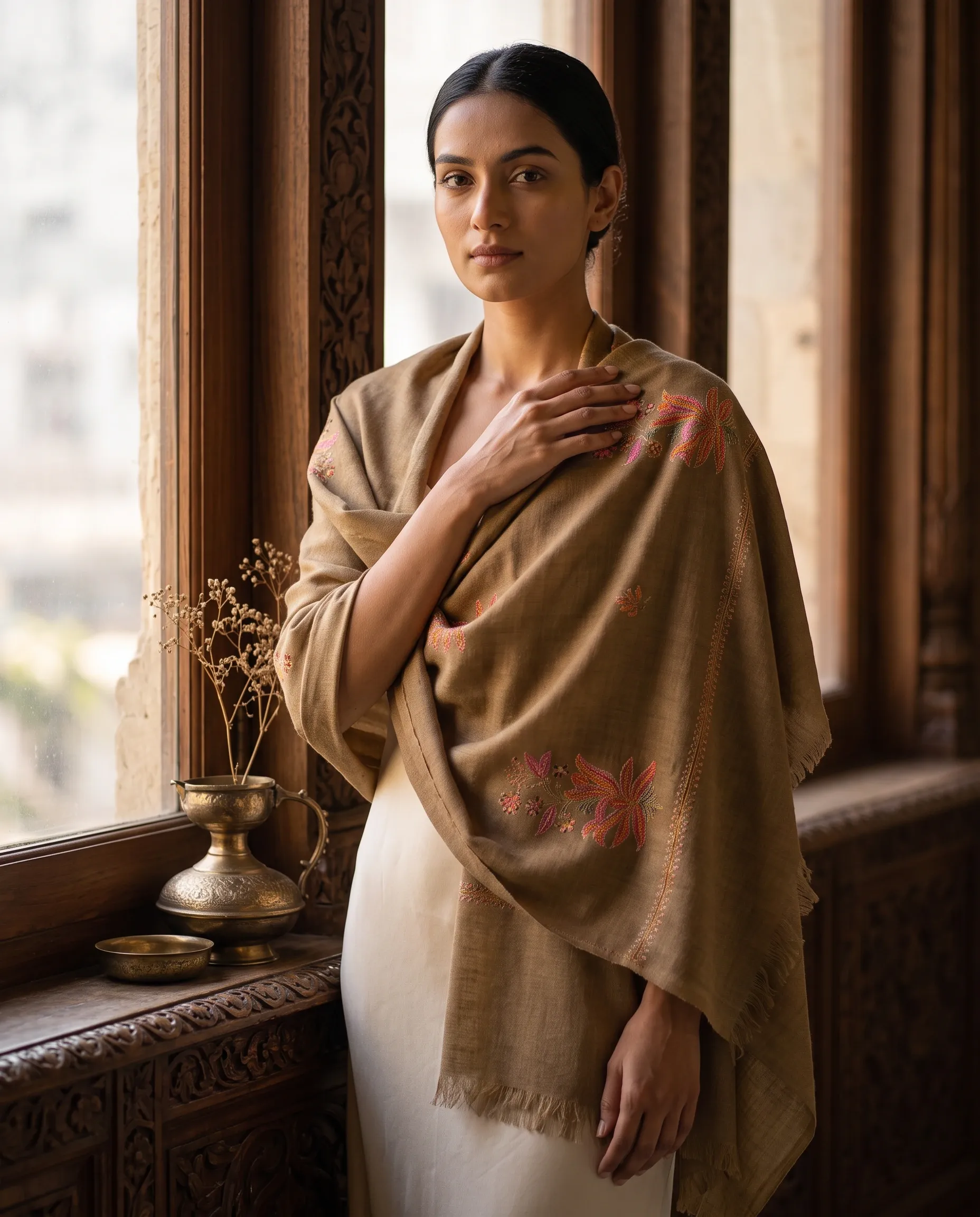
1. Classic shoulder drape. Centre the shawl's long edge at the back of the neck and let both ends fall forward, level with each other. It suits almost any neckline and is the safest way to wear a large shawl to an office. Both ends forward add width across the chest, so keep the rest of the outfit close.
2. Single-shoulder drape over a coat. Fold the shawl in half lengthwise, lay it over the coat with the fold at the left shoulder and bring both ends across the chest and down the back. The line works best on a tailored coat with a defined shoulder; on a soft, dropped shoulder the shawl will slide.
3. Belted cape over a dress or knit. Open a large shawl fully, centre it on the shoulders and fasten a belt at the waist. Arrange the excess into two soft folds. A dress or a fine knit gives it the cleanest background. A narrow belt can mark the weave, so choose a smooth edge and do not cinch it tight.
4. Blanket wrap for evening or outdoor cold. Hold the shawl behind you at shoulder height, bring the two top corners forward and cross them over the chest. Tuck the ends under the opposite arm or knot them at the back. It suits a seated dinner outdoors or a cold car. The wrap hides the waist, so keep the outfit beneath simple.
The test of a drape is simple: if it needs adjusting every few minutes, it is the wrong drape for the outfit.
Ways five to eight: necklines, loops and knots
The next four work at the neck. Most suit a stole; the collar tuck wants a shawl.
5. Triangle front for a V neckline. Fold the shawl in half diagonally so a point falls at the centre of the chest, cross the ends behind the neck and bring them forward. V necklines, wrap dresses and open blazer collars take it well. A point below the bust line shortens the torso.
6. Simple loop scarf for a stole. Fold the stole in half lengthwise, drape it around the neck and pass the two loose ends through the loop once. Pull until the loop rests at the collarbone. A high coat collar or heavy knit holds it in place. The loop doubles the cloth, so on a short neck it can crowd the face.
7. Parisian knot for a short stole. Fold a short stole lengthwise into a band about 15 cm wide, wrap it once around the neck and tie a loose knot below the chin. A tailored coat or collared shirt suits it. A tight knot crushes the fringe and strains the weave, so keep it loose enough to slip a finger under.
8. Over the coat, collar-style, ends tucked inside. Lay the shawl over the coat with the long edge at the back of the neck, bring both ends forward and tuck them inside the lapels. A tailored overcoat or a trench carries the extra volume. The coat needs room at the chest; a close fit will bunch the shawl at the front.
Ways nine to twelve: travel, cover and deep winter
9. Travel: neck pillow or lap blanket. On a flight, fold a stole into a band, roll it into a soft ring and set it behind the neck. Unfolded, a shawl becomes a lap blanket. It earns its place on long flights, trains and cold waiting rooms. Keep it off the floor and fold it right side in.
10. Head and shoulders cover. Open the shawl, centre it over the head so the front edge sits above the brows, and gather the ends under the chin. Wind, strong sun and a shrine where the head is covered all call for it. A light stole works better than a grand shawl; weight pulls the edge back and the cover slips.
11. Evening wrap over a sleeveless dress. Place the shawl across the back with one end over the left shoulder and the other under the right arm. Bring the second end over the right shoulder so it falls down the back. A sleeveless dress and bare neckline suit it. Silk linings give the shawl nothing to grip, so a textured bodice holds it better.
12. Layering two shawls in deep winter. Put the fine shawl on first, close to the neck, then the heavier shawl over it with the folds offset. Deep winter, outdoor ceremonies and unheated rooms are where it earns its keep. Two patterned shawls compete; keep the under-layer plain and check that each can be removed alone.
Proportion: volume, height and shoulder line
A drape that flatters a tall frame can overwhelm a shorter one, but height is only part of it. The shoulder line matters more: a defined shoulder carries a large shawl, while a sloping shoulder does better with a stole that follows its line.
Volume in the coat changes the answer. A generous coat already fills the space a shawl would, so a single-shoulder drape works better than a blanket wrap. Over a close-fitting dress or knit, a large shawl has room to be the outer layer.
Check where the shawl ends. At the widest part of the hip it adds width; past the hip it lengthens the line.
Colour: solids, pattern and complexion
A neutral solid is easier for daily wear because it asks nothing of the rest of the outfit. Ivory, camel, grey and deep blue sit beside most wardrobes and let the weave show.
Complexion matters in a narrow way: the colour nearest the face sets the light on the skin. Cool grey or clear blue flatters a cool undertone; warm camel or cream flatters a warmer one. Hold the shawl at the jaw in daylight.
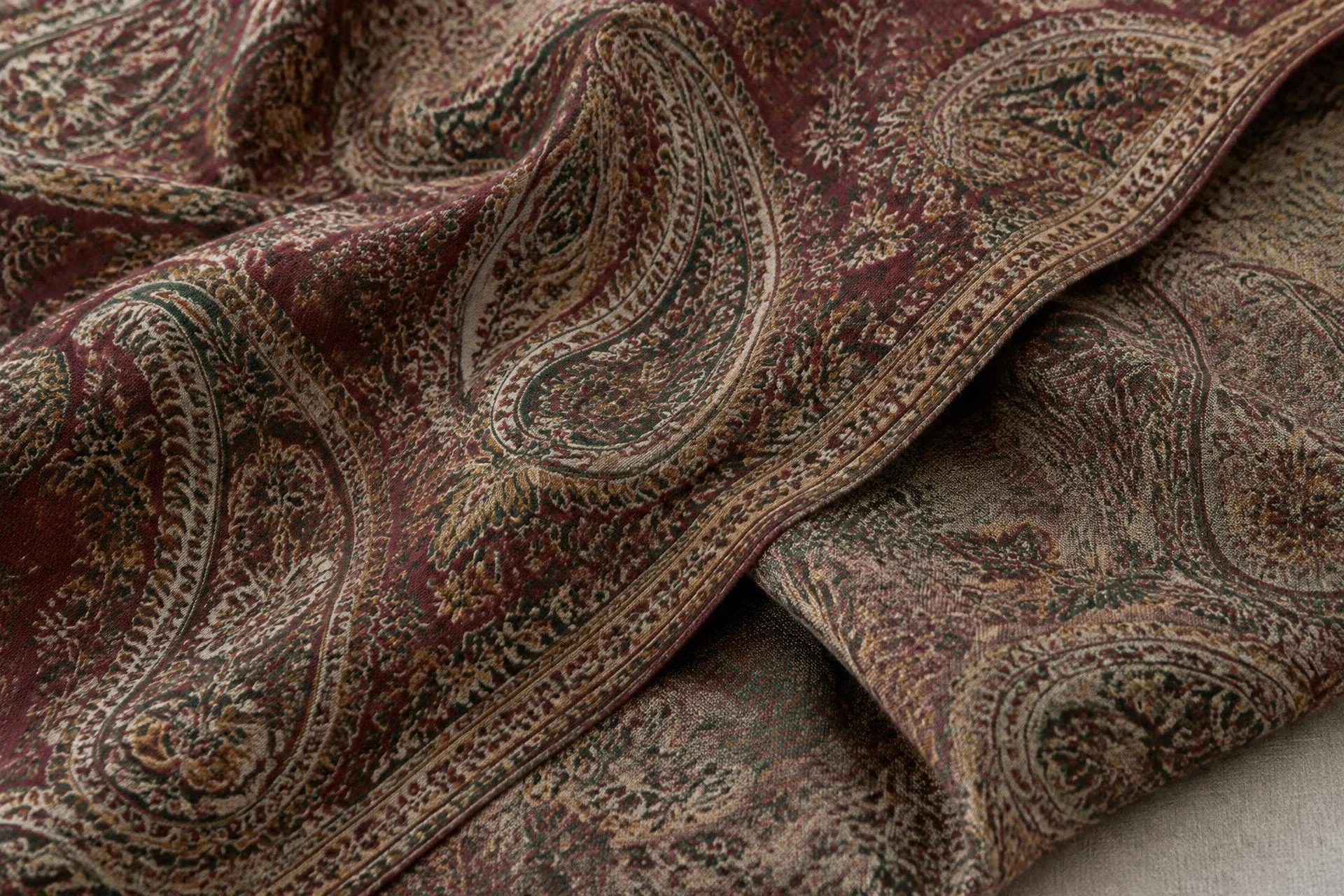
A patterned Kani should be the only pattern in the outfit. The motif is woven into the cloth rather than printed on it (Craft Development Institute), and it carries colour, rhythm and a border; a second print interrupts it. Sozni embroidery follows the same rule: one embroidered layer over a solid ground.
What damages a shawl while you wear it
Most damage happens in the wearing, not the washing. A brooch pin holds a shawl securely, but the hole it leaves in a fine weave does not close as it would in tight wool.
Bag straps and seat belts abrade the surface where they cross the cloth. Move the strap under the shawl, or take it off in the car.
Perfume and deodorant carry alcohol and oils that can mark the fibre. Spray before dressing, and let the skin dry before the shawl goes on.
Rough jewellery, a watch clasp or a zip tooth catches the surface. Repeated folding on the same line weakens the fibres, so fold on a different line and store it flat or rolled. Fine wool is better aired than washed (Woolmark care guidance), and how to wash a Pashmina shawl covers the occasional deep clean.
An occasion map
For the office, a stole in a neutral solid, looped or worn collar-style over a coat, is the least conspicuous. A wedding calls for a large shawl or grand shawl in a deep colour, over the shoulders or as an evening wrap.
A flight takes a fine stole folded into a neck roll or spread as a lap blanket. A sleeveless dress takes an evening wrap; a knit takes a belted cape. A cold-weather city break takes a fine shawl layered under a heavier one, both plain if the coat is patterned.
Men: the shawl over a coat, the stole as a scarf
A large shawl works over a coat much as it does over a dress. Centre it at the back and bring both ends forward, or fold it and throw it over one shoulder. The scale suits a broad shoulder and a long coat.
The stole reads as a scarf. Loop it once at the throat or tuck it inside the coat collar, and keep the colour close to the coat or knit beneath. A patterned Kani is best kept to one layer; a solid is easier to wear daily.
Questions we are asked
What size should a first Pashmina be? A stole if you wear scarves; a shawl if you want a wrap for shoulders and evenings. Try it over the coat you wear most, since the coat decides how much cloth you can carry.
Can a Pashmina be worn in summer? Yes, in the evening and in shade. One fine layer is enough; a heavy shawl in direct sun is hard on the cloth.
How do you stop a shawl slipping off the shoulders? Choose a wider shawl, wear it over a textured cloth and cross one end over the body. Avoid pins, which solve the slip and leave a mark.
Can a patterned Kani be worn with a patterned outfit? Only if one pattern is very quiet. A Kani looks best as the only pattern, over a solid coat or dress.
A last note on wearing
A Pashmina does not need a system. It needs the right size for the day, a drape that follows the body rather than fighting it, and enough care to keep the surface sound. To enquire about a piece, where to buy explains how the process works.