Style · 13 min read
How to Wear a Pashmina with an Abaya
How to pair a pashmina shawl with an abaya: fabric weight, colour, coverage and four ways to drape it for the Gulf climate and beyond.
By Timothy V. Manley
7 November 2026
A pashmina worn with an abaya needs two things: enough weight to fall cleanly and not enough to add bulk. A fine stole around 70 cm wide and 200 cm long suits shoulder, crossed and belted drapes; a lighter, softer weave is the better choice if the shawl will also sit near the head.
The abaya is a complete garment: volume at the shoulder, length to the floor, a line meant to fall straight. A shawl added over it either respects that line or fights it, and the difference is rarely about colour. It is about weight, width and where the cloth is allowed to gather.
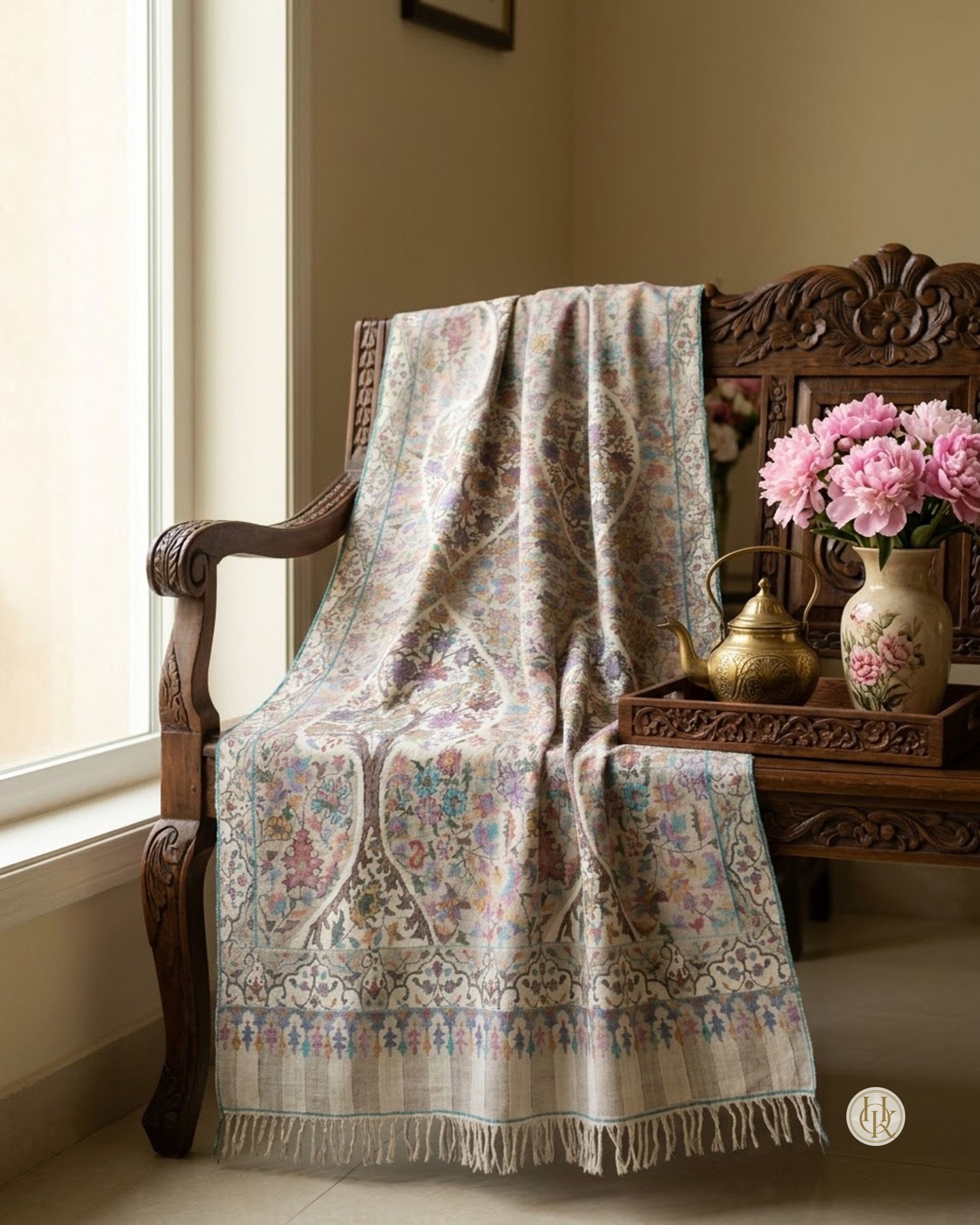
This guide is about wearing a piece we make — a woven pure Pashmina pages shawl — with a garment we do not make. It is written for wardrobes in the Gulf and for the diaspora in Britain and Europe, where the same abaya meets a different climate. The aim is a shawl that sits still, covers what it should and can be worn for an evening without constant adjustment.
Weight first, colour second
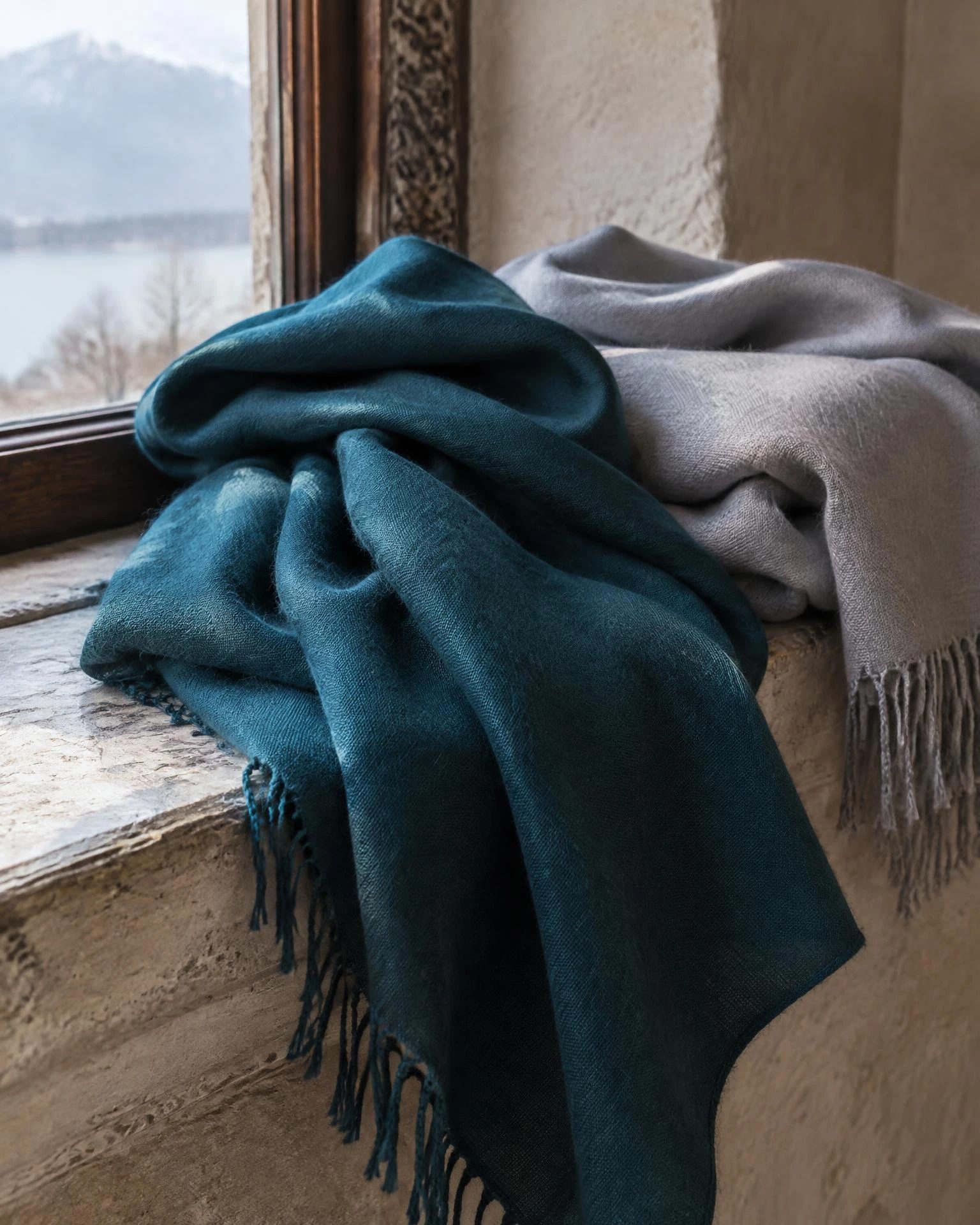
Hold a shawl up to a window before you buy it. If you can read the outline of the window frame through two layers, the cloth is open enough that it will look grey over black rather than the colour it appears on the shelf. That is not a fault in the shawl; it is a property of a loose weave, and it matters most over a dark abaya.
For abaya wear, a slightly denser weave behaves better. It keeps its colour, it does not cling, and it holds a fold without a pin. The fine, airy shawls that are wonderful in summer light are the ones that disappoint in a photograph beside a black abaya, because the camera reads the transparency as dullness.
Weight also decides how the piece feels in the hand. A shawl of around 70 by 200 cm in a fine pashmina weighs very little, and that lightness is the reason it can be worn indoors without discomfort. Heavier cloth drapes more slowly and photographs better in the evening, and it is too much for a mall in August.
The compromise most wardrobes settle on is two pieces: one light stole for daytime and air-conditioning, one denser shawl for evenings and travel. Modest fashion is now tracked as one of the seven sectors of the global Islamic economy [1]. The shawl logic does not change with the cut of the abaya.
Avoiding bulk over an abaya
Bulk comes from three places: width, folding and the shoulder seam.
Width is the first. A 100 cm shawl folded in half puts two layers over each shoulder, and over an abaya that already has a set-in sleeve and a wide cut, the result is a silhouette that reads as padded. A 70 cm stole, worn open, adds one layer and keeps the shoulder line.
Folding is the second. A stole folded into a narrow band and wrapped twice at the neck creates a thick collar that pushes the chin up and gaps at the back. Fold once lengthways, not twice, and let the ends hang.
The shoulder seam is the third. An abaya's sleeve seam sits lower than a Western coat's, and a shawl that ends exactly at that seam cuts the arm in half visually. Let the shawl fall past it, or keep the drape closer to the neck so it does not compete.
Pins are a last resort rather than a first. A fine pashmina holds a shoulder drape by friction if the weave has texture and the piece is wide enough. If it will not stay, the shawl is too narrow for that drape, and a different drape will serve better than a pin hole.
Four drapes with a pashmina over an abaya
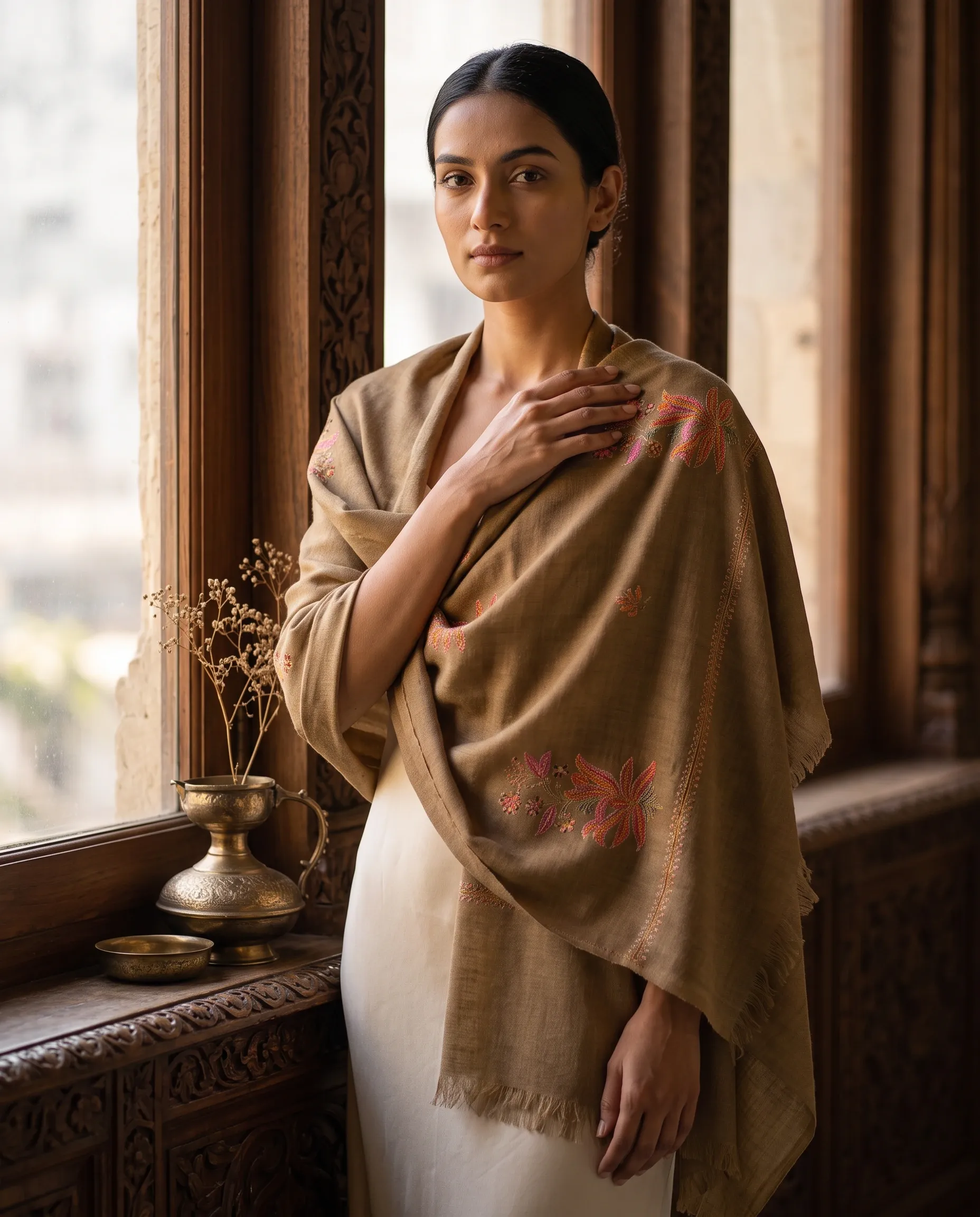
The shoulder drape. Open the shawl to its full width, centre it on the back of the neck and let both ends fall down the front, outside the abaya. The cloth covers the shoulders and the upper arms and hangs in two straight lines. This is the drape for a straight-cut abaya and an evening indoors, and it is the one that shows a Sozni border to best effect. A dense weave holds it; a very light one will slide.
The crossed drape. Fold the stole along its length until it is about 35 cm, place it behind the neck, bring the ends across once at the chest and let them fall. The crossover sits below the collarbone, not at the throat. This is the daytime drape, it works with an open or closed abaya, and it keeps the front of the garment visible.
The belted drape. Put the shawl over the shoulders, then close a wide belt over both the abaya and the shawl at the waist. The abaya keeps its length and the shawl becomes a soft layer above it. This works best with an open abaya and a wide, flat belt; a narrow belt gathers the shawl into folds that will not sit flat.
The head-cover coordination. A pashmina can be worn near the head, and many wardrobes use a fine shawl as a shayla. The requirements are different from a shoulder drape: the cloth must be light enough to fold without a bulge at the temple, matte enough not to slip, and free of a heavy fringe that will pull. If the shawl is also to be worn on the shoulders in the same evening, choose a colour that reads as a deliberate companion to the head covering rather than an attempted match.
Weights are described rather than numbered, because the same words mean different things to different weavers; ask for a photograph against a window if you buy at a distance.
Occasion · Abaya style · Shawl weight · Drape
- Daytime, work or mall Abaya style: Closed, straight cut; Shawl weight: Light stole; Drape: Crossed
- Evening indoors Abaya style: Straight or lightly embroidered; Shawl weight: Dense shawl; Drape: Shoulder
- Wedding or celebration Abaya style: Open, belted or embroidered; Shawl weight: Dense shawl, patterned border; Drape: Belted or shoulder
- Travel and airport Abaya style: Any, usually closed; Shawl weight: Light stole; Drape: Crossed, then shoulder on board
- Prayer or quiet visit Abaya style: Plain, closed; Shawl weight: Light, matte stole; Drape: Head-cover coordination
An occasion map
The table above is the short version. The longer version is that the abaya sets the formality and the shawl sets the temperature, and the two should not be asked to do each other's work.
At a family wedding, the abaya is often the more embellished garment and the shawl should be quieter: a solid colour with a woven border, or a fine Sozni piece where the abaya is plain. Two heavily decorated pieces beside each other flatten both. If the abaya carries embroidery at the cuff and the hem, keep the shawl to the shoulders.
At work, the calculation reverses. A plain abaya and a good shawl do the work that a jacket does in a Western wardrobe, which is to make the outfit look intentional. A deep colour and a clean edge are enough.
For travel, the shawl is a blanket before it is an accessory. Airports are cold, cabins are colder, and the piece that folds into a bag and comes out uncreased is worth more than the one that photographs best.
A colour strategy that works with black
Black is a ground, not a competitor. Three strategies work over it, and one does not.
Tonal. Ivory, oyster, stone or charcoal over black gives contrast without colour. This is the safest and the most photographed, and it is forgiving of a shawl whose weave is slightly open, because the value difference carries the eye. Ivory is the classic; a warm off-white is easier to wear near the face than a cold one.
Contrast. A deep colour — burgundy, forest, indigo, aubergine — over black reads as deliberate and works in low evening light. The risk is a colour that is too close in value to black and reads as a mistake; hold the shawl against the abaya in daylight before you decide.
Metallic. A shawl with metal thread in the border, or a soft gold or bronze tone, is the evening answer. True metallic cloth is difficult to wear and difficult to clean; a border is enough, and it lets the rest of the piece stay quiet.
The strategy that does not work is matching the abaya's embroidery with a shawl pattern in the same motif. The two were not designed together, and the eye reads the mismatch before it reads the design.
Undertone matters more than the colour name. A cool grey shawl beside a warm black abaya can look green; a warm ivory beside a blue-black one can look yellow. Take the abaya with you, or take a photograph of it in daylight, and compare the shawl against it rather than against the shop wall. Our 279-shade card page groups the solid range by family for exactly this comparison, and our guide to pashmina shawl colours covers undertone in more detail.
If you want a patterned piece, a Sozni border gives you colour without a full repeat. Our Sozni embroidery pages page shows how the needlework sits on the ground cloth, which is easier to judge than a photograph of a finished shawl on a model.
Perfume, oud and the fibre
Perfume and pashmina are not natural companions. Most fragrance carries alcohol and oils, and both settle into a fine protein fibre. A shawl worn over a scented abaya will pick up the scent at the shoulder and hold it longer than the garment underneath.
The practical rule is order: apply fragrance to skin before dressing, let it dry, and put the shawl on last. Do not spray the shawl to freshen it, and do not hang it in a wardrobe with open bottles.
Oud and bakhoor are a different problem. The smoke deposits resin on any cloth left in the room, and a shawl that sits near a burner will carry both the scent and a faint dullness on the surface. Air the piece away from the smoke, and keep it in a cotton bag rather than on an open shelf.
If a shawl has absorbed a scent, airing does more than washing: a day in moving air outdoors, out of direct sun, will lift most of it. Washing to remove a smell is a large intervention for a small problem, and every wash stresses the fibre.
Moths and carpet beetles are the other wardrobe risk, and they prefer dark, undisturbed places — which is what a wardrobe is. A clean shawl, stored dry in breathable cotton and checked each season, is the practical defence [3].
The Gulf and the diaspora: two climates
In the Gulf, the shawl is an indoor garment for most of the year. Air-conditioning makes a light layer useful in summer, and the winter evenings outdoors are the season for the denser piece. The abaya is worn in both, so the shawl must work at two temperatures without changing the outfit.
In Britain and northern Europe, the same abaya meets wind, rain and a much cooler ambient temperature. The shawl becomes an outer layer, and the denser weave earns its place. Light in a northern winter is low and cool, which pulls pale colours towards grey and makes deep colours look richer; a shawl that looks chalky in Dubai can look elegant in Manchester and the reverse is also true.
Layering differs too. In the Gulf the shawl goes over the abaya and nothing else. In a British winter it may go over a coat, and then the width matters again: a 100 cm shawl over a coat is a different proposition from the same shawl over an abaya. Our guide to pashmina scarf, stole and shawl sizes sets out the measurements, and our Dubai buying guide covers what to check in a shop in the Gulf.
The fibre travels well in both climates because it is a cashmere: the international definition sets a mean diameter of 19 microns or less, with a cap on coarse fibre [2], and a fine cloth insulates without weight. That is why a piece bought for an abaya wardrobe in Doha can be worn over a coat in London without feeling like a different garment.
If you are choosing a shawl for a specific abaya, send us a photograph of the garment in daylight through where to buy. We answer with the shades we would put beside it and the weight we would choose for the season you describe.
Questions we are asked
Can a pashmina be worn as an abaya?
No. An abaya is a garment cut and sewn to cover the body; a pashmina is a woven shawl. Some listings use "pashmina abaya" for a shawl heavy enough to wrap around the body, but a shawl does not give the coverage or the line of a sewn abaya.
What size shawl works best over an abaya?
A stole measuring roughly 70 by 200 cm is the most useful, because it adds one layer and can be crossed or left open. The larger 100 by 200 cm shawl is better for evenings, travel and cold climates, where the extra width is doing real work.
Should the shawl match the abaya?
Match the undertone, not the colour. A tonal shawl in ivory, stone or charcoal over black is the most reliable choice; a deep contrast colour works for evening. Avoid matching an embroidered motif with a woven one.
Will a light shawl look grey over black?
It can, if the weave is open enough to show the black underneath. Test it against a window in daylight: if the pattern of the frame shows through two layers, the colour will read duller over a dark abaya.
How do I remove oud from a pashmina?
Air it first, outdoors and out of direct sun, for a day. Most of the scent will lift. If it persists, a professional clean is safer than a home wash, and you should tell the cleaner what the shawl has absorbed.
Is pashmina too warm for Gulf summers?
A fine stole is comfortable indoors, which is where most of the day is spent. Outdoors in summer, no shawl is comfortable; the piece earns its place in air-conditioning, in the evening and in winter.
Whichever drape you settle on, the useful test is a mirror and ten minutes of movement: sit, reach, carry a bag. A shawl that stays put through that will stay for an evening. If you would like help choosing the weight and shade for a particular abaya, the private enquiry page reaches the house directly, and we answer with photographs rather than adjectives.
Sources
- DinarStandard. "State of the Global Islamic Economy Report 2025/26." https://www.dinarstandard.com/insights/state-of-the-global-islamic-economy-report-2025-26. Accessed 2026-11-07.
- Cashmere and Camel Hair Manufacturers Institute. "Definition of Cashmere, Fine and Superfine Wool" (archived copy). https://web.archive.org/web/20240523004544/https://www.cashmere.org/definition-cashmere-wool.php. Accessed 2026-11-07.
- Canadian Conservation Institute. "Caring for textiles and costumes — Preventive conservation guidelines for collections." https://www.canada.ca/en/conservation-institute/services/preventive-conservation/guidelines-collections/textiles-costumes.html. Accessed 2026-11-07.