Kani · 12 min read
Kani Shawls in Pakistan: Prices, Quality and Checks
What a Kani shawl price in Pakistan reflects, how to tell handwoven from machine-made, and what to ask before buying in Lahore, Karachi or online.
By Timothy V. Manley
7 November 2026
Ask what the Kani shawl price in Pakistan is and the honest answer is a range, not a figure. Price follows pattern density, the fineness of the pashm, the number of colours and whether the piece was handwoven or machine-jacquard. Two shawls on the same shelf can differ enormously for good reasons.
That range is why so many buyers in Lahore, Karachi and Islamabad end up unsure whether they have been quoted fairly. The number on the tag is the last thing to look at. The first is the reverse of the cloth, and the second is the vocabulary the seller uses, because "Kani" carries several meanings in the Pakistani market and not all of them describe a loom.
This guide is written from the outside of that market as well as the inside of the craft. We weave in Srinagar, we meet Pakistani buyers and dealers, and we have spent years handling the same family of shawls. Where we describe market practice, we say so; where we cannot verify a figure, we do not quote one. Prices in this trade move with the season, the city and the platform, and a page that pretends otherwise is not helping anyone.
What "Kani" means in the Pakistani market
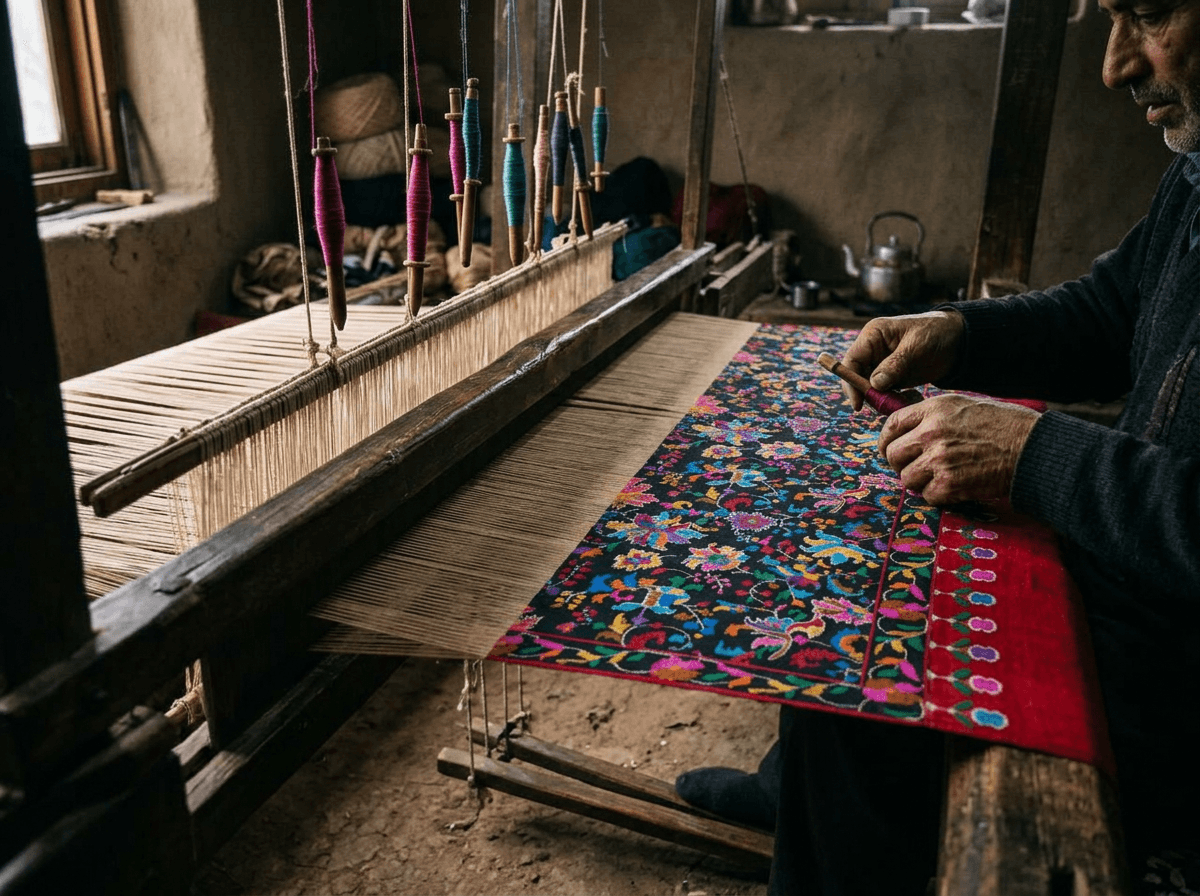
In the strict sense, Kani is a weaving technique, and the registered specification describes it exactly. The weft sits on small eyeless wooden bobbins, the kanis, instead of a shuttle. The weave is a twill in which the wefts lock together wherever the colour changes. The pattern is followed from a written talim [2]. That description does not belong to one country. It describes a loom practice used in the valley and beyond for centuries.
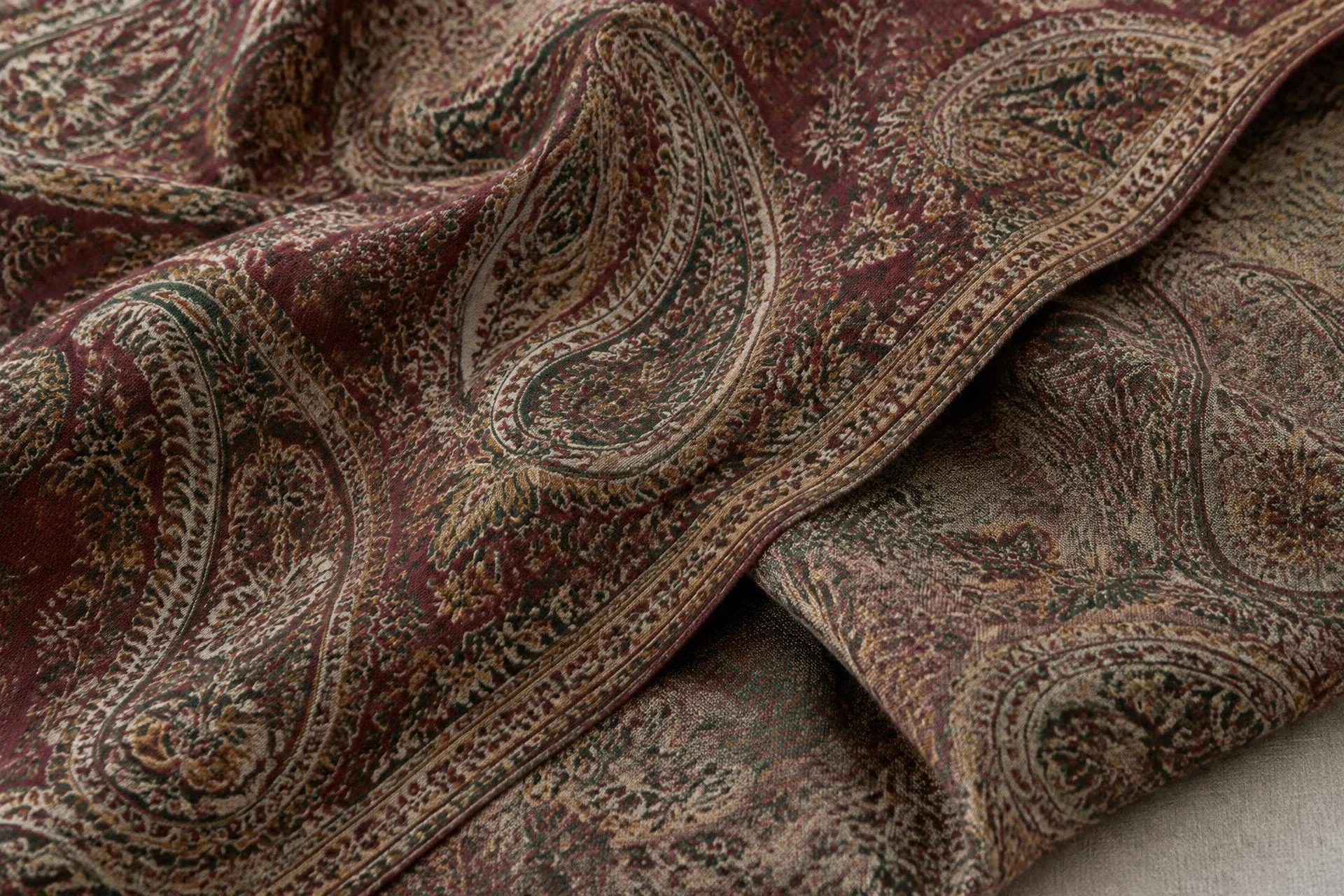
In the market, the word does more work. It is used for the technique, for a shawl woven that way, and sometimes for any densely patterned shawl that looks as though it might have been. "Kani work" can mean handwoven, and it can mean a jacquard pattern that resembles one. This is not unique to Pakistan; the same looseness exists in Srinagar and in London. It does mean that a buyer who hears the word has learned almost nothing yet.
The other word to keep straight is jamawar. An all-over patterned shawl woven in the Kani technique is a jamawar in the older trade language, because jamawar names the format rather than the loom. The two are explained side by side in our comparison of Kani vs jamawar.
What the Kani shawl price in Pakistan depends on
Four variables do most of the work, and they compound.
The first is the fibre. Fine pashm, combed from the Changthangi goat and spun by hand, costs more at the yarn stage and takes longer to weave because the warp can be set denser. Coarser fibre, or a blend, lowers both costs at once. The usual cashmere thresholds are a mean diameter of no more than 19 microns with no more than 3% of fibres over 30 microns [4]; a shawl whose label says only "pashmina" has told you nothing measurable.
The second is pattern density. A design that changes colour every few picks consumes far more time than a large motif with long plain passages, because each change means another bobbin, another interlock and another place where an error must be unpicked.
The third is the number of colours. Every colour is another set of bobbins and another join along the length of the shawl. A field of eight colours and a field of thirty are different projects, not different versions of the same one.
The fourth is who wove it. A handwoven piece carries the weaver's months; a jacquard piece carries the machine's minutes. Once a seller is clear about which of the two you are looking at, the asking price becomes readable rather than mysterious.
Size matters less than buyers expect. A modest shawl with a dense drawing can absorb more hours than a large one with open spaces, so a price per gram or per square metre tells you very little.
The price tiers, described honestly
We are not going to print rupee figures. We cannot verify a price list across Lahore, Karachi and Peshawar, and a number copied from one shop in one season would be worse than no number at all. What can be described is the structure of the market, which is stable even when the figures are not. A number copied from one platform in one week would be out of date before the page was indexed.
At the entry level sit machine-jacquard shawls and blends, often sold with the word Kani in the description. They can be attractive and warm, and they are not dishonestly priced if the seller is clear about the machine. The pattern repeats exactly, the reverse is clean, and the price reflects a factory rather than a loom.
In the middle sit handwoven pieces with moderate pattern density: borders, panels, a repeating motif, a limited palette. These are real Kani weaving, and they are where most informed buyers should be looking. The labour is visible on the reverse, and the price is set by months rather than by brand.
At the top sit fine pashm shawls with dense all-over patterns, many colours and the kind of drawing that only a good talim can carry. Here the price is a workshop's calendar, and the difference between a good piece and a great one is often a matter of drawing rather than fibre.
Prices also move with the occasion. Wedding season, Eid and the winter months lift demand, and a shawl bought in a hurry in December is rarely bought well.
Handwoven and machine: what the loom decides
Machine patterning begins with instructions the loom can read: a chain of punched cards on an older machine, a digital file on a newer one. The harness lifts the warp in sequence and a shuttle carries the weft the whole way across. At the boundary of each colour the yarn is cut, so the back of the cloth ends up with short floats or with the trimmed ends of those cuts, and the pattern resolves into small steps.
Kani weaving has no such instruction reader. The design lives in the talim, and the colour is carried by hand, one small bobbin at a time, each turned back where its shape ends [2]. The result is cloth in which the pattern is the structure: no cuts, no floats, and a back that reads like a drawing.
In the hand, a densely woven Kani feels springy at the fold, and its selvedge shows where the weft turned. A jacquard piece is flatter, more even, and its pattern has the regularity of a printed page.
None of this makes machine weaving a swindle. It becomes one when the price is a handwoven price and the cloth is not.
Reading the reverse before you pay
Turn the shawl over in daylight, in the shop, before any number is discussed. Ask for the middle of the field to be shown, not only the border. Four things are worth checking.
At every colour boundary, look for a tiny interlock: two wefts turning around each other along the edge of a shape. On a handwoven piece the join is part of the structure, so it reads as a small thickening, not a knot.
Look for floats. The interlocking removes any need for a thread to travel across the back [2], so a reverse crossed by long threads belongs to a different method.
Check the repeat. A handwoven field wanders a pick or two over its width, and the drawing carries small human irregularities. Exact replication, motif after motif, is the signature of a file.
Check the edges. On a handwoven shawl the fringe is usually twisted from the warp ends. A cut or glued hem is worth questioning along with everything else.
In our experience, a seller who is confident about the piece will hand it over to be turned without being asked twice. Hesitation is information.
The GI question across the border
The Kani Shawl entry in the Indian register was filed in February 2006 and certified in November 2008 under certificate number 83, with protection recorded as valid to 12 February 2036 [1]. The registration reserves a name for goods made in a defined region to a written specification, and that specification is precise about handweaving, the bobbins, interlocked wefts and the talim [2].
A geographical indication ties a product to a place and to a quality that place is known for, and handicrafts are eligible for the protection [3]. It is not a grading system. Certification means a piece was measured against that written specification; it says nothing about whether the drawing is beautiful or the weaving is a workshop's best work.
For buyers in Pakistan, the practical point is this: the registration we can verify is Indian [1], and we cannot verify an equivalent Pakistani registration for Kani from the sources available to us. That does not mean no Pakistani workshop meets the standard; it means the paperwork question is separate from the cloth question. If a seller says "GI certified", ask which registration, which product name and which certificate number. A legitimate answer takes ten seconds. Our explainer on the pashmina GI tag sets out how a certificate is checked.
Buying online, shipping and customs
Online buying adds distance to every check above, so it needs more evidence rather than less. Photographs of the front are close to useless on their own; ask for the reverse, the selvedge, the fringe and the label, in daylight, and for a short video of the cloth being folded. A shawl that drapes stiffly in a video is telling you something.
Payment terms matter as much as the piece. A seller who wants a full bank transfer before any documentation is asking you to carry all the risk. Ask what happens if the shawl arrives misdescribed, and get the answer in writing before you pay. Our guide to buying pashmina online sets out the checks in full.
Shipping between countries in the region is a practical question with a moving answer. Customs treatment depends on the importing country, the declared value and the route, and duties are usually payable by the receiver. We do not quote rates we have not verified, and we would be wary of a seller who quotes them confidently without knowing your address. Ask how the piece will travel, who pays what at the border, and what documentation accompanies it.
If you are buying in Pakistan and the piece is being sent from India, allow for delay. Documents are checked, values are queried, and a shawl can sit in a customs office for longer than anyone promised. That is an argument for buying from a seller who has done it before, not an argument against the shawl. If you would rather handle the cloth than the photographs, you can enquire about availability and we will tell you what is on the loom.
A quality checklist
Check · What good looks like · Walk away if
The table is a filter, not a valuation. Two shawls can pass every line and still differ by a factor of five, because one is finer, denser and better drawn.
- Fibre What good looks like: Fine, springy hand; label states pashm or cashmere; Walk away if: Vague "wool blend" with a Kani price
- Reverse What good looks like: Interlocked colour joins, no long floats; Walk away if: Trimmed tufts or a perfectly repeating back
- Pattern What good looks like: Slight drift across the field; Walk away if: Exact motif repeat from edge to edge
- Edges What good looks like: Warp fringe, hand-finished selvedge; Walk away if: Cut or glued edge, machined hem
- Label What good looks like: Named fibre, micron or GI claim with a number; Walk away if: Claims with no certificate reference
- Price What good looks like: Explained by labour, density and fibre; Walk away if: "Last piece" pressure and no questions allowed
Questions we are asked
How can I tell a real Kani shawl in Pakistan?
Start with the reverse. Interlocked colour joins, no long floats and a pattern that drifts slightly rather than repeating exactly. Then ask how the pattern was made and watch whether the answer is about a loom or a machine file. The front of a good imitation can be convincing; the back rarely is.
Why do Kani shawl prices vary so much between shops?
Because four variables compound: fibre fineness, pattern density, number of colours and handwork. A shop selling machine-jacquard pieces and a workshop selling handwoven ones can use the same words for very different objects. Compare pieces, not shops, and compare them on the reverse.
Is a Pakistani Kani shawl GI certified?
The Kani Shawl registration we can verify is Indian [1], and we cannot verify an equivalent Pakistani registration from the sources available to us. A Pakistani workshop can meet the same technical standard without holding that certificate. Ask for the registration name and certificate number, and treat an unverifiable claim as marketing rather than assurance.
Can I buy a Kani shawl online from Pakistan safely?
Yes, with the same discipline you would use anywhere: reverse and selvedge photographs, a video, written terms, a payment method with a route to redress, and a seller who answers questions before the sale rather than after it. Distance removes the hand-feel test, so the documentary evidence has to carry more weight.
Is pashmina cheaper in Pakistan than in India?
Not reliably. Asking prices differ by city, season and shop, and a lower price often reflects a coarser fibre or a machine-woven pattern rather than a better market. Compare micron claims and handwork, and remember that the cheapest Kani-patterned shawl in any market is usually not Kani at all.
Sources
If you are comparing a Pakistani asking price with what a handwoven piece costs to make, our handwoven Kani shawls show the work that goes into one, and the pure Pashmina shawl pages explain the fibre behind the price. Collectors who want a particular palette or size can arrange a private appointment with the house.
- Intellectual Property India, GI Registry. Details — Kani Shawl (GI Application 51). Accessed 2026-11-07.
- Craft Development Institute, Srinagar. Quality Manual for Enforcement of Kani Shawl GI, updated 2023. Accessed 2026-11-07.
- World Intellectual Property Organization. Geographical Indications. Accessed 2026-11-07.
- Cashmere and Camel Hair Manufacturers Institute. Definition of cashmere, fine and superfine wool, archived 2024-05-23. Accessed 2026-11-07.