Care · 12 min read
Moth Holes in Pashmina: Repair Them and Stop More
Pashmina repair starts with containment: why moths attack the fibre, how to spot the damage, which repairs work and what to ask a restorer.
By Timothy V. Manley
7 November 2026
Pashmina repair begins with containment, not stitching. A hole left by clothes moth larvae is fixed by one of four methods — hand darning, reweaving, felting or a patch — chosen by size, position and how visible the repair may be. First, confirm the infestation is over.
A shawl folded away in April and opened in November tells you everything in the first minute. Either the cloth is as it went in, or there are three small holes along a fold and a scatter of pale grit. The second case is what this article is about, and it is not a reason to throw the piece away — but the order of operations matters more than the repair: a perfect darn in a shawl that still harbours larvae will be eaten again by spring.
We have handled shawls in this house for four generations, and the lessons have not changed much. What has changed is the advice available: plenty about storage, little about what to do once the damage is done.
Why moths choose pashmina
The insects that damage cloth are not eating the dye or the finish. They are eating protein. The Canadian Conservation Institute puts the problem plainly: clothes moths and carpet beetle larvae "perforate and consume wool or other keratinous protein fibre", and textile collections suit them because they offer food, shelter and an undisturbed dark place to live [1].
Pashmina is an unusually good food source. It is the undercoat of the Changthangi goat, and the Kashmir Pashmina specification registered under the GI sets 100% pashm, a 16-micron ceiling, hand spinning and hand weaving [2]. Cashmere, the broader category, is defined by the Cashmere and Camel Hair Manufacturers Institute on three measurements: a mean diameter at or below 19 microns, a coefficient of variation at or below 24%, and no more than 3% by weight of fibres above 30 microns [3]. Pashmina sits at the fine end of that range, so the cloth is thin, and a thin cloth lets a small mouthpart do real damage quickly.
The damage is done by larvae, not by the adult moth. Adults lay eggs near a food source; the hatched larvae graze across the surface or bore through it. Carpet beetles work the same way and often start at the fold or the hem, where dust and skin cells collect. Neither insect is drawn to clean fibre so much as to what is left on it: sweat salts, sebum, perfume, food and room dust. A shawl worn once and put away unwashed is therefore at more risk than one worn twenty times and washed.
Fine cloth also hides the early stage. On a heavy blanket a first hole is an event. On a 16-micron pashmina it can be the width of a pinhead and easy to mistake for a pulled thread. By the time three holes appear along a fold, the larvae have usually been at work for weeks. For the fibre and the word behind it, see what is pashmina.
Live infestation or old damage
Before choosing a repair, decide whether anything is still alive. A repair on an active infestation is a meal served on a plate.
Look for grit. Larval frass is fine, sand-coloured and gathers along a fold. Look for webbing or small cases the colour of the cloth, especially in corners and along hems, and for the larvae themselves: small, pale, grub-like, usually curled. Adult moths are weak fliers that settle rather than dart, so check the wardrobe corners and the ceiling. Carpet beetles are smaller and darker, and their larvae are bristly.
Then look at the holes. Fresh damage has loose fibre at the rim and a ragged edge, with sound cloth around it. Old damage has a softened, felted rim, sometimes a tidemark from an earlier wash, and no grit nearby. A hole with a clean, hard edge and a matchstick-like fray is often mechanical: a snag on a drawer, a watch clasp, a zip.
If you are unsure, seal the piece in a clear bag with a sheet of white paper for a couple of weeks and keep it where you will see it. Anything that falls out is evidence. Pheromone traps in the wardrobe answer a different question: whether adults are active in the room.
Do not spray insecticide in a drawer that holds shawls; a fine fibre takes up what is in the air. If a room is infested, treat the room, not the textile.
Freeze, wash or send it out
The decision is a sequence: contain, clean, then repair.
For a piece with live activity, our own practice is to seal it in a bag, put it in a domestic freezer for several days, and let it return to room temperature still sealed, so condensation forms on the bag and not on the cloth. Freezing does not remove the debris that attracted the insects, so it is a step, not a cure. Heat is worse: a domestic oven or a hot wash will felt the fibre before it solves anything.
Washing comes next, because the point is to remove what the insects were eating. A plain pure Pashmina shawl pages shawl can be hand washed in cool water with a pH-neutral wool detergent, pressed rather than rubbed, and dried flat. A Kani, a heavily embroidered Sozni piece, an old or fragile shawl, or anything lined should go to a specialist cleaner who will treat it as a textile rather than a garment. If the piece is going to a restorer anyway, ask whether they would rather clean it themselves; a repair is easier to match on washed cloth.
Send the work out when the hole sits on a colour join in a Kani, passes through raised Sozni embroidery, falls on a fringe or selvedge, or when the cloth around it is thin. Those are the cases where a home repair tends to make the damage more visible than the hole was. A restorer has a frame, a lamp, matching yarn and the ability to undo a bad decision.
Four repairs, and what each one hides
Hand darning is the honest repair. A needle and a fine matching thread are worked across the hole in lines that echo the weave, closing the gap and stabilising the edges. It suits a small hole in the body of a plain shawl, and fails at anything you hope to disguise: darning is visible in raking light, and on a very fine cloth the stitching reads as a small shadow. Done well, it stops the hole growing.
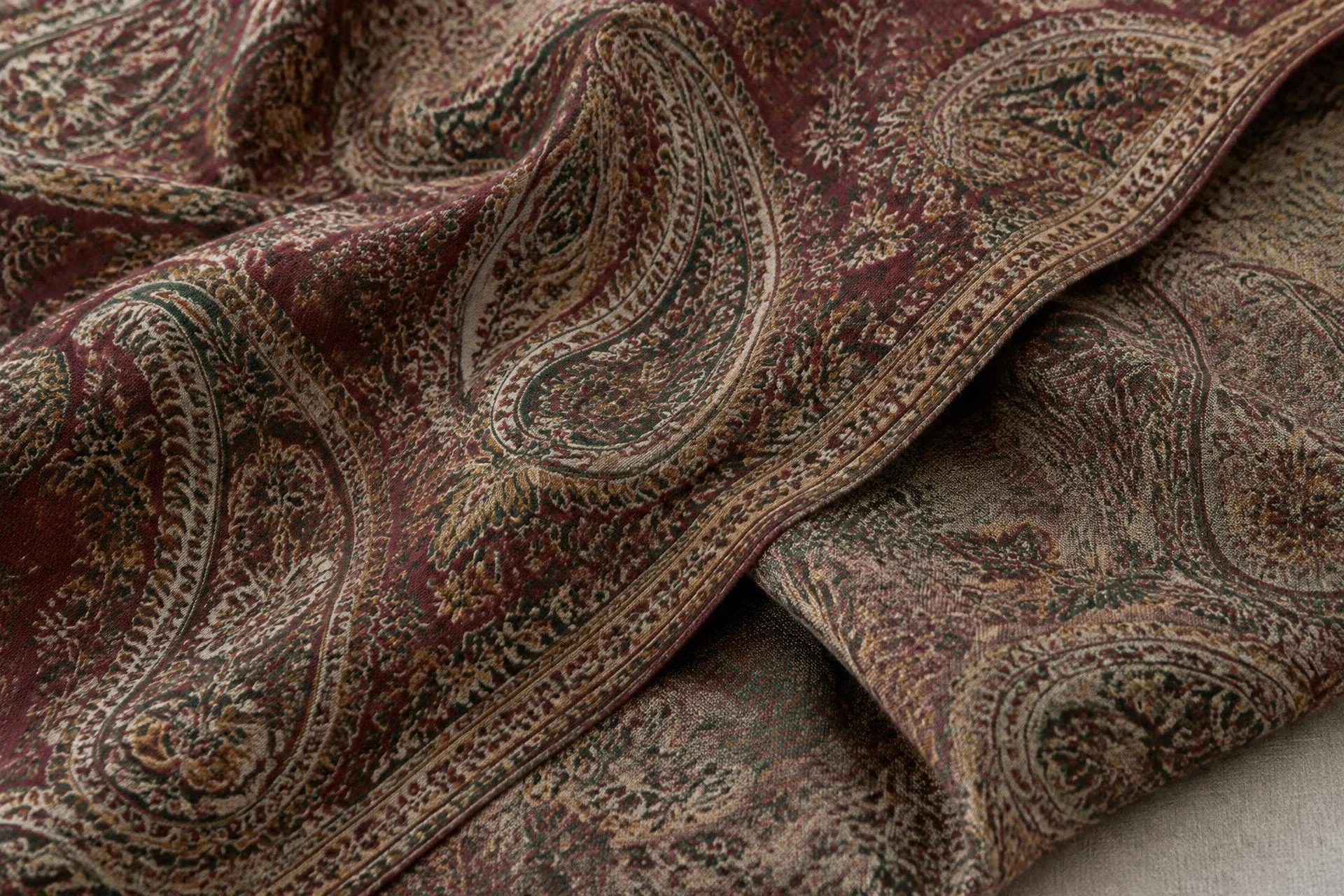
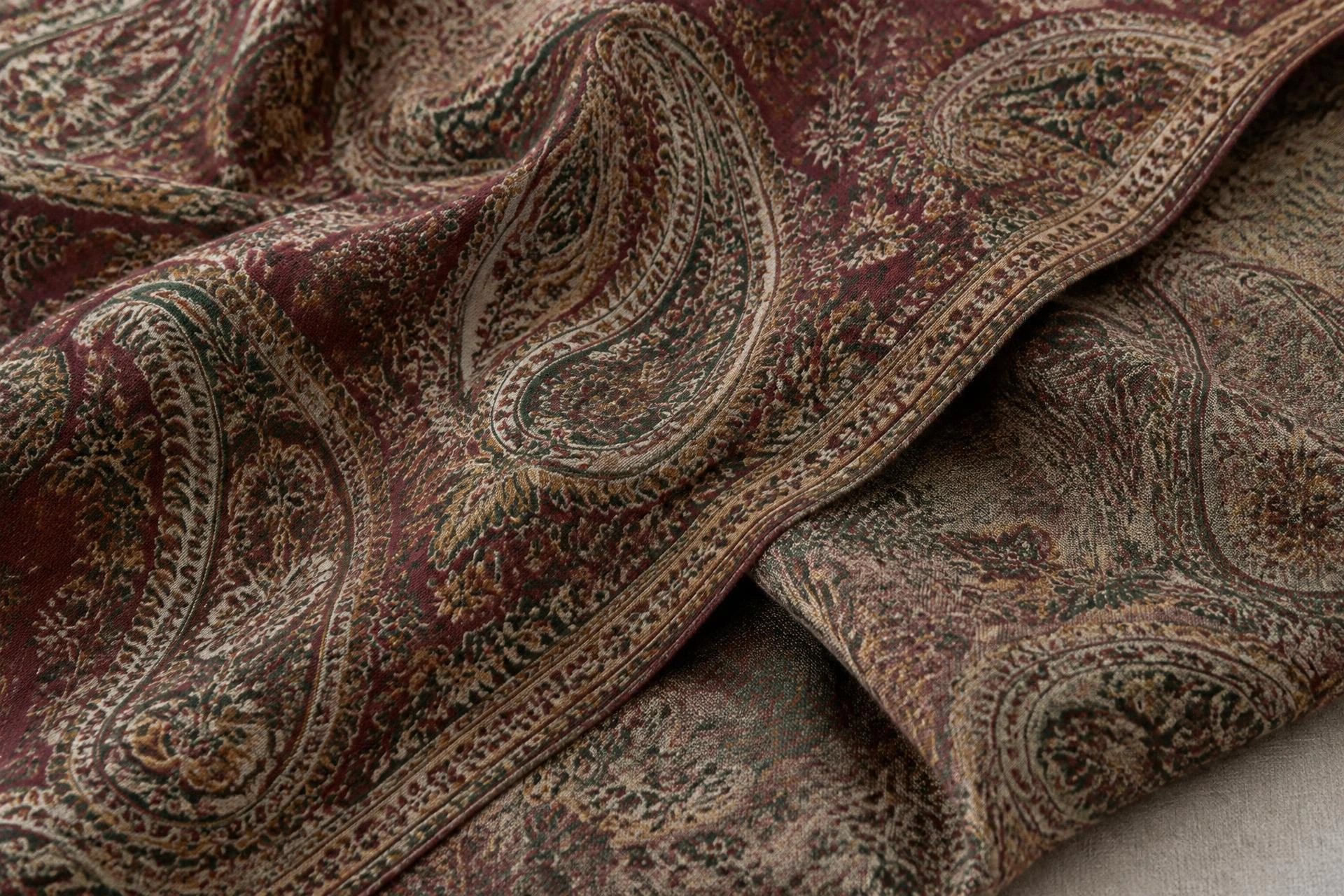
Reweaving is the invisible rebuild; darning, sometimes called rafu, is the repair most people mean. The restorer opens the surrounding weave, recovers yarn where possible, and rebuilds the missing warp and weft so the structure continues through the damaged area. It is slow, it demands a real understanding of the cloth, and it is the only method that can restore a patterned piece without interrupting the design. On a Kani the colour joins are rebuilt in sequence; on a Sozni shawl the embroidery may be lifted and reworked. This is the method we use on pieces that matter.
Felting is the shortcut, with a narrow use. Where the yarn is still there and the hole is a separation rather than a loss, moisture and controlled agitation can persuade the fibres to interlock and close. It works best on a plain, dense cloth and worst on anything open or fine. The result is a small, slightly stiff patch that will not unravel and will not disappear. It is not reversible, so it is not the first thing to try on a good shawl.
A patch is the pragmatic repair. A piece of matching cloth is cut with the grain, set behind or over the hole and stitched down. It is visible by design, which suits a working shawl: a travel piece, something worn indoors, an inherited piece that is used rather than displayed. On a fine pashmina it shows as a change in thickness, so match the weight, not only the colour.
Matching a pashmina repair to the damage
Damage · Method · Skill needed · Visibility · Use when
Two notes sit outside the table. The reverse is where the truth is: a repair that looks acceptable from the front can be a knot on the back, and a knot will rub through the cloth beside it. The repair should also be slightly larger than the hole.
- A pinprick, with the yarn still present Method: Felting; Skill needed: Low; Visibility: Faint on a plain cloth; Use when: The hole is a separation, not a loss
- A small round hole in the body Method: Hand darning; Skill needed: Moderate; Visibility: Visible as a small panel of stitching; Use when: You want the cloth stabilised and wearable
- A hole on a plain field, with sound cloth around it Method: Reweaving; Skill needed: High; Visibility: Close to invisible from the front; Use when: The piece matters and the cloth can take the work
- A hole at a Kani colour join or through Sozni Method: Reweaving by a textile restorer; Skill needed: Very high; Visibility: Depends on the pattern; Use when: The design must continue unbroken
- A large hole, a tear or a worn patch Method: Patch from matching cloth; Skill needed: Moderate; Visibility: Deliberately visible; Use when: The shawl is used, not displayed
What to ask a restorer
The answers tell you whether the person has worked on this kind of cloth. Ask what they intend to do — darn, reweave, felt or patch — and why. Ask whether they have matching yarn and where it comes from. Hand-spun pashmina yarn has an S twist while machine-spun yarn runs the other way, a difference used in GI testing [2]; a repair in machine-spun yarn sits differently and can abrade the cloth around it.
Ask whether they will work from the reverse, and whether they will open the fringe or the selvedge to reach the damage. Ask what the repair will look like under a lamp at an angle, because that is how you will see it when you wear the shawl. Ask to see a previous repair on similar cloth, and whether cleaning and repair are priced separately.
Then ask what happens if the hole is larger than it appears. It often is. A quote given from a photograph is a guess; a restorer who insists on seeing the cloth is being careful. Be cautious with anyone who promises an invisible repair on any cloth at any price. Reweaving comes very close on a plain field; it cannot make a hole in a Kani pattern disappear, and it cannot restore fibre that has been eaten away.
Stopping the next generation
A repair is only durable if the conditions that caused the damage change. The routine is the same whether or not you have just paid for a reweave.
Wash or clean before storage. This is the single most useful step, because it removes the food. Store folded, not hung, in a breathable cotton or muslin bag rather than sealed plastic, in a cool, dry, dark place. Refold along different lines once a year so a crease does not become a wear line, and air pieces at the start of the season rather than leaving them undisturbed for months.
Check anything that comes into the house. A vintage shawl from a market, an inherited piece, a blanket from a house clearance: bag it, inspect it, clean it, and only then let it near a wardrobe. Infestations usually arrive; they rarely appear.
Finally, watch the repaired piece for a season. If fresh grit appears, the problem was not solved, and the next step is the room rather than the shawl. Our guide to how to store pashmina shawls sets out the storage system in full; the our craftsmanship pages page explains what a loom-finished edge looks like, which helps when you are inspecting a repair.
If the damage has made you reconsider the piece, or you are choosing a replacement and want to see how a sound cloth behaves before you commit, an appointment at the house is the better conversation. You can arrange one through private client appointment, and we will show you the reverse of a shawl rather than a photograph of the front.
If a repair needs matching yarn and the fibre content is uncertain, a laboratory can identify and quantify the blend by light microscopy under ISO 17751-1 [4]. It is a small cost against the value of the shawl, and it settles the question of what you are repairing. When a piece is beyond repair, or you would rather replace it with something sound, the house can talk you through the options by private enquiry service; there is no cart, only a conversation about the cloth.
Questions we are asked
Can a moth hole in pashmina be repaired invisibly?
On a plain field, a good reweave can be very hard to see from the front, especially after washing. On a Kani pattern, through Sozni embroidery, or where much fibre is missing, no. The honest aim is a repair that is sound and quiet from a normal distance, not one that defeats a close look.
Is a small hole worth repairing?
Usually, yes. A hole in a fine cloth is a place where the weave can unravel, and a small darn costs far less than a large rebuild. The exception is a hole in cloth that is already thin across a wide area; there, a repair simply moves the problem.
Can I felt a hole closed at home?
Sometimes, if the yarn is still there and the cloth is plain and dense. Wet the area, work the fibres gently with a finger or a felting needle, and stop as soon as the gap closes. The patch will feel stiff. Do not try it on a Kani, a loose weave or a piece you intend to sell.
Do moth traps stop the damage?
Pheromone traps catch adult males and show whether moths are active in a room. They do not remove eggs, larvae or the food source, and they are not a treatment for a shawl already infested. Use them as a monitor, not a solution.
Sources
- Canadian Conservation Institute, "Caring for textiles and costumes — Preventive conservation guidelines for collections", https://www.canada.ca/en/conservation-institute/services/preventive-conservation/guidelines-collections/textiles-costumes.html — Accessed 2026-11-07.
- Craft Development Institute, Srinagar, "Quality Manual for Enforcement of Kashmir Pashmina GI", http://iictsrinagarcarpet-gi.org/documents/Quality%20Manual%20Kashmir%20Pashmina%20Updated%202023.pdf — Accessed 2026-11-07.
- Cashmere and Camel Hair Manufacturers Institute, "CCMI Definition of Cashmere, Fine and Superfine Wool" (archived), https://web.archive.org/web/20240523004544/https://www.cashmere.org/definition-cashmere-wool.php — Accessed 2026-11-07.
- International Organization for Standardization, "ISO 17751-1:2023 — Textiles: Quantitative analysis of cashmere, wool, other speciality animal fibres and their blends — Part 1: Light microscopy method", https://www.iso.org/standard/83595.html — Accessed 2026-11-07.